

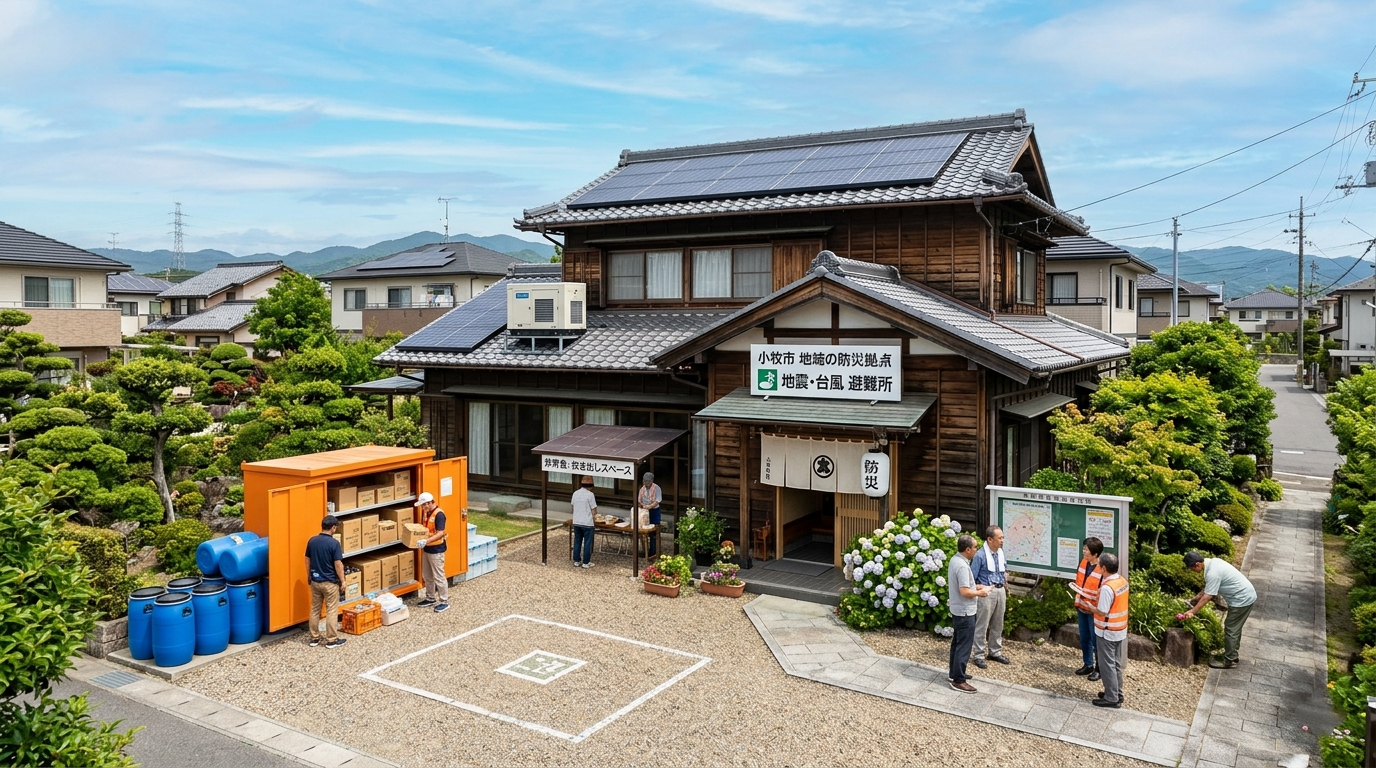
The “Akiya” (vacant house) problem has become a serious social issue in Japan. However, from a different perspective, these properties hold the potential to be reborn as valuable resources for protecting the community. Especially in a country like Japan, where natural disasters such as earthquakes and typhoons are frequent, repurposing vacant houses as “disaster prevention hubs” is a groundbreaking solution to enhance local resilience.
In this article, we will explain in detail specific ideas and the benefits of transforming vacant houses into disaster prevention bases and shelters.
1. Why are Vacant Houses Ideal for Disaster Prevention Hubs?
Existing designated evacuation centers (such as school gymnasiums and community centers) tend to become overcrowded during large-scale disasters. They face challenges regarding privacy, infectious disease control, and accommodating people with pets.
- Implementation of Distributed Evacuation: By utilizing vacant houses scattered throughout residential areas, we can prevent people from concentrating in specific locations and enable “distributed evacuation” within walking distance.
- Effective Use of Existing Stock: Repurposing is more cost-effective than building new disaster prevention warehouses from scratch. Furthermore, maintaining the buildings helps preserve the public safety and aesthetics of the neighborhood.
2. Four Plans for Repurposing Vacant Houses as Disaster Hubs
① Temporary Stay & Welfare Evacuation Centers
Vacant houses with earthquake resistance reinforcement can be used as “welfare evacuation centers” for those who find it difficult to live in a gymnasium, such as the elderly, pregnant women, and people with disabilities.
- Equipment Installation: Handrails, barrier-free access (removing steps), and stockpiling portable toilets.
- Benefits: It allows vulnerable individuals to stay in a calm, home-like environment, helping to prevent secondary health issues.
② Disaster Stockpile & Distribution Hubs
This idea focuses on using the property as a storage base for the entire community rather than for residential purposes.
- Equipment Installation: Stockpiling emergency food, drinking water, blankets, simple toilets, generators, and rescue tools.
- Benefits: By involving local residents in management and operation, it is expected to increase disaster awareness during normal times.
③ Activity Bases for Voluntary Disaster Prevention Organizations
During normal times, these houses can operate as community cafes or disaster prevention salons. In the event of a disaster, they function as a command headquarters.
- Equipment Installation: Wi-Fi environment (satellite communication, etc.), large monitors, and display of hazard maps.
- Benefits: Building “face-to-face relationships” during normal times ensures smoother mutual aid when an emergency occurs.
④ Soup Kitchen & Energy Supply Bases
Vacant houses with gardens or parking lots can be prepared as bases for food distribution and power supply.
- Equipment Installation: Installation of solar panels and storage batteries, rainwater storage tanks, and “kamado” benches (benches that turn into stoves) in the garden.
- Benefits: Even during power outages, it becomes possible to charge smartphones and provide warm meals, increasing the sense of security in the community.
3. Challenges and Solutions for Revitalization
There are several hurdles to transforming vacant houses into disaster prevention hubs:
- Ensuring Earthquake Resistance: Buildings constructed before 1981 (under the old seismic standards) must be reinforced. Renovations using local government subsidies are highly recommended.
- Determining the Operating Body: A clear set of rules is needed regarding how voluntary disaster prevention organizations, NPOs, or private companies will manage the facility.
- Understanding of Owners: The key is to appeal to the owners’ desire to “serve the public good” and offer benefits such as fixed asset tax reductions.
4. Conclusion: From “Liability” to “Asset”
If left unattended, vacant houses become “negative legacies” that carry risks of collapse or fire. However, by regenerating them as disaster prevention hubs, they transform into a “shield that protects the community.”
Deciding how to utilize the vacant houses in our own towns may be the first step toward creating our own safe future.