
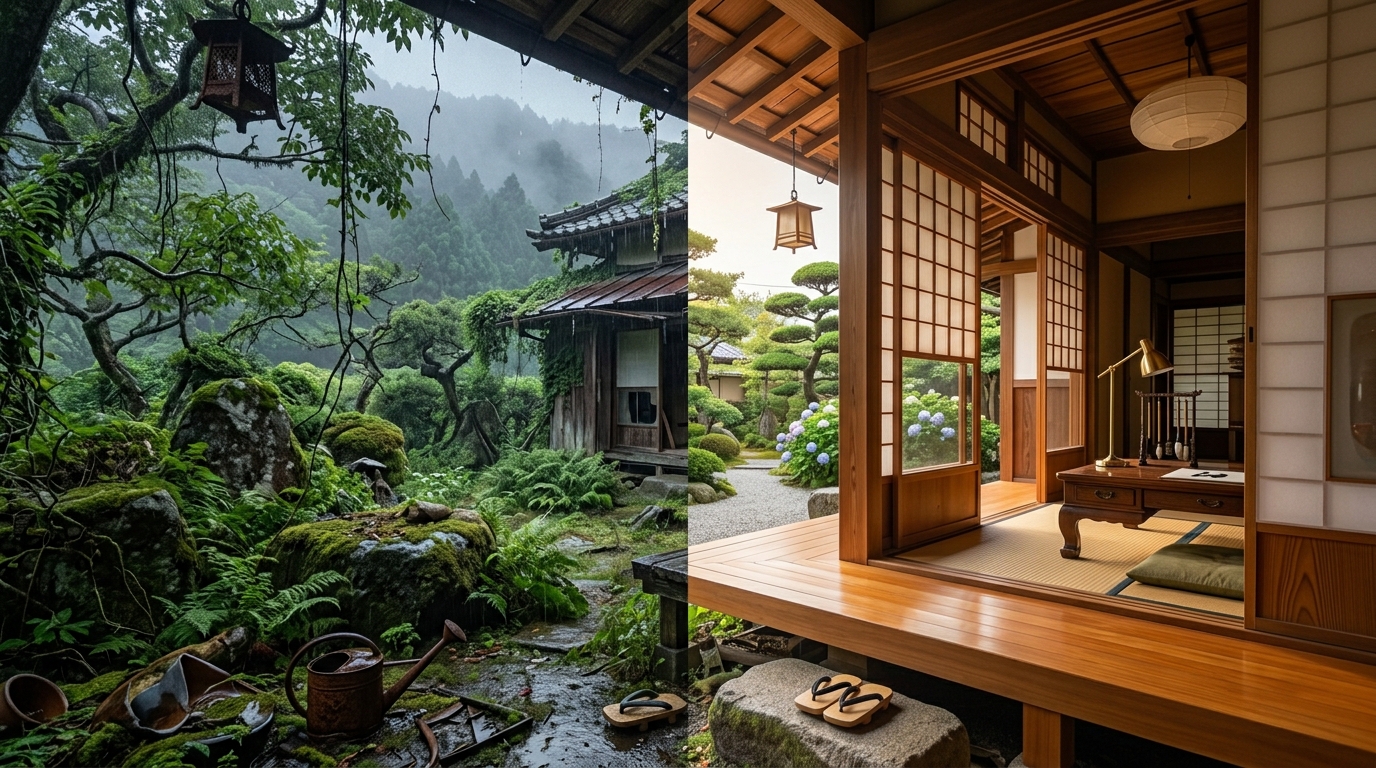
For anyone who has inherited a family home or owns a property they do not currently plan to live in, dealing with vacant house (Akiya) maintenance and management is an issue that cannot be avoided.
In recent years, you may have seen news or media reports claiming that “leaving a vacant house unattended can cause property taxes to jump up to 6 times.” This is not an exaggeration or a rumor—it is a very real financial risk grounded in Japanese law.
In particular, with the Revised Act on Special Measures Concerning Promotion of Vacant House Countermeasures that came into force in December 2023, the criteria for tax increases have expanded significantly, making early action more urgent than ever before.
This article explains in detail everything from why leaving a house vacant causes property taxes to jump 6x, the key points regarding the newly established “Poorly Managed Vacant House” category, the dangers of abandonment, and a practical maintenance checklist to avoid being designated as a “Specified Vacant House.”
1. Why? The Mechanism Behind Property Taxes Jumping “Up to 6x”
Why does leaving a house unattended cause taxes to skyrocket in the first place? The reason lies in a tax relief measure applied to residential land known as the “Special Exemption for Residential Land” (住宅用地の特例 – Jutaku Yonchi no Tokurei).
What is the Special Exemption for Residential Land?
Normally, land occupied by a residential building receives a significant reduction in property tax assessment value to ease the burden on homeowners.
- Small-scale Residential Land (up to 200 m²): Tax base is reduced to 1/6th
- General Residential Land (portion exceeding 200 m²): Tax base is reduced to 1/3rd
(Note: City Planning Tax is also reduced to 1/3rd for small-scale residential land and 2/3rds for general residential land.)
Thanks to this exemption, property taxes on land with a house on it are kept dramatically lower compared to bare, undeveloped land (Seiji).
When the Exemption is Revoked, Tax Returns to the Original Rate (Effective 6x Increase)
However, if a property is officially designated by the local municipality as a “Specified Vacant House” (特定空家 – Tokutei Akiya) or a “Poorly Managed Vacant House” (管理不全空家 – Kanri Fuzen Akiya), and the owner fails to comply with an official administrative “Recommendation” (勧告 – Kankoku), this Special Exemption for Residential Land is revoked.
When the 1/6th tax base discount is removed, the taxable assessment value jumps back up to its full rate. As a result, the property tax on the land effectively increases by up to 6 times. (City Planning Tax also increases by up to 3 times.)
[Important Note] This does not mean a brand-new 600% tax rate is applied; rather, it means the 1/6th discount you were previously receiving is canceled, returning your tax bill to its full, un-discounted rate.
2. What Changed in the December 2023 Law Revision? “Specified Vacant House” vs. “Poorly Managed Vacant House”
Previously, the tax exemption was only revoked if a property fell into an extreme, hazardous state near structural collapse (Specified Vacant House). However, the law revision enacted in December 2023 established a brand-new category.
① Specified Vacant House (特定空家 – Tokutei Akiya)
This refers to a vacant property that has been neglected to the point of posing explicit danger or harm to the surrounding environment. Municipalities evaluate properties based on four criteria:
- High danger of collapse or structural hazard (e.g., cracked foundations, falling roofs or exterior walls).
- Severe hygiene or health hazard (e.g., accumulated garbage, foul odors, infestations of pests or vermin).
- Severely damaging the local landscape (e.g., severe decay, graffiti, overgrown trees/weeds).
- Otherwise inappropriate to leave unattended for the local living environment (e.g., risk of trespassers, trees encroaching on public roads or neighboring properties).
② [NEW] Poorly Managed Vacant House (管理不全空家 – Kanri Fuzen Akiya)
This is the new category introduced in December 2023. It refers to a property in a “yellow card” warning state that, if left unattended, is likely to become a Specified Vacant House in the near future.
- Broken window panes left unrepaired.
- Roof materials peeling off or loose.
- Overgrown trees and weeds significantly encroaching into neighboring properties or roads.
Under the old law, local governments could not issue formal guidance until a house became an active “Specified Vacant House.” Under the revised law, administrative guidance can now be issued at the earlier “Poorly Managed Vacant House” stage. If an owner ignores administrative guidance and receives a formal “Recommendation,” their property tax exemption will be revoked even before the house collapses.
3. Administrative Steps and the 4 Major Risks of Abandonment
If a vacant house is left neglected, taxes do not jump overnight. The local municipality follows a strict, step-by-step administrative procedure.
The Administrative Process
- On-site Inspection / Investigation (Conducted by municipal officers).
- Official Designation as a “Poorly Managed Vacant House” or “Specified Vacant House.”
- Advice / Guidance (助言・指導 – Jogen / Shidou): If you take voluntary action to fix the issues at this stage, tax increases are avoided.
- 【RECOMMENDATION】 (勧告 – Kankoku): ★ The residential land exemption is officially revoked here, and property taxes jump up to 6x starting the following tax year.
- Order (命令 – Meirei): Failure to comply can result in fines of up to 500,000 yen.
- Administrative Substituted Execution (行政代執行 – Gyousei Daishikkou): The municipality forcefully demolishes or repairs the property and bills the entire cost directly to the owner.
The 4 Major Risks of Leaving a House Vacant
1. Financial Risk (6x Taxes & Massive Demolition Costs)
Beyond the tax jump, if the municipality executes a forced demolition (Gyousei Daishikkou), costs ranging from several million to tens of millions of yen will be billed to you personally. Declaring bankruptcy often does not discharge these administrative cost claims.
2. Legal Liability & Damages (Civil Code Article 717: Structure Liability)
Under Article 717 of the Japanese Civil Code, if roof tiles or exterior walls fall due to aging, earthquakes, or typhoons and injure a passerby or damage a neighbor’s property, the owner bears strict liability (liability without fault). Damages in such personal injury or property damage lawsuits can reach tens or hundreds of millions of yen.
3. Security and Fire Risks (Arson & Squatting)
Unmanaged empty homes become prime targets for illegal dumping, arson attacks, broken windows, trespassing, and illegal squatting.
4. Neighborhood Conflicts & Environmental Blight
Overgrown vegetation crossing property lines, infestations of termites, masked palm civets, or rats, along with foul odors, severely damage relationships with neighbors and ruin the local community’s living environment.
4. Never Get Designated! 7 Maintenance Checkpoints for Vacant Houses
To avoid being designated as a “Specified Vacant House” or “Poorly Managed Vacant House,” you must demonstrate that the property is under regular and proper management. Below is an essential checklist whether you manage the house yourself or hire a vacant property management service.
【Vacant House Maintenance Checklist】
[ ] 1. Regular Ventilation & Airing Out (At least once a month, circulate air through all rooms)
[ ] 2. Water Flushing & Drain Trap Checks (Run water to prevent sewer gas odors and pest entry)
[ ] 3. Tree Pruning & Weeding (Prevent vegetation from crossing property lines)
[ ] 4. Exterior Inspection (Check for roof/wall cracks, water leaks, or loose fixtures)
[ ] 5. Trash Removal & Illegal Dumping Prevention (Keep the yard clean and visible)
[ ] 6. Lock Checks & Security Measures (Ensure all doors/windows lock, consider sensor lights)
[ ] 7. Mailbox Cleanup (Overflowing flyers signal an abandoned house to criminals)
Key Management Tips
- Ventilation and Water Flushing: Stagnant air causes rapid mold growth and timber rot. Open all windows for 1–2 hours once a month. Water in plumbing traps evaporates over time; running faucets for a few minutes refills the trap, blocking sewer gases and insects.
- Yard Work: The #1 neighbor complaint in Japan is overgrown vegetation crossing boundary lines. Prune trees and apply weed killer at least twice a year (early spring and autumn).
- If You Live Far Away: If you live too far to visit regularly, consider using a specialized “Vacant House Management Service” (Akiya Kanri Service), which often costs between 5,000 to 10,000 yen per month.
5. 3 “Exit Strategies” If Maintenance Is Difficult
If you live too far away or find the financial burden of maintenance unsustainable, the solution is not to ignore the property, but to execute a clear exit strategy to sell, utilize, or relinquish it.
① Sell the Property (Utilize the 30 Million Yen Special Tax Deduction)
When selling an inherited vacant house, if certain conditions are met, you can qualify for the 30 Million Yen Special Tax Deduction for Inherited Vacant Properties (Souzoku Akiya no 3,000-man-yen Tokubetsu Koujo). If the house was built before May 31, 1981, selling it after seismic retrofitting or demolishing it first allows you to significantly reduce or eliminate capital gains taxes.
② Renovate and Rent or Repurpose
Depending on local demand, you can renovate the property into a rental home, sharehouse, or vacation rental (Minpaku / guesthouse). Registering the property on the local municipality’s “Akiya Bank” (空き家バンク) system is a great way to find buyers or renters looking to relocate or do DIY renovations.
③ Demolish, Utilize the Land, or Return Land to the State
If the building is too dilapidated to save, demolishing it to use the land as a parking lot or selling the bare land is an option. Additionally, if you have inherited land that no one is willing to buy, you may consider the System for Returning Inherited Land to the National Treasury (Souzoku Tochi Kokko Kizoku Seido), a government program enacted in 2023 that allows eligible inherited land to be surrendered to the state (subject to screening and a one-time fee).
6. Conclusion: Early Action Is Key to Protecting Your Property’s Value
With the recent revisions to the Special Measures Act for Vacant Houses, penalties for leaving a property abandoned in Japan are growing stricter every year.
Holding onto a home with the mindset of “I’ll deal with it later” can lead to a sudden administrative warning or recommendation, causing property taxes to jump 6x while exposing you to neighbor disputes and massive civil liability.
- Inspect and evaluate the current condition of your vacant home.
- Hire a management service if you cannot perform regular upkeep yourself.
- Decide early on an exit strategy—whether to sell, renovate, or demolish.
Take action today to prevent a valuable family asset from turning into a costly financial liability.