
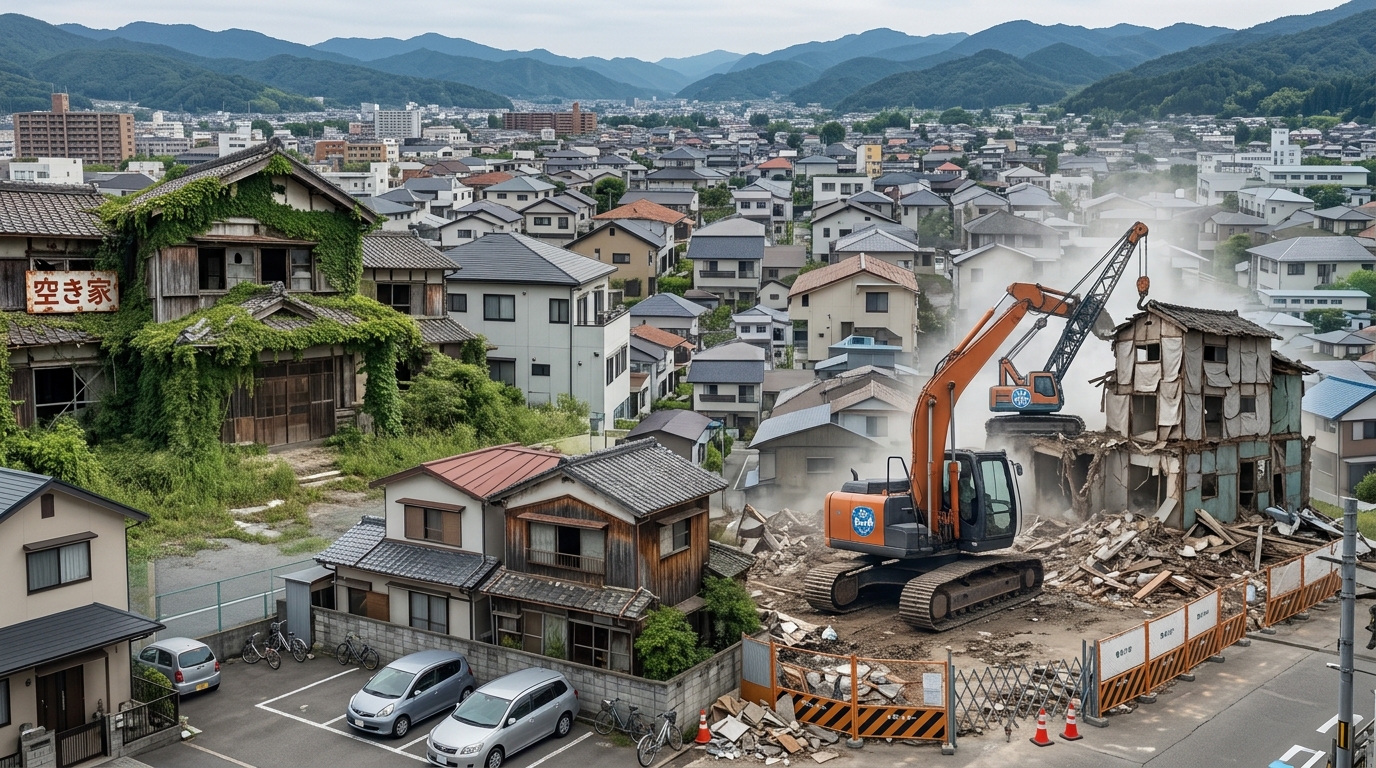
The number of vacant houses (Akiya) across Japan continues to reach record highs. According to the Housing and Land Survey by the Ministry of Internal Affairs and Communications, vacant homes now account for over 14% of total housing stock nationwide.
Discussions surrounding the Akiya issue typically focus on daily living environment impacts—such as crime and fire risks, deteriorating scenery, or the danger of collapsing structures. However, hidden behind these visible issues lies a structural macroeconomic problem that is quietly yet steadily driving local governments toward fiscal insolvency.
This article explores the structural damage vacant houses inflict on municipal finances through three key lenses: distortion in property taxes, skyrocketing infrastructure maintenance costs, and the risk of unrecoverable expenses in administrative subrogation.
1. The Property Tax Trap: Why Leaving Akiya Abandoned Erodes Local Revenue
For local governments—especially in rural areas and municipalities facing steep population decline—Fixed Asset Tax (Kotei Shisan Zei) is a crucial source of independent revenue. However, Japan’s current tax framework creates a perverse incentive: leaving a house abandoned is financially more advantageous for the owner than removing it.
The Dilemma of the “Special Provision for Residential Land”
Under Japanese tax law, land designated for residential housing benefits from a significant tax reduction. For plots under 200 square meters, the tax assessment base is reduced to one-sixth of its standard value.
- Demolishing the house to clear the land: The property tax on the land jumps up to 6 times higher.
- Leaving a dilapidated house standing: Even if unoccupied, the land retains its “residential” classification, keeping the tax rate capped at one-sixth.
Because of this mechanism, many owners choose to leave derelict houses standing rather than pay several million yen in demolition costs just to face a significantly higher tax bill.
Rising Tax Delinquency and Untraceable Ownership
Compounding the issue is the rise of ownerless land and abandoned properties caused by aging owners passing away without clear estate planning. When heirs renounce their inheritance or fail to update land registries, municipalities are left unable to track down who should be billed or taxed.
As a result, local governments suffer a double burden: uncollected property taxes piling up as bad debt, alongside rising administrative costs spent trying to trace legal owners.
2. Skyrocketing Infrastructure Maintenance Costs and the “Sponge” Phenomenon
As vacant houses proliferate, urban areas experience a phenomenon known as “urban sponging,” where empty structures and vacant lots scatter randomly throughout neighborhoods. This trend drastically reduces the efficiency of public infrastructure management.
Reduced Efficiency in Low-Density Infrastructure
Even as population density drops and only a few households remain on a street or in a hamlet, local authorities cannot simply shut down public services.
- Water and Sewage Maintenance: Even if usage drops by half, the cost of pipe repairs and system overhauls remains the same. Reduced usage leads directly to deficits in public water utility accounts.
- Roads, Streetlights, and Garbage Collection: As long as a single resident lives in an area, road repairs, streetlight electricity costs, and garbage truck routes must be fully maintained.
This inflates administrative maintenance costs per capita, placing immense strain on annual municipal budgets. In rural cities where compact urban planning has not taken hold, the burden of maintaining sprawling infrastructure drains municipal treasuries.
3. The Reality of Administrative Subrogation: The Impassable Wall of Unrecoverable Millions
When an abandoned property deteriorates to the point of imminent collapse or fire hazard, local governments are forced to resort to legal enforcement: Administrative Subrogation (Gyōsei Daishikō) or summary subrogation.
What is Administrative Subrogation?
Under the Act on Special Measures Concerning Unoccupied Houses, municipalities can step in to forcibly demolish extreme-risk properties (classified as “Designated Akiya“) or trim hazardous trees on behalf of the owner.
Single-Digit Recovery Rates: Taxpayer-Funded Demolitions
Demolition costs—ranging from 2 to 5 million yen for standard wooden houses to tens of millions of yen for larger or difficult-access structures—are legally billable to the property owner.
However, in practice, recovering these funds is extraordinarily difficult due to several factors:
- Insolvent Owners: Owners often lack the financial capacity or savings to pay.
- Untraceable or Renounced Inheritance: The legal owner cannot be identified, or all heirs have formally renounced the inheritance.
- Low-Value Land Assets: The cleared land itself often holds so little market value that foreclosing and auctioning it off cannot cover the demolition expenses.
In many municipalities, the millions spent on administrative subrogation end up written off as uncollectible debt, effectively funded out of local taxpayers’ pockets. This creates a severe, unexpected strain on local budgets.
4. The Risk of Municipal Bankruptcy and Broader Macroeconomic Impact
The combination of shrinking tax revenues, escalating infrastructure expenses, and unrecoverable enforcement costs creates a real risk of municipalities entering official financial distress (becoming fiscal rehabilitation entities).
Lessons from Yubari City and Today’s Akiya Crisis
When a municipality enters financial rehabilitation—similar to the famous case of Yubari City in Hokkaido—the consequences for residents are severe:
- Drastic Cuts to Public Services: Closure or halted funding for libraries, parks, and public facilities, alongside hikes in waste disposal fees.
- Higher Local Taxes and Utility Rates: Increases in municipal resident taxes and water charges.
- Accelerated Outflow of Younger Generations: Deteriorating public services push working-age families to neighboring cities, leaving behind even more empty homes in a vicious cycle.
The Akiya crisis is not merely an aesthetic or real estate problem; it is a slow-motion fiscal disaster capable of dismantling local economic ecosystems.
5. The 2023 Revised Akiya Special Measures Act and Future Outlook
To address these mounting fiscal risks, the Japanese government enacted the revised Act on Special Measures Concerning Unoccupied Houses in December 2023.
Introduction of “Poorly Managed Akiya”
Previously, municipalities could only intervene after a property was officially designated as a high-risk “Designated Akiya.” The updated law introduces a new category: “Poorly Managed Akiya” (Kanri Fuzen Akiya). If an owner fails to comply with municipal guidance or warnings at this earlier stage, the local government can revoke the one-sixth property tax discount before the house becomes a critical hazard.
Public-Private Partnerships and Private Renovation Investments
Because municipal budgets alone cannot cover the costs of demolition and management, leveraging private sector dynamics is crucial moving forward:
- Regional Integration of Akiya Banks: Proactive data sharing aimed at relocation seekers and international investors.
- Private Regeneration Businesses (Renovation & Adaptive Reuse): Transforming abandoned properties into guesthouses, cafes, and co-working spaces to generate commercial value.
- Smart Shrinkage: Concentrating residential zones while converting hazardous vacant plots into green spaces or community plazas early on.
Conclusion
For local municipalities, vacant houses present a difficult dilemma: leave them abandoned and watch tax revenues shrink, or demolish them forcibly and absorb massive unrecoverable costs.
Overcoming this crisis requires more than just administrative enforcement. It demands a thriving ecosystem that turns “negative assets” (Fudōsan) into valuable community assets through private sector creativity, renovation, and investment.