
In recent years, driven by Japan’s rural revitalization movement and the trend toward countryside living, global interest in “1-Yen Akiya” (vacant houses) and “free transfer properties (0-Yen homes)” has reached an all-time high. Renovating a property through DIY to create a dream home and embracing a slow life surrounded by nature—an increasing number of people both within Japan and overseas share this vision.
However, why are these houses “free” in the first place?
Building deterioration and remote locations are not the only reasons. In reality, many of these ultra-cheap or free vacant homes are situated in “high-risk disaster zones that pose life-threatening dangers.” In this article, we examine the harsh realities from a professional real estate perspective: how neglecting to check the “Hazard Map” when purchasing an Akiya directly leads to severe legal traps and a lifetime financial burden (a “negative asset”).
1. The Shattered Myth of “It’s Been Safe for 50 Years”
When viewing a vacant home in rural Japan, prospective buyers are frequently told by elderly neighbors or former owners: “This house is 50 years old, but it has never suffered from floods or landslides.” Buyers tend to trust these firsthand accounts, but in modern Japan, this empirical logic no longer holds true.
Due to climate change, the frequency of “linear precipitation zones” (heavy localized torrential rain) and mega-typhoons has surged. Land that remained safe for decades can now be swallowed overnight by raging torrents and mudslides. Past safety offers zero guarantee for future security. That is precisely why checking the “Hazard Map”—an objective, up-to-date disaster prediction map—is an absolute requirement.
2. The “Red” and “Yellow” of Hazard Maps: The Desperate Costs of the Red Zone
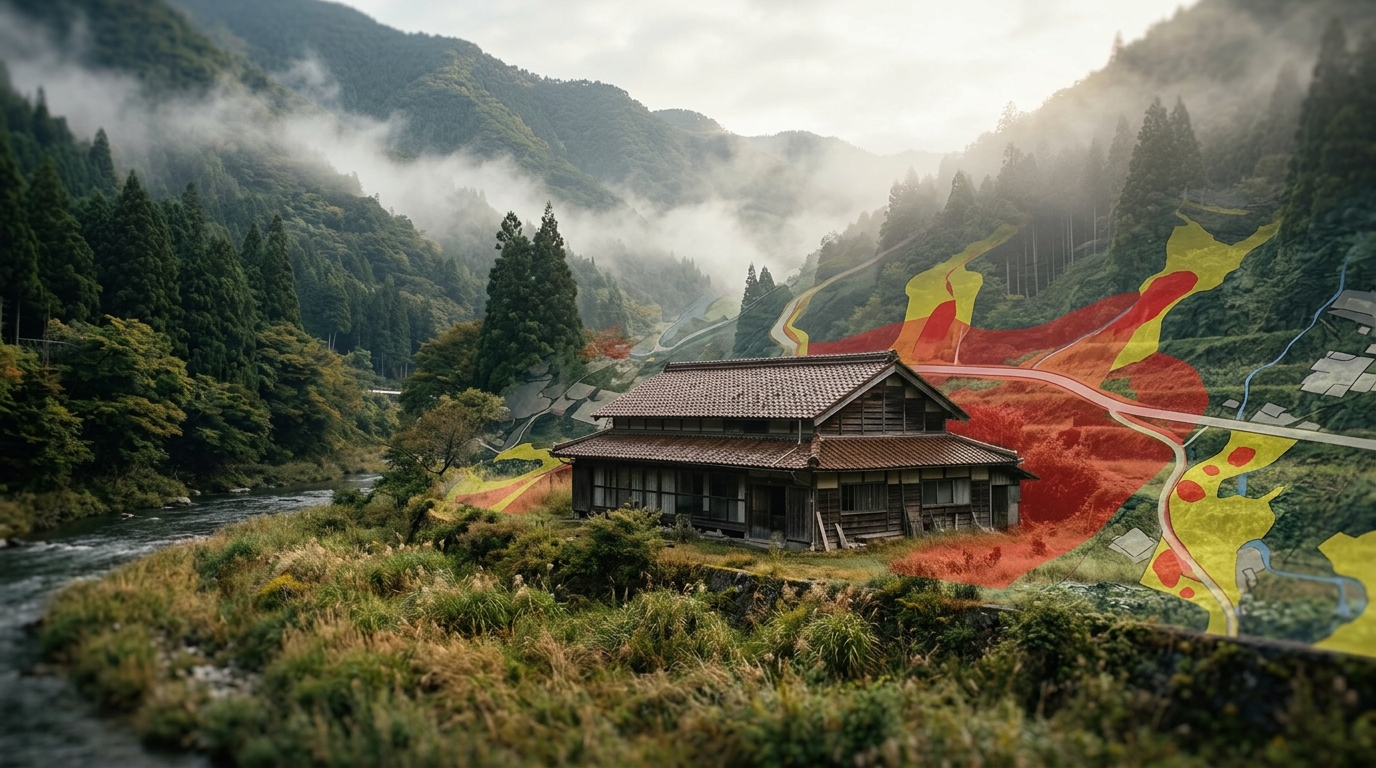
When reviewing a hazard map, particular caution must be exercised regarding designations related to landslides (dosha-saigai). On hazard maps, these areas are primarily highlighted in Yellow (Yellow Zone) and Red (Red Zone). This color distinction radically alters both property value and legal standing under Japanese law.
Yellow Zone (Landslide Warning Area)
The Yellow Zone designates areas where residents’ lives could be endangered should a landslide occur. While there are no direct legal restrictions on construction within this zone, a major pitfall lies in skyrocketing insurance premiums. Due to the elevated disaster risk, flood coverage attached to fire insurance becomes significantly more expensive than in standard areas. Furthermore, there is an ongoing risk that future official assessments will reclassify the property into the far more restrictive Red Zone.
Red Zone (Special Landslide Warning Area)
The Red Zone identifies areas where landslides could cause structural damage to buildings, posing a severe threat to residents’ lives. If you acquire a vacant home here simply because it is “free,” you will face a fatal hurdle: a practical ban on rebuilding (Rebuilding Restrictions / Saikenchiku Fuka).
Rebuilding a house within a Red Zone triggers extremely strict structural regulations under Japan’s Building Standards Act. For instance, exterior walls facing mountains or slopes must be built using thick reinforced concrete (RC), or massive retaining walls (yoheki) costing tens of millions of yen must be installed. Demolishing an old wooden Akiya to build an affordable new wooden home is legally prohibited or financially impossible. Because these mandated engineering costs far exceed standard budgets, the property becomes an “unrebuildable asset.”
3. The Hidden Trap of Peer-to-Peer (C2C) Sales Without Real Estate Agents
You might wonder: “If a location is that dangerous, wouldn’t a licensed real estate agent inform me before I buy?”
Indeed, following an amendment to Japan’s Real Estate Brokerage Act in August 2020, real estate agents are legally obligated to explain a property’s flood hazard map status during the “Important Matters Explanation” (Jutoku Setsumei) prior to contract execution.
However, a massive loophole exists within the Akiya market. A large proportion of properties listed on local Akiya Banks or online peer-to-peer (C2C) matching platforms for “0 Yen” or a few hundred dollars are direct transactions conducted between individuals without a licensed real estate broker. Without a broker involved, no party is legally required to deliver an Important Matters Explanation. Sellers rarely volunteer disadvantageous information such as “this house is in a Red Zone,” leaving buyers entirely on their own to investigate legal and environmental hazards.
4. No Way Out: Abandoning Property Triggers 6x Higher Taxes and Millions in Demolition Bills as a “Specified Vacant House”
Thinking, “Since I got the house for free, if I later discover it’s in a Red Zone or unlivable, I can just abandon it again,” is a dangerous misconception.
Current Japanese legal frameworks do not permit vacant properties to be abandoned with impunity. If an abandoned Akiya presents structural or disaster hazards, local municipal authorities will designate it as a “Specified Vacant House” (Tokutei Akiya). Once designated, tax relief measures on residential land are revoked, causing property taxes to skyrocket by up to six times.
If the neglect continues, municipal governments can enact “Direct Administrative Performance” (Gyosei Daishikko)—forcibly demolishing the structure and billing the owner (you) for the full demolition costs, which routinely reach millions of yen. You cannot sell it, it is too hazardous to live in, and abandoning it triggers tax penalties and compulsory demolition fees—turning what you hoped was an “asset” into a true “negative asset” (fudosan / legal liability).
Conclusion: Checking the Hazard Map Portal Site is an Absolute Requirement
No matter how charming a traditional house (kominka) may appear, and no matter how enticing a 1-Yen price tag seems, your very first step must always be looking up the exact address on the Ministry of Land, Infrastructure, Transport and Tourism’s (MLIT) “Hazard Map Portal Site.”
Overlay layers for flooding, landslides, and tsunami risks to check which color category the property falls into. If it sits in a Red Zone, it is far more likely to be a legal and financial time bomb than a peaceful country retreat.
Free properties are free for very specific reasons. Accurately understanding hidden natural disaster risks and legal barriers before signing is the single most crucial factor for a successful Akiya acquisition in Japan.