
Can you really buy a house in Japan for just one yen?
From time to time, striking headlines appear across social media and international news websites:
“Japan is giving away homes for free.”
“Buy a Japanese house for less than the price of a cup of coffee.”
“Japanese towns are offering abandoned homes to foreigners.”
Some Japanese municipalities, property platforms, and individual owners do occasionally list vacant homes—known as akiya—for zero yen, one yen, or another symbolic price.
However, an extremely low purchase price does not mean the property will be inexpensive to own, renovate, or operate.
In some cases, the advertised price may be the smallest cost in the entire project.
When you acquire a one-yen akiya, you may inherit more than an old building. You may also take on its maintenance obligations, taxes, structural defects, legal complications, renovation requirements, and possible demolition costs.
The real questions are therefore:
Why would anyone sell a house for one yen?
And how much will the property actually cost after it becomes yours?
Why Would a House Be Sold for One Yen?
Under normal circumstances, selling a property for one yen may appear irrational. The situation can be very different, however, in parts of rural Japan affected by population decline, ageing communities, and outward migration.
An unused house does not automatically remain a valuable asset.
For some owners, it becomes a “negative asset”—a property that generates continuing costs and responsibilities but little or no income.
Even when nobody lives in the building, the owner may still be responsible for:
- Fixed asset tax and, where applicable, city planning tax
- Cutting weeds and maintaining trees
- Repairing roofs, exterior walls, windows, and gutters
- Controlling termites, insects, rodents, and mould
- Inspecting the property after typhoons, earthquakes, or heavy rain
- Responding to complaints from neighbours or local authorities
- Preventing fire, trespassing, illegal dumping, and collapse
- Conducting regular inspections
- Paying for demolition if the building becomes dangerous
- Compensating third parties if the property causes damage
When an akiya is located far from its owner’s residence, travel and property-management expenses create an additional burden.
For some owners, the objective is therefore not to make a profit from the sale. It is to transfer the future costs and responsibilities associated with the property.
A price of zero or one yen may not indicate that the building is highly valuable. Instead, it may reveal that the burden of continuing ownership has become greater than the owner’s expectation of future value.
A “Free House” Is Not a “Cost-Free House”
Even when the purchase price is zero or one yen, ownership cannot usually be transferred without formal procedures.
Depending on the property and the transaction structure, a buyer may encounter expenses such as:
- Ownership-transfer registration
- Judicial scrivener fees
- Real estate acquisition tax
- Stamp duty and contract preparation
- Real estate agency commission
- Land surveying and boundary confirmation
- Building inspections
- Seismic assessment
- Fire and earthquake insurance
- Water, electricity, gas, and utility restoration
- Sewerage or septic-tank work
- Renovation and structural reinforcement
- Removal and disposal of abandoned belongings
- Asbestos or hazardous-material inspections
- Demolition if the house cannot be safely reused
The advertised price should never be the only figure used to evaluate an akiya.
A more realistic calculation is:
Total investment = Purchase price + transaction costs + essential repairs + infrastructure work + ongoing ownership costs + contingency budget
Even if the purchase price is one yen, the complete project may cost several million yen—and in major renovation cases, considerably more.
What Problems Could Be Hiding Behind an Ultra-Cheap Akiya?
When you discover an exceptionally cheap house, the first question should not be, “How quickly can I buy it?”
The first question should be:
Why is this property so cheap?
1. Serious Building Deterioration
A wooden house that has remained unoccupied for years may contain problems such as:
- Roof leaks
- Rotten beams and columns
- Termite damage
- Mould and excessive moisture
- Subsiding floors
- Foundation cracks
- Damaged pipes
- Deteriorated exterior walls and window frames
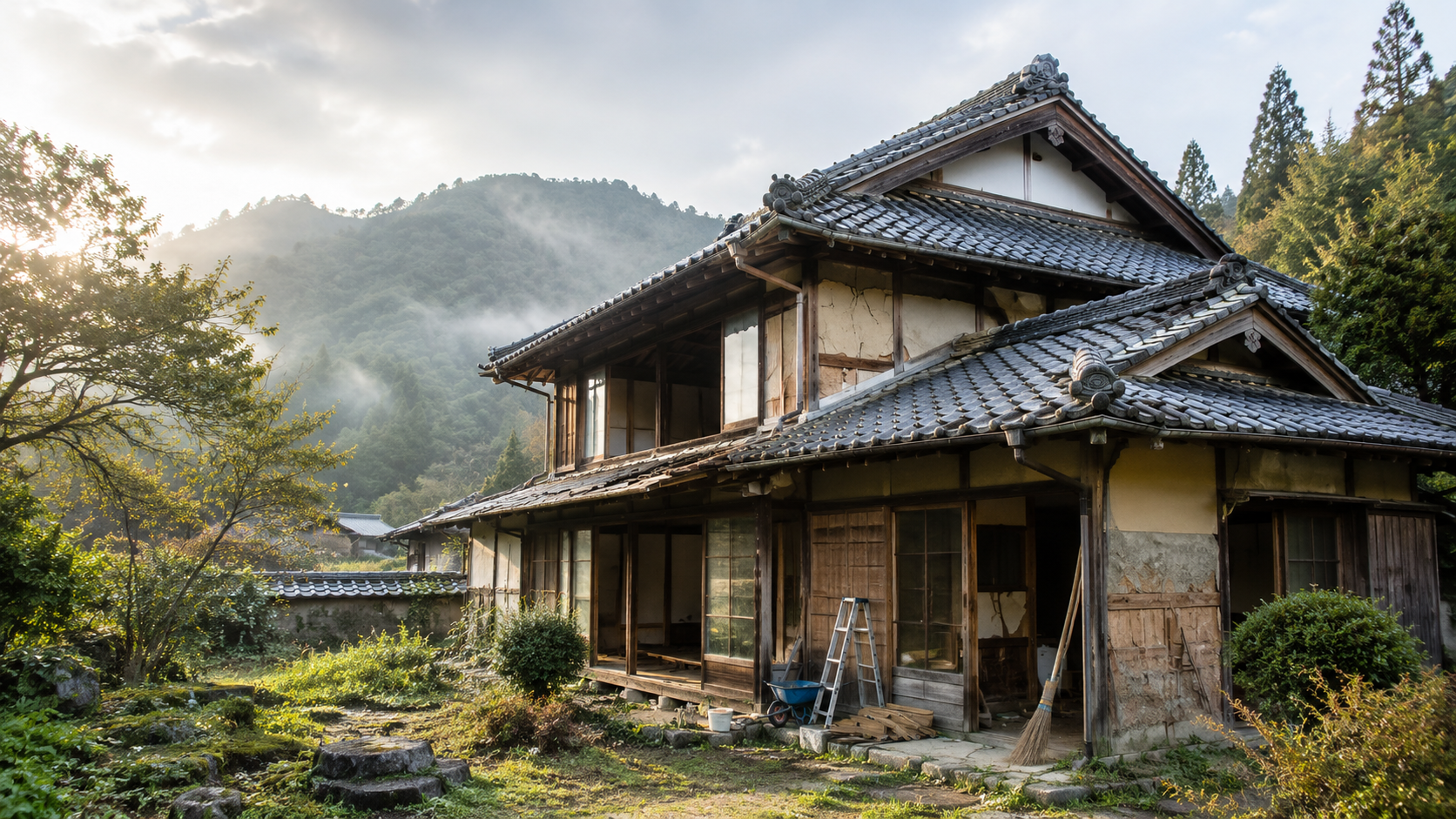
A traditional Japanese kominka can look beautiful from the outside while concealing expensive structural damage.
Large wooden beams and traditional craftsmanship can be valuable features, but their presence does not guarantee that the building is safe.
2. Insufficient Earthquake Resistance
Japan is one of the world’s most earthquake-prone countries.
Older properties may have been built under previous seismic standards and could require detailed assessment and reinforcement.
New wallpaper, tatami, kitchens, and bathrooms can dramatically improve a house’s appearance. Cosmetic renovation, however, does not solve weaknesses in the foundation, load-bearing walls, columns, or roof structure.
Before purchasing an older akiya, buyers should evaluate structural safety—not merely interior design potential.
3. The Property May Be Ineligible for Rebuilding
Some older houses do not satisfy current road-access requirements under Japan’s Building Standards Act.
The existing structure may be usable, but once it is demolished, permission to build a replacement may not be available.
Such properties are often described as saikenchiku fuka (再建築不可), meaning “rebuilding not permitted.”
Before purchasing, buyers should confirm:
- Whether the land legally faces an approved road
- Whether the required road frontage is available
- Whether reconstruction is permitted
- Whether a setback is required
- Whether private-road access rights are secured
- Whether consent is needed to excavate beneath a private road for utilities
A large plot can appear attractive, but if rebuilding is prohibited, its future use and resale value may be severely restricted.
4. The Property Boundaries May Be Unclear
For some older rural properties, the registered land information may not match the area historically used by the occupants.
Boundary markers may have disappeared, or neighbouring owners may never have formally confirmed the dividing lines.
Disputes can emerge after the purchase when the buyer wants to:
- Install a fence
- Create a parking area
- Extend the building
- Demolish the house
- Construct a new building
- Sell part of the land
A formal boundary survey can take time and money. It may also require confirmation from several neighbouring landowners.
5. Multiple Owners or Heirs May Be Involved
The registered owner of a long-abandoned property may already be deceased.
If inheritance registration was not completed, the legal interest may have passed to multiple heirs. Over several generations, the number of people involved can become surprisingly large.
Potential complications include:
- Some heirs cannot be located
- An heir lives overseas
- Family members disagree about the sale
- Management responsibility is unclear
- Not everyone provides the required consent
- Old mortgages or other rights remain registered
In Japan, inheritance registration became mandatory on April 1, 2024. In principle, an heir who becomes aware of acquiring real estate through inheritance must apply for registration within three years.
This reform is important, but it has not instantly resolved every historical ownership problem.
The appearance of a property in an advertisement does not necessarily mean that its ownership can be transferred immediately.
6. Furniture and Personal Belongings May Remain Inside
Some akiya properties still contain furniture, appliances, clothes, bedding, tableware, farming equipment, documents, Buddhist altars, photographs, and other belongings.
Removing and legally disposing of these items can be expensive.
The sale contract should clearly explain:
- Which items are included in the transfer
- Who is responsible for removal
- Who will pay the disposal costs
- When the property must be emptied
- Whether any items must be returned to the former owner or family
Particular care is needed when the house contains family photographs, documents, memorial tablets, or culturally and emotionally important items.
7. Utilities and Infrastructure May Be Inadequate
Some rural areas are not connected to a public sewer system and instead depend on septic tanks.
An old septic system may need inspection, repair, or replacement. Water pipes, electrical wiring, gas systems, and water heaters that have not been used for years may also be unsafe or unusable.
Anyone planning to use an akiya as a residence, remote office, guesthouse, or rental property should also investigate:
- Internet availability
- Mobile-phone reception
- Water pressure
- Electricity capacity
- Heating requirements
- Snow and cold-weather conditions
- Access for maintenance vehicles
A visually attractive house may still be unsuitable for modern living without significant infrastructure investment.
8. The Property May Have a Psychologically Stigmatized History
A death, suicide, crime, or other serious event may have occurred at the property.
Such homes are often associated with the term jiko bukken (事故物件), commonly translated as a stigmatized property.
This does not automatically make the property a bad investment. Nevertheless, buyers should carefully consider:
- What information has been disclosed
- Whether the history could affect future resale
- Whether tenants would accept the property
- How the local community views the house
- Whether the buyer and family are personally comfortable with its history
A low price may appear attractive at the time of purchase but create difficulties when the owner later tries to rent or sell the property.
What Happens If You Buy a One-Yen House and Leave It Empty?
A common but risky idea is:
“It is so cheap that I will buy it now and decide what to do with it later.”
Once ownership is transferred, responsibility for managing the property generally passes to the new owner.
Japan strengthened its measures for poorly managed vacant homes through amendments to the Act on Special Measures Concerning Vacant Houses in 2023.
A property that is not properly maintained and is at risk of becoming seriously hazardous may be treated as a kanri-fuzen akiya (管理不全空家), or poorly managed vacant house.
If the owner fails to follow official guidance and receives a formal recommendation, the land may lose the preferential fixed-asset-tax treatment normally available to residential land.
A more dangerous building may be designated a tokutei akiya (特定空家), or specified vacant house.
Authorities may require measures such as:
- Repairing unsafe parts
- Removing dangerous building materials
- Cutting overgrown trees and vegetation
- Preventing unauthorised entry
- Improving sanitation and safety
- Demolishing the structure
Under certain legal procedures, a municipality may carry out the necessary work and seek reimbursement from the owner.
A house acquired for one yen can therefore develop into a major financial and legal liability if it is left unmanaged.
Can Foreigners Buy One-Yen Akiya in Japan?
As a general rule, Japanese citizenship is not universally required to purchase real estate in Japan. Subject to applicable regulations and the property’s circumstances, foreign individuals may acquire land and buildings.
However, property ownership and immigration status are entirely separate matters.
- Property ownership: The legal right to own land or a building
- Immigration status: The right to live and conduct approved activities in Japan
Buying a house in Japan does not automatically provide a visa, permanent residence, or long-term right to remain in the country.
Municipal akiya-bank programmes, free-transfer schemes, and renovation grants may also include specific eligibility requirements, such as:
- Living in the municipality for a specified period
- Moving one’s registered residence to the area
- Completing renovation by a deadline
- Participating in neighbourhood or community activities
- Belonging to a young or child-raising household
- Not immediately reselling the property
- Using the home for a minimum number of years
- Employing local contractors for subsidised work
Foreign buyers should therefore confirm whether they can purchase the property and whether they qualify for any municipal support programme. These are separate questions.
When Can a One-Yen Akiya Become a Genuine Opportunity?
Not every ultra-cheap akiya is a bad property.
With proper research, a realistic budget, and a clear use plan, an abandoned house can become a successful project that benefits both the owner and the community.
A Permanent or Secondary Home
For people who want to leave crowded city life and live closer to nature, a rural akiya may offer space, peace, and a stronger connection with the community.
However, buyers should also investigate access to:
- Hospitals and medical care
- Schools and childcare
- Shops and everyday services
- Public transportation
- Snow removal
- Disaster evacuation routes
- Employment opportunities
A beautiful house is not enough if the surrounding area does not support the buyer’s everyday needs.
A Remote-Work Base
An akiya in an area with reliable internet can be converted into a combined residence and workplace.
Larger rural properties may provide room for:
- Private offices
- Meeting rooms
- Studios
- Storage
- Online broadcasting
- Photography and video production
Reliable broadband and mobile coverage should be confirmed before purchase.
A Guesthouse or Small Accommodation Facility
A property near a tourist destination, hot spring, ski resort, beach, heritage area, or hiking route may have accommodation potential.
Before purchasing, buyers should investigate:
- Zoning
- Building regulations
- Fire-safety rules
- The Hotel Business Act
- The Private Lodging Business Act
- Emergency exits
- Parking requirements
- Local ordinances
- Neighbourhood acceptance
Being permitted to buy a house does not automatically mean that the house can legally operate as a guesthouse or vacation rental.
An Artist’s Studio or Creative Hub
A spacious kominka can be suitable for ceramics, woodwork, painting, photography, music, film production, crafts, or cultural activities.
Cooperation with local residents and craftspeople may allow the property to host:
- Workshops
- Exhibitions
- Cultural exchanges
- Training programmes
- Regional product events
A Community Facility
Vacant houses can also be reused for social purposes, including:
- Senior community spaces
- Children’s learning centres
- Community kitchens
- Disaster-response bases
- Migration information centres
- Coworking spaces
- Local business incubators
- Regional product shops
An akiya should not always be viewed only as a piece of real estate. It can also become a tool for solving local social problems.
A Land-Focused Project
Sometimes the building itself has little value, while the location or size of the land creates an opportunity.
If demolition and redevelopment are planned, buyers should confirm:
- Demolition costs
- The presence of asbestos
- Land boundaries
- Road access
- Rebuilding permission
- Ground conditions
- Buried waste or structures
- Water and sewer connections
- Land-use restrictions
- Tax consequences after demolition
Demolishing the house before confirming that the land can be redeveloped may destroy the entire business plan.
Twelve Checks to Complete Before Buying
Anyone considering a free, one-yen, or exceptionally cheap akiya should complete at least the following checks before signing a contract:
- Confirm that the seller is the legally registered owner.
- Review inheritance issues, mortgages, seizures, easements, and other registered rights.
- Determine whether the land boundaries have been formally confirmed.
- Verify whether reconstruction is legally permitted.
- Check road access, private-road rights, and setback requirements.
- Arrange a professional building inspection.
- Investigate seismic performance, foundations, roofing, leaks, moisture, and termites.
- Assess the risk of asbestos and other hazardous materials.
- Check water, electricity, gas, sewerage, septic systems, and internet access.
- Obtain written confirmation of municipal grant and residency requirements.
- Request renovation and demolition estimates from multiple contractors.
- Calculate the property’s total costs for at least the first five years.
The most important principle is simple:
Do not calculate only the price of buying the house. Calculate the price of completing the entire project.
A Sample Cost Scenario
The following table is not an official quotation for a particular property. It demonstrates the types of costs that may arise after acquiring a one-yen akiya.
| Cost category | Possible situation |
|---|---|
| Purchase price | Zero or a symbolic amount such as one yen |
| Registration and professional fees | Required to complete the ownership transfer |
| Removal of belongings | Potentially expensive depending on volume |
| Roof repairs | May require urgent intervention |
| Timber and termite treatment | Damage may appear only after inspection or dismantling |
| Seismic reinforcement | May be necessary in older wooden homes |
| Water and sewerage systems | Repair or replacement may be required |
| Electrical system | May not support modern usage safely |
| Insulation | Important for comfort and energy efficiency |
| Taxes, insurance, and maintenance | Continue for as long as the property is owned |
| Demolition | A major expense if the building cannot be reused |
The lesson is clear: a purchase price close to zero does not produce a total investment close to zero.
Which Is Better: A One-Yen Akiya or a More Expensive Ready-to-Use Home?
Consider two options:
- A one-yen akiya requiring extensive repairs
- A more expensive existing home that can be used immediately
The first option is far more exciting on social media. The second, however, may be financially safer after total costs, time, and risk are considered.
A meaningful comparison should include:
- Purchase and renovation costs
- Completion time
- Permits and administrative procedures
- Seismic safety
- Future maintenance expenses
- Rental and resale potential
- Local population trends
- Access to hospitals, schools, and public transportation
- Natural-disaster exposure
- Exit strategy after five, ten, or twenty years
Buying a house cheaply is not, by itself, a success.
The real achievement is transforming it into a safe, usable, and sustainable asset.
The ANIHON Akiya Japan Approach
At ANIHON Akiya Japan, we do not view akiya properties simply as “cheap Japanese real estate.”
We believe that the true potential and risk of a vacant home should be assessed through four stages.
1. Legal Verification
Ownership, inheritance, boundaries, road access, zoning, restrictions, and rebuilding eligibility should be investigated.
2. Technical Assessment
The structure, seismic performance, foundation, roof, moisture, termites, utilities, and overall condition should be examined.
3. Economic Feasibility
The calculation should include purchase costs, registration, renovation, taxes, insurance, management, operation, and potential rental or resale income.
4. Selecting the Most Appropriate Use
The property may be suitable for use as:
- A private residence
- A rental home
- A guesthouse
- An office
- A shop
- A community facility
- A creative workspace
If the building cannot be safely reused, responsible demolition and an alternative use for the land may be the better solution.
In the future, integrating property sales, online auctions, preliminary building assessments, renovation planning, and reverse auctions for demolition work into a single digital platform could provide a more transparent and efficient response to Japan’s vacant-house challenge.
Conclusion: Is a One-Yen Akiya a Gift or a Transfer of Responsibility?
The existence of zero-yen and one-yen houses in Japan is not entirely an internet myth.
Properties are occasionally transferred for extremely low or symbolic prices.
It is nevertheless misleading to describe them simply as “free houses.”
With careful research, a realistic budget, and a clear plan, an ultra-cheap akiya can become the foundation of a successful regeneration project.
Without those preparations, the buyer may face renovation, maintenance, tax, demolition, and legal costs far greater than the original purchase price.
Whenever you encounter an exceptionally cheap akiya, ask three questions:
- Why is this house so inexpensive?
- What is the total cost of making it safe and usable?
- How will I use, rent, or sell it five or ten years from now?
If you can answer these questions with documents, professional inspections, and reliable cost estimates, a one-yen house may represent the beginning of an exciting transformation.
If the answers remain unclear, the one-yen price may simply be the entrance fee to a very expensive responsibility.
Disclaimer
This article is provided for general information only. It does not constitute legal, tax, architectural, immigration, or investment advice.
Before purchasing real estate in Japan, consult the relevant municipality and qualified professionals, such as a licensed real estate agent, judicial scrivener, land and house investigator, architect, building inspector, and tax adviser.