

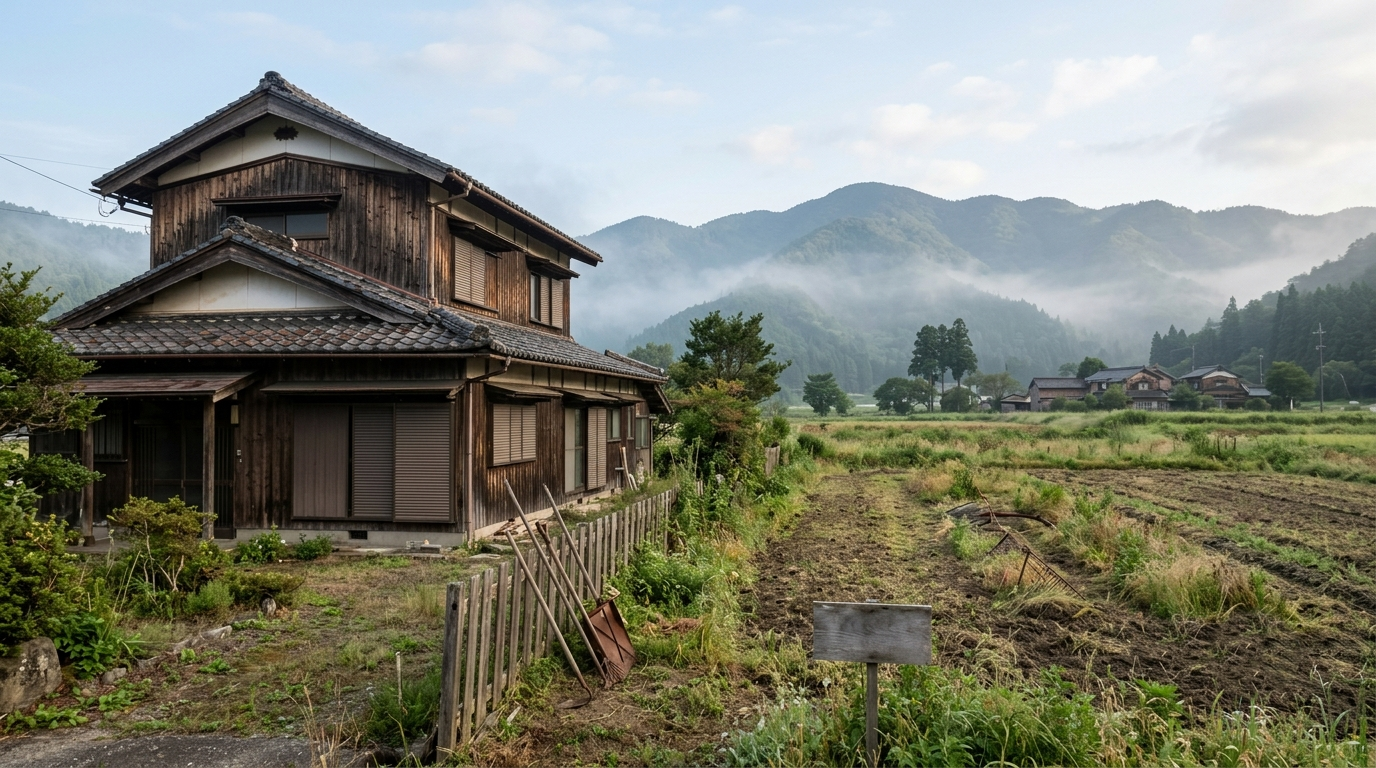
Among Japan’s growing number of vacant homes (Akiya), those located in rural and suburban areas frequently come bundled with farmland. For people dreaming of moving to the countryside to start a self-sufficient lifestyle or simply enjoy growing vegetables in a spacious yard, an “Akiya with farmland” (Nōchi-tsuki Akiya) seems like an ideal choice.
However, when moving forward with the actual purchase, many buyers run into a major legal wall: “I can buy the house, but I can’t buy the farm attached to it,” or “We signed the sales contract, but we can’t register the land title.”
The main reasons behind this obstacle are Japan’s Agricultural Land Act (Nōchi-hō) and the municipal administrative body known as the Agricultural Committee (Nōgyō Iinkai).
This guide breaks down the legal framework you need to know when buying an Akiya with farmland, the role of the Agricultural Committee, and concrete steps to ensure a smooth purchase.
1. Why Can’t You Just Buy Farmland Easily? Basics of the Agricultural Land Act
In Japan, even if land is privately owned, any parcel registered as “farmland” (Nōchi—such as rice paddies or dry fields) cannot be freely bought, sold, or leased like standard residential land. This is strictly regulated by the Agricultural Land Act.
Purpose of the Agricultural Land Act
The law was enacted to protect high-quality agricultural land across the nation and secure a stable food supply. Consequently, speculative land purchases for non-agricultural purposes, uncontrolled land degradation, and unauthorized conversions to other uses are heavily restricted.
To transfer ownership or execute a lease agreement for farmland, you must obtain approval from or submit a official notification to the local municipal Agricultural Committee.
2. Two Approaches to Acquiring an Akiya with Farmland (Article 3 vs. Article 5 Permit)
When purchasing an Akiya bundled with farmland, the applicable legal provisions and procedures differ significantly depending on how you intend to use the land.
Pattern A: Keeping it as Farmland or a Home Garden (Article 3 Permit)
If you intend to continue using the land for agriculture or growing crops after the purchase, you must apply for an Article 3 Permit under the Agricultural Land Act.
Key Requirements for Article 3 Approval:
- Full Utilization Requirement: You must efficiently utilize all farmland currently owned or leased, including the newly requested plot, for agricultural management.
- Regular Farming Engagement: The applicant (or family member) must engage in farm work for a minimum required number of days per year.
- Harmony with the Local Community: Your farming activities must not interfere with neighboring agricultural operations or the local farming ecosystem.
★ Important Legal Change in April 2023 Previously, obtaining an Article 3 permit required meeting a strict “Minimum Area Requirement” (generally cultivating at least 50 ares / 5,000 m² outside of Hokkaido). However, to address the rise in vacant homes and abandoned farmland, this minimum area requirement was completely abolished nationwide in April 2023. As a result, obtaining an Article 3 permit for small home garden plots attached to an Akiya has become much easier.
Pattern B: Converting Farmland into a Yard, Parking Space, or Residential Site (Article 5 Permit)
If you do not plan to farm and instead want to turn the plot into a garden, build a garage/parking area, or construct an annex, you must undergo Farmland Conversion (Nōchi Ten-yō) under Article 5 of the Agricultural Land Act.
The Difficulty of Conversion and Land Classifications
Farmland conversion is not permitted on every piece of land. Farmland in Japan is categorized based on location and soil quality:
- Class A & Class 1 Farmland: Highly productive, consolidated farmland. Conversion is generally prohibited.
- Class 2 Farmland: Land located near urbanized areas. Conversion is permitted only if no alternative land is available.
- Class 3 Farmland: Farmland located inside urbanized zones. Conversion is generally permitted.
If the farmland attached to the Akiya falls under “Class 1 Farmland,” there is a high probability that conversion approval will be denied, regardless of how much you wish to purchase it.
3. Common Pitfalls and Risks During the Purchase Process
① The House and Farmland Require Separate Contracts and Permits
Although it may look like a single property packaged as “house + garden/field,” legally, the “building and residential plot” and the “farmland” are treated as completely distinct real estate assets. Even if the sales contract for the house is finalized, the title transfer for the farmland cannot be registered without the Agricultural Committee’s explicit approval.
② Delays Caused by the Committee’s Monthly Meeting Schedule
Agricultural Committees usually meet only once a month. From the document submission deadline to the review process and the issuance of the permit, it typically takes 1 to 2 months (or longer). Moving forward without accounting for this timeline can cause severe delays in your moving plans and property handover.
③ Risks of Unauthorized Occupation or Illegal Conversion
Buying farmland without the Agricultural Committee’s approval renders the contract legally void. Furthermore, making unauthorized structural modifications to farmland (such as paving it over for parking) violates the Agricultural Land Act and carries risks of order-to-restore mandates or criminal penalties.
4. Four Key Strategies to Smoothly Buy an Akiya with Farmland
Strategy 1: Leverage Municipal “Akiya Bank Special Provisions”
To revitalize local communities and reduce vacant homes, many municipalities offer special exemptions for properties registered in their official Akiya Banks. Purchasing through an Akiya Bank often comes with relaxed approval criteria or priority support from local officials, making it the safest place to start.
Strategy 2: Consult the “Agricultural Committee Secretariat” Before Signing
Before committing to a contract, visit the local municipal Agricultural Committee office to confirm:
- What classification the target farmland falls under (and whether conversion is possible).
- The likelihood of receiving an Article 3 or Article 5 permit under your intended usage.
- Required documentation and whether you need to contact local agricultural associations.
Strategy 3: Include a “Suspensive Condition” Clause in the Contract
When entering into a real estate purchase agreement, always include a Suspensive Condition Special Provision stating: “If approval from the Agricultural Committee cannot be obtained, this contract will be unconditionally canceled and rendered void.” This protects you from losing your earnest money deposit or facing financial loss if the permit is denied.
Strategy 4: Build Good Relationships with Local Residents and Farmers
Agricultural Committee reviews also evaluate how well the buyer will integrate with the community and local farming operations. In rural Japan, greeting the local neighborhood association president (Jichikai-chō) and neighboring farmers in advance, while sincerely explaining how you intend to use the land, goes a long way toward ensuring a smooth approval process.
Summary: Realize Your Rural Life Vision with the Right Knowledge
An Akiya with farmland offers a wonderful opportunity to acquire a spacious plot and a charming traditional home (Kominka) at an affordable price. However, navigating the rules of the Agricultural Committee and the Agricultural Land Act is an absolute necessity.
- Clarify your purpose (Will you use it for agriculture/gardening, or convert it into residential land?).
- Stay updated on legal reforms (such as the 2023 abolition of the minimum area requirement).
- Always consult the local Agricultural Committee office before signing any contracts.
By following these legal steps properly, you can avoid costly legal complications and step confidently into your ideal rural Japanese lifestyle.