

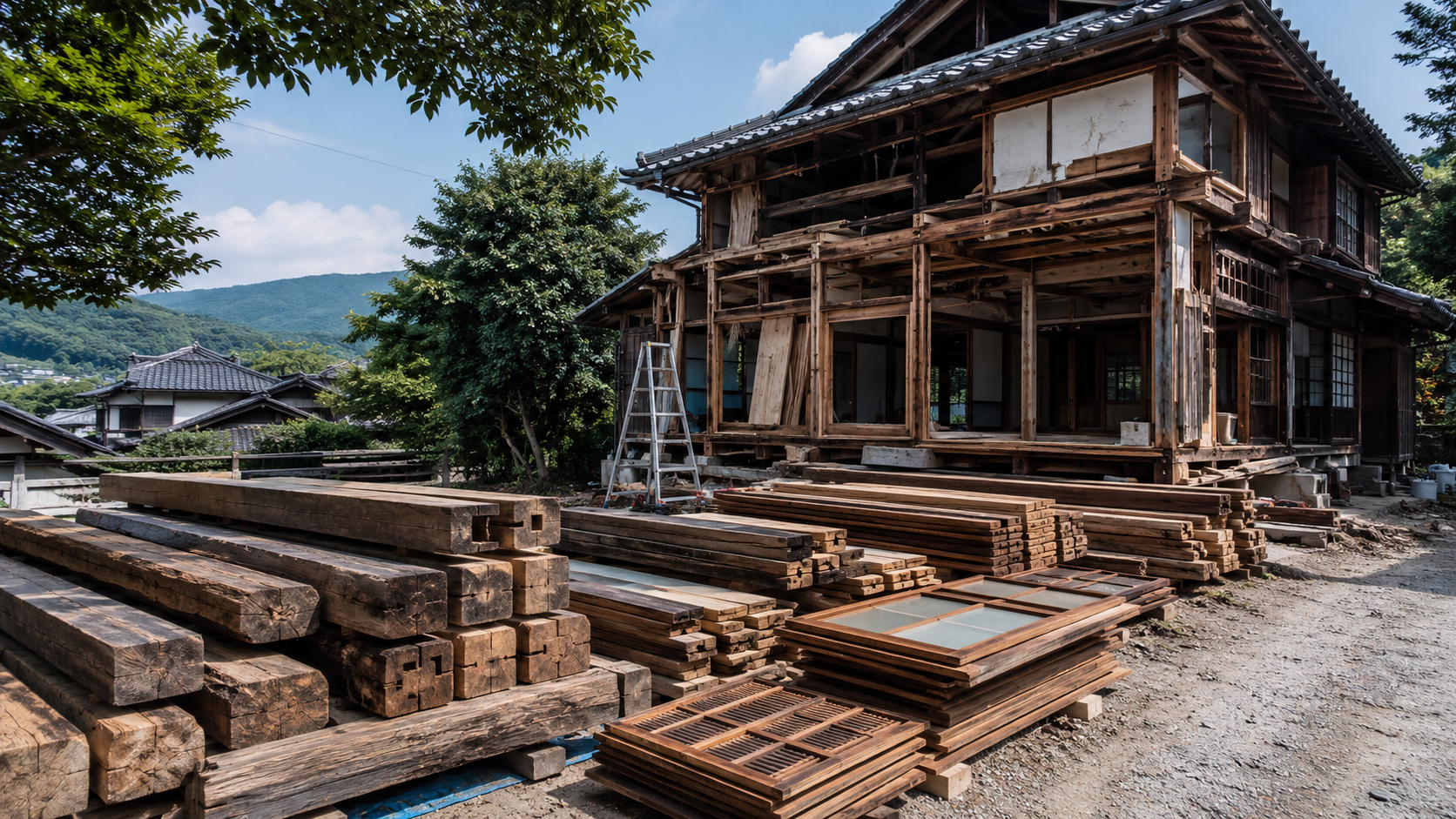
Japan’s Akiya problem is not only about the increasing number of vacant and unused houses. Many of these abandoned homes have been left untouched for years, gradually becoming weaker, more vulnerable to earthquakes, exposed to fire risks, and potentially dangerous for the surrounding neighborhood.
Some Akiya houses can be renovated and brought back to life. However, in many cases, especially when the structure is too old or unsafe, demolition becomes the most realistic and safest option.
But demolishing an Akiya does not simply mean removing an old building. Since many traditional and older Japanese homes are wooden structures, the wood materials generated during demolition can hold significant resource value.
In many demolition projects, wood from old houses is treated only as waste. However, if it is properly inspected, separated, and managed, this wood can be reused, recycled, or converted into energy. With the right approach, Akiya demolition can become more than a cost; it can become a process of resource recovery and circular value creation.
Instead of viewing demolition as the end of a building’s life, Japan can begin to see it as the beginning of a new material cycle.
1. The Importance of Wood in Japanese Akiya Houses
Many Akiya houses in Japan, especially in rural areas, older residential neighborhoods, and regional towns, are wooden homes. In traditional Japanese architecture, wood has always been more than a structural material. It is deeply connected to the culture of living, craftsmanship, nature, and design.
Wood is used in pillars, beams, floorboards, ceilings, doors, window frames, shoji screens, fusuma panels, ranma transoms, corridors, and engawa verandas.
This means that an old Akiya house may contain not only building materials, but also traces of Japanese craftsmanship, regional history, family life, and traditional architectural culture.
Large beams and pillars used in old Japanese houses often have a special character that cannot easily be found in modern mass-produced materials. Their aged color, natural grain, hand-crafted details, and timeworn texture can create a sense of depth and authenticity.
For this reason, before demolishing an Akiya, it is important to carefully inspect the wood materials. Some pieces may be suitable for direct reuse. Some may be processed into new products. Some may be converted into wood chips or biomass fuel. Others may require special treatment or safe disposal.
2. Wood Should Not Be Treated as One Single Category
One of the common mistakes in Akiya demolition is treating all wood materials as the same type of waste. In reality, the condition, value, and reuse potential of each piece of wood can be very different.
Wood from Akiya demolition can generally be divided into three main categories.
The first category is valuable reclaimed wood that can be reused. This includes solid pillars, large beams, thick floorboards, old doors, window frames, ranma decorative panels, and other traditional wooden elements in good condition.
The second category is wood that may not be suitable for direct reuse as building material, but can still be recycled into wood chips, wood fibers, particle board material, paper raw material, compost support material, landscaping mulch, or biomass fuel.
The third category is wood that requires special treatment. This includes rotten wood, insect-damaged wood, chemically treated wood, wood with old paint or adhesives, moldy wood, moisture-damaged wood, or wood that may contain hazardous substances.
If this classification is not made and all wood is mixed with general demolition waste, valuable materials may be lost. Recycling becomes more difficult, disposal costs may increase, and the opportunity to recover value disappears.
That is why wood classification before demolition is a very important step in sustainable Akiya management.
3. The Potential of Reclaimed Wood
Among the materials generated from Akiya demolition, reclaimed wood can be one of the most valuable. Solid beams, pillars, floorboards, doors, and wooden fittings from traditional Japanese houses may find new life in modern architecture and interior design.
Reclaimed wood has a charm that new materials often do not have. The deep color created over time, the texture of the surface, the marks left by hand tools, the natural aging process, and the atmosphere of history all give the material a unique character.
Such wood can be used in many types of projects.
It can be used in Japanese-style restaurants, cafés, boutique hotels, minpaku accommodations, renovated kominka houses, luxury interiors, retail stores, galleries, cultural facilities, and private residences.
For example, a large beam taken from an old Akiya can become a decorative ceiling feature in a modern café. An old wooden door can be reused as the entrance design of a boutique hotel. Floorboards can be transformed into tables, counters, shelves, wall panels, or custom furniture.
This approach has value not only from an environmental perspective, but also from a cultural one. Old wood carries the memory of the house, the people who lived there, and the region where it was built. Reusing it in a new place helps preserve part of Japan’s architectural heritage.
4. The Aesthetic and Cultural Value of Wood from Old Japanese Houses
In Japanese architecture, wood is not merely a construction material. It represents harmony with nature, simplicity, warmth, silence, craftsmanship, and the beauty of time.
The wood used in old Akiya houses may have supported family life for several decades. Its surface may carry traces of seasons, humidity, sunlight, human touch, daily life, and traditional craftsmanship.
This gives reclaimed wood a depth that modern industrial materials often lack. For restaurants, ryokan-style accommodations, tea rooms, cultural spaces, art galleries, and design-focused homes, old Japanese wood can become a powerful identity element.
Reusing old wood is also important for sustainable architecture. Producing new wood materials requires cutting, transportation, drying, processing, and distribution. These processes consume energy and create environmental impact.
By reusing existing wood from Akiya houses, demand for new materials can be reduced. Demolition waste can also be decreased, and carbon emissions related to material production and disposal can be lowered.
Therefore, selecting and preserving valuable old wood during Akiya demolition is not only an economic decision. It is also an environmental and cultural responsibility.
5. Use in Furniture and Interior Design
Wood from Akiya houses does not have to be reused only as construction material. It can also be transformed into furniture, interior elements, decoration items, and custom-made products.
Old pillars can become table legs. Large beams can be turned into dining tables. Old doors and window frames can be used as wall decorations, store design elements, or display panels. Floorboards can be processed into shelves, countertops, table surfaces, wall panels, or signs.
These products are especially attractive to people who value materials with a story.
A table made from wood taken from an old Akiya is not just furniture. Behind it is the story of a house, a family, a region, and a period of time.
This idea can also create a new business model around Akiya demolition. Valuable wood can be separated before demolition, cleaned, processed, stored, and supplied to furniture makers, designers, architects, restaurant owners, hotel operators, and renovation companies.
In this way, Akiya demolition can shift from being only a cost-generating process to becoming a value-creating process.
6. Recycling as Wood Chips and Wood Fibers
Not every piece of wood can be reused directly. Some pieces may be broken, damaged, small, irregular in shape, or too weak to serve as structural material.
However, this does not mean that such wood has no value.
If processed properly, it can be converted into wood chips, wood fibers, sawdust, or raw material for wood-based boards.
Wood chips can be used in particle boards, wood panels, paper production, livestock bedding, composting, garden mulch, landscaping, and biomass fuel.
In particular, the use of wood chips as biomass fuel can support local energy circulation. Properly separated and quality-checked wood may be used as an alternative to fossil fuels in certain conditions.
However, quality control is essential. Wood that contains paint, adhesives, preservatives, anti-termite chemicals, plastic coatings, metal pieces, mold, or other contaminants may not be suitable for every use.
Therefore, even when wood is recycled into chips, proper separation and inspection are necessary.
7. Potential as Biomass Energy
In Japan, energy diversification and carbon reduction have become increasingly important. In this context, wood waste generated from Akiya demolition may have potential as biomass energy.
Biomass energy refers to the use of organic resources, such as wood and plant materials, as energy sources. Wood generated from Akiya demolition can be part of this system if it meets the required conditions.
This may be especially meaningful in rural areas. Many rural communities have a high number of Akiya houses, and some also have local energy needs, heating demands, or biomass facilities.
For example, if several old wooden houses are demolished in the same region, part of the wood generated from those demolitions could be sent to local biomass facilities. This would reduce waste, support regional energy use, and contribute to a more circular local economy.
However, biomass use requires careful judgment. The type of wood, moisture content, presence of chemicals, paint, adhesives, and foreign materials must be checked.
Not all demolition wood is suitable as fuel. Expert assessment and proper classification are essential.
8. Potential Use in Composting, Agriculture, and Landscaping
Some clean and natural wood materials may also be used in agriculture, gardening, and landscaping after proper processing.
If the wood does not contain paint, chemicals, adhesives, or preservatives, it may be processed into wood chips or mulch. These materials can help retain soil moisture, reduce weeds, and improve the appearance of gardens and landscapes.
In some cases, properly treated wood materials may also be used as a support material in composting.
This can create an interesting circular model, especially in rural areas where many Akiya houses exist. Wood from unused homes can be processed and reused in local farms, gardens, parks, and green spaces.
However, safety is extremely important. Wood that may contain preservatives, anti-termite chemicals, paint, mold, rot, or other contaminants may not be suitable for agricultural use.
For this reason, clean source selection and appropriate processing are required before using demolition wood in agriculture or landscaping.
9. Wood That Requires Special Treatment
Not all wood generated from Akiya demolition can be safely reused. In houses that have been abandoned for many years, wood may be rotten, damp, insect-damaged, moldy, or structurally weakened.
In older homes, wood may also have been treated with preservatives, anti-termite chemicals, paint, adhesives, or surface coatings.
Such wood may not be suitable for reuse, composting, landscaping, or biomass fuel. If used incorrectly, it may pose risks to human health or the environment.
For example, insect-damaged wood may spread pests to a new building or furniture product. Moldy wood may not be appropriate for indoor use. Chemically treated wood may not be suitable for composting or agricultural applications.
Therefore, when turning Akiya wood into resources, the question is not only whether the wood can be reused. It is also necessary to determine whether it is safe, legally appropriate, and suitable for the intended use.
10. Creating a Wood Inventory Before Demolition
To make effective use of wood from Akiya demolition, pre-demolition inspection is essential.
Before demolition begins, the wood materials inside and outside the building should be checked and recorded through photos and videos. Large beams, pillars, floorboards, doors, ceilings, decorative wooden parts, and other potentially valuable materials should be identified in advance.
A wood inventory can include the following information:
Type of wood, location in the building, approximate size, condition, reuse potential, difficulty of removal, transportation requirements, need for special treatment, and possible future use.
This information can help owners, demolition companies, recycling companies, reclaimed wood dealers, architects, furniture makers, and local governments make better decisions before demolition starts.
If this data is registered on a digital platform, potential buyers or reuse partners may even be found before the demolition begins.
This system can prevent valuable materials from being destroyed at the site and reduce the amount of waste generated.
11. Selective Dismantling and Careful Removal
The demolition method is also very important for preserving the value of wood materials.
If a building is immediately crushed by heavy machinery, reusable beams, pillars, doors, floorboards, and decorative wooden parts may be damaged and become mixed waste.
For Akiya houses that contain valuable wood, selective dismantling or careful manual removal should be considered.
Selective dismantling means removing reusable and valuable materials before the main demolition work begins. Doors, ranma panels, pillars, beams, floorboards, and decorative elements can be carefully taken out and stored.
This method may require more time and labor than ordinary demolition. However, when considering the value of reclaimed materials, reduction of waste, environmental benefits, and preservation of cultural value, it can be a very meaningful approach.
Instead of completely erasing an old house, part of its material history can be carried into the future.
12. A Digital Marketplace for Akiya Wood
To make better use of valuable wood from Akiya houses, a digital marketplace model could be developed.
In this system, reusable wood from a house scheduled for demolition would be photographed and registered with information such as size, condition, quantity, location, and expected removal date.
Architects, interior designers, furniture makers, construction companies, restaurant owners, hotel operators, and kominka renovation businesses could browse the available materials.
This would make it possible to match wood materials with potential users before demolition even begins.
For example, an architect may want to use an old beam in a restaurant project. A furniture maker may want to turn old floorboards into a custom table. A hotel operator may want to use traditional wooden doors or panels to create a Japanese atmosphere.
With such a system, wood from Akiya demolition becomes a tradable resource rather than waste.
It can also create a new regional business model while helping to solve the Akiya problem.
13. A New Akiya Management Model for Local Governments
The use of wood from Akiya houses is not only important for owners and demolition companies. It can also be a valuable opportunity for local governments.
Many municipalities in Japan are struggling with the increasing number of vacant houses. Issues include unknown owners, inheritance problems, complaints from neighbors, collapse risks, fire risks, visual deterioration, and demolition subsidies.
However, if Akiya demolition is viewed not simply as building removal, but as regional resource management, a new policy model can be created.
If local governments create databases that include structure type, age, materials, deterioration level, and demolition possibility, they can estimate what types of wood resources may become available in their region.
These materials can then be connected with local carpenters, furniture makers, recycling facilities, biomass energy facilities, architecture offices, and kominka renovation projects.
This kind of model can contribute to waste reduction, local economic revitalization, environmental policy, decarbonization, and regional development.
14. Contribution to Decarbonization and Sustainability
Reusing wood from Akiya houses is also important from a decarbonization perspective.
Producing new construction materials requires raw material procurement, cutting, transportation, drying, processing, distribution, and installation. Each stage consumes energy and generates carbon emissions.
If existing wood from Akiya houses can be reused, demand for new materials can be reduced. Environmental burdens from waste transportation and disposal can also be lowered.
In other words, the reuse of Akiya wood has both economic value and environmental value.
As Japan moves toward carbon neutrality, circular economy, and local resource utilization, the use of wood from Akiya demolition should receive more attention.
A platform such as ANIHON AKIYA Japan can approach Akiya not only as a real estate or demolition issue, but also as an environmental, recycling, carbon reduction, and regional revitalization issue.
15. Practical Steps for Akiya Owners
If an Akiya owner is considering demolition, the first step should be to check whether the building contains valuable wood.
Old pillars, beams, floorboards, doors, shoji screens, fusuma panels, ranma transoms, ceiling materials, and window frames should be carefully inspected before demolition.
If possible, the owner should consult not only demolition companies, but also reclaimed wood dealers, carpenters, furniture makers, renovation specialists, and recycling companies.
When requesting a demolition estimate, it is important to ask whether wood materials will be separated, whether reusable materials can be removed, whether wood chips will be produced, and whether any wood requires special treatment.
If the building contains valuable old wood, selective dismantling or careful manual removal may be worth considering instead of fast machine-based demolition.
Taking photos and videos before demolition is also important. These records can document the building’s history and help evaluate the potential value of its wood materials.
16. Future Akiya Demolition Will Become Smarter and More Data-Driven
In the future, Akiya management will likely become more connected with AI, databases, image analysis, material prediction, and recycling matching systems.
For example, by uploading photos, construction year, structure type, roof material, floor area, location, and deterioration level, AI could estimate how much wood may be generated from a building, which parts may be reusable, and which materials may be suitable for chipping or biomass use.
As more demolition data is collected, cost estimates and material predictions can become more accurate. This would benefit owners, demolition companies, municipalities, recycling businesses, and designers.
In systems such as Akiya demolition auctions, evaluation should not be based only on demolition price. Reuse plans, waste reduction plans, recycling rate, manifest management, and environmental responsibility could also become important criteria.
This would help shift the market away from simply choosing the cheapest demolition provider and toward selecting the safest, most appropriate, and most sustainable demolition solution.
Conclusion: Akiya Wood Is Not Waste, but a Resource for the Future
Akiya houses in Japan are often seen as a major social problem. However, inside these buildings, there may still be valuable resources waiting to be recovered. Wood, in particular, can return to society in new forms if it is properly inspected, separated, and used.
Some wood may be reused in restaurants, cafés, hotels, homes, and retail interiors. Some may become furniture or decorative products. Some may be turned into wood chips, wood-based boards, compost support materials, or biomass fuel. Some may require special treatment and safe disposal.
The important point is not to view Akiya demolition simply as the act of removing an old house.
With the right perspective, Akiya demolition can become a process that protects the environment, reduces waste, lowers carbon emissions, supports the local economy, and preserves Japan’s traditional architectural culture.
Wood from Akiya houses is a quiet witness to past lives. Instead of sending it directly to waste facilities, giving it new value and returning it to society is meaningful for the environment, the economy, and cultural heritage.
One of the most important ideas for the future of Akiya management in Japan should be this:
Do not simply demolish vacant houses. Recover the valuable resources inside them and return those resources to society.