

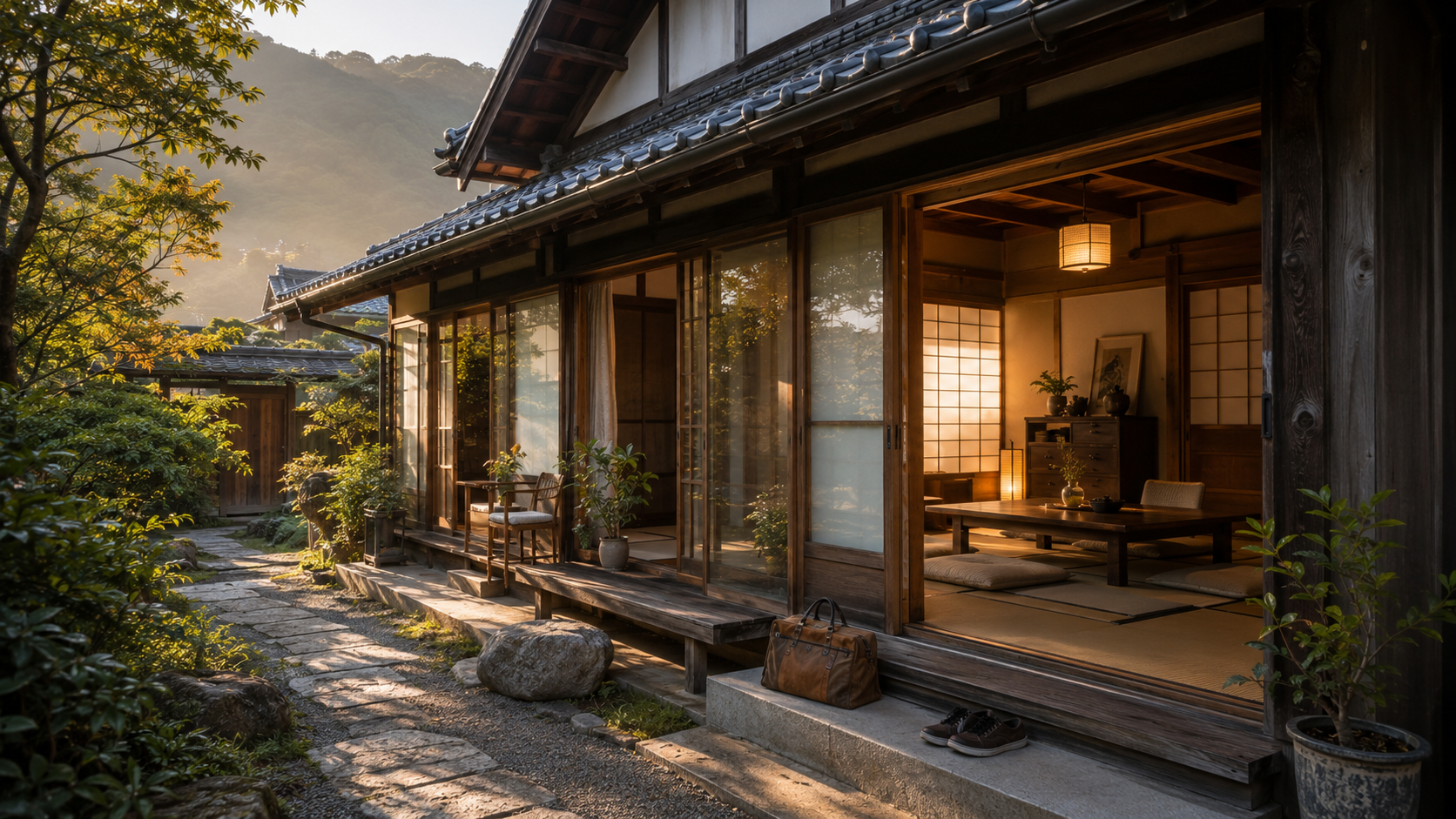
A Practical Guide to Creating Not Just “a Place to Stay,” but “a Place Where People Continue to Gather”
Across Japan, more vacant houses are being converted into guesthouses, minpaku properties, small accommodation facilities, and community spaces.
Traditional Japanese homes offer a kind of charm that modern hotels often cannot reproduce. Large wooden beams, old fittings, tatami rooms, engawa verandas, tiled roofs, earthen walls, mature gardens, and the traces of long years of daily life give these buildings a unique identity.
Carefully restoring such a property and turning it into a place where travelers can stay does more than preserve a building. It can bring new visitors into the area, create customers for nearby restaurants and shops, and provide opportunities for interaction between local residents and travelers.
However, purchasing an Akiya and giving it a beautiful interior renovation does not automatically create a successful guesthouse business.
Restoring a building and sustaining a business are two different challenges.
The real goal should not be simply to create “a house where people can stay,” but to create a living place where guests, local residents, and operators can continue to connect over time.
This article explores the regulations, building conditions, community relationships, revenue models, daily operations, and communication strategies that should be considered before converting an Akiya into a guesthouse or small accommodation facility.
1. Decide the purpose of the Akiya project first
When people begin considering Akiya renovation, they often start with interior design ideas.
“I want to expose the old beams.”
“I want to preserve the tatami room.”
“I want foreign travelers to experience Japanese culture.”
“I want to combine a kominka café with accommodation.”
These are all valuable ideas, but one important question must come first:
Who is this building being restored for, and what role should it serve?
The required design, equipment, permits, and operating model can change greatly depending on the target guest and the project’s purpose.
If the main audience is international visitors, multilingual guidance, reliable Wi-Fi, cashless payment, luggage storage, and transportation information may be essential.
If the target is domestic families, parking, child safety, bathing facilities, laundry equipment, and connections with nearby restaurants and attractions may be more important.
For long-stay guests or remote workers, desks, chairs, power outlets, quiet online meeting spaces, and a shared kitchen may be necessary.
If the goal is to create a community hub, the design should support meals, workshops, and small events where both guests and local residents can participate.
When renovation begins without a clear purpose, the result may be visually attractive but difficult to use.
The first step in Akiya regeneration is not interior design. It is defining the users and the operational purpose.
2. Minpaku, simple lodging, and ryokan operations are not the same
In everyday language, providing short-term accommodation in all or part of a residence is often called minpaku.
In practice, however, different operating formats require different permits, notifications, and legal standards.
The main options generally include:
- Minpaku under the Private Lodging Business Act
- Simple lodging under the Hotel Business Act
- Special-zone minpaku in designated areas
Under the Private Lodging Business Act, accommodation is generally limited to 180 days per year.
Simple lodging operated under the Hotel Business Act usually does not have the same annual day limit. However, the requirements for land use, fire safety, sanitation, evacuation routes, and building standards are often stricter.
Local governments may also impose additional restrictions through their own ordinances.
For this reason, researching the rules only after purchasing a property may be too late.
Before buying an Akiya, it is wise to consult:
- The local health center
- The fire department
- The municipal building control office
- The city planning department
- An administrative scrivener familiar with lodging businesses
- An architect
- A real estate professional experienced in accommodation projects
Even if an Akiya is inexpensive and attractive, it may not be legally usable as an accommodation property because of road access, zoning, evacuation requirements, or fire safety conditions.
A building that can be used as a private home is not automatically suitable for commercial accommodation.
3. A cheap Akiya may require an expensive conversion
An Akiya may be purchased for one million yen, but that does not mean a guesthouse can be opened for one million yen.
After purchase, the following problems may be discovered:
- Roof leaks
- Rotten pillars or foundations
- Termite damage
- Sloping floors
- Cracked walls
- Old electrical wiring
- Insufficient electrical capacity
- Deteriorated plumbing
- Septic tank issues
- Poor insulation
- Gaps around windows and doors
- Weak seismic resistance
- Mold and unpleasant odors
When a property is converted into accommodation, additional systems may also be required:
- Fire alarms
- Exit signs
- Fire extinguishers
- Emergency lighting
- Guest room locks
- Additional sinks and toilets
- Sufficient shower and hot-water capacity
- Soundproofing
- Clearly planned evacuation routes
Even when the purchase price is low, design, renovation, permits, fire protection, furniture, equipment, and operational preparation can greatly increase the total investment.
The important question is not simply:
“How cheaply can I buy this property?”
It is:
“How much will it cost in total to open it legally, safely, and professionally?”
4. Do not replace everything old with something new
The appeal of kominka renovation is not to remove every old feature and turn the building into a modern hotel.
Travelers who choose an old Japanese house are not looking for a standard hotel experience. They want to feel the history and character of the building.
Old beams, pillars, ranma transoms, shoji screens, fusuma panels, earthen walls, engawa verandas, gardens, and roof tiles can become key parts of the property’s identity.
However, not every old element should be preserved simply because it is old.
Areas related to safety, sanitation, durability, and comfort must be brought up to modern standards.
This includes:
- Structural reinforcement
- Electrical systems
- Plumbing
- Bathrooms and toilets
- Insulation
- Fire safety equipment
At the same time, elements that communicate the building’s story, such as beams, pillars, doors, and floorboards, should be preserved or reused wherever possible.
The ideal kominka restoration does not erase age. It preserves the old value while making the building safe and comfortable for modern use.
5. Beautiful photographs alone will not sustain occupancy
Renovated kominka guesthouses are often very attractive in photographs.
Wooden beams, tatami, shoji, gardens, and traditional lighting can draw strong interest on social media.
However, gaining attention at opening is not the same as maintaining high occupancy over time.
Guests usually evaluate factors that are not clearly visible in promotional photographs:
- Cleanliness
- Bed and futon comfort
- Bathroom usability
- Winter heating
- Summer cooling
- Pest control
- Wi-Fi quality
- Noise levels
- Staff support
- Accessibility
- Ease of check-in
Older wooden buildings may have weak insulation and soundproofing.
Even if the property looks beautiful, guests may be dissatisfied if the rooms are extremely cold in winter, conversations can be heard through the walls, or the hot-water supply is insufficient.
Social media may bring guests to the property. Basic comfort and reliable operations are what create positive reviews and repeat demand.
6. Akiya regeneration begins with trust from the neighborhood
When an Akiya becomes an accommodation facility, new people begin entering a location that may previously have been quiet.
For local residents, this can create both opportunity and concern.
Possible problems include:
- Late-night conversations
- Increased car traffic
- Incorrect parking
- Improper waste separation
- Smoking
- Entry into private areas
- Traffic issues on narrow roads
If the operator simply says, “The business is legal, so we can operate,” relationships with neighbors may quickly deteriorate.
Before opening, the operator should greet nearby residents and the neighborhood association, explain the type of facility being created, identify the person responsible, and provide an emergency contact number.
Guests should also receive clear local rules.
These may include:
- Waste disposal procedures
- Quiet hours
- Parking areas
- Smoking locations
- Restricted private areas
Guidance should be available in Japanese, English, and other languages when necessary.
Regenerating an Akiya is not only about changing a building. It means introducing new human activity into the daily life of a neighborhood.
That is why local trust is just as important as renovation work.
7. Include the local area in the guest experience
Travelers do not always travel simply to sleep in an old house.
They may be looking for local food, nature, culture, and interaction with residents.
For this reason, the guesthouse should not operate as an isolated facility.
Partnerships can be built with:
- Local restaurants
- Farmers
- Sake breweries
- Traditional craftspeople
- Hot spring facilities
- Tour guides
- Bicycle rental businesses
- Local shopping streets
Possible experiences include:
- Serving a local breakfast
- Introducing agricultural activities
- Organizing craft workshops
- Recommending neighborhood restaurants
- Holding meals where residents and guests can meet
The goal should not be to capture every yen inside the guesthouse.
It should be to create a flow in which visitors spend time and money throughout the wider community.
When that happens, local residents are more likely to see the facility not as an unwanted tourism business, but as a place that brings value to the area.
8. Do not depend only on accommodation revenue
Small guesthouses may struggle to generate sufficient profit through room fees alone.
In rural areas, occupancy can fall during weekdays, winter, the rainy season, and off-peak tourism periods.
For this reason, additional revenue sources should be considered before opening.
Examples include:
- Café operations
- Sales of local products
- Event space rental
- Workshops
- Coworking facilities
- Long-stay plans
- Rental for photography and filming
- Sales of antiques or local goods
However, launching too many services at the same time can increase operational pressure.
It is usually safer to establish the core accommodation business first and gradually add services that match the building and the operator’s capacity.
A property that can also be used when there are no overnight guests will be more sustainable.
9. Build a system that does not exhaust the operator
Running a kominka guesthouse may appear free and enjoyable from the outside.
In reality, it includes:
- Reservation management
- Answering inquiries
- Cleaning
- Laundry
- Bed preparation
- Check-in support
- Equipment problems
- Neighborhood complaints
- Social media
- Accounting
In small facilities, most of these tasks may be handled by one or two people. This can leave the operator with little time to rest.
An Akiya project does not end when construction is complete. Daily operations begin at that point.
Before opening, the following questions should be answered:
- Who will clean the property?
- Who will handle nighttime emergencies?
- Who will support guests when the main operator is away?
- Which contractors will be contacted when equipment fails?
- Who will manage the property during illness or holidays?
Smart locks and automated check-in systems are useful, but they do not solve every problem.
A guest may get lost, the lock may fail, the hot-water system may stop, or someone may become ill.
The sustainability of the facility depends not only on the durability of the building, but also on whether the operator can continue working without burnout.
10. Record the story of the building
An old Akiya has more than walls and a roof. It also has a history.
Before renovation begins, it is valuable to take photographs and videos and, where possible, speak with former owners or local residents.
Questions may include:
- When was the house built?
- Who lived there?
- What work did the family do?
- Were the beams and fittings made by local craftspeople?
- Do the garden trees have special meaning?
- What local events did the house witness?
This information is more than promotional material.
It gives guests a cultural entry point into the building and the region.
Before-and-after photographs, preserved elements, and reused materials can be introduced through a small exhibition, website, or social media series.
The value of a kominka does not come only from looking old. It comes from the time it has spent within the community.
11. On social media, show the process, not only the final result
Many properties publish only beautiful photographs after renovation.
For people interested in Akiya regeneration, however, the most engaging part is often the transformation process.
The following stages can be documented:
- The property before purchase
- Removal of abandoned belongings
- Building inspection
- Dismantling
- Preservation of reclaimed wood
- Craftwork
- Repair of floors and walls
- Meetings with local residents
- Opening preparations
This allows the audience to understand not only the final result, but also how the building was saved.
It is also valuable not to hide every difficulty.
Unexpected leaks, additional construction, budget adjustments, permit delays, and equipment problems can become useful educational content when explained honestly and professionally.
Platforms such as ANIHON AKIYA Japan can provide practical knowledge by showing both successful results and the decisions and difficulties behind them.
12. Success should not be measured only by the number of guests
The success of a guesthouse should not be measured only by annual guest numbers or revenue.
Other important outcomes include:
- Preventing an Akiya from being demolished
- Creating local employment
- Increasing customers for nearby businesses
- Bringing younger visitors into the area
- Creating interaction between residents and travelers
- Reusing old building materials
Of course, the business must generate enough income to continue.
However, its social and cultural contribution should also be recorded.
Possible indicators include:
- Number of guests
- Number of referrals to local businesses
- Event participation
- Number of local partnerships
- Quantity of reclaimed wood reused
- Amount of local spending generated
This information can help explain the property’s social value to municipalities, financial institutions, sponsors, and business partners.
Akiya regeneration is not simply about making an old building look beautiful.
It is an effort to reconnect people, the local economy, culture, and the environment.
Conclusion: Regenerating an Akiya means giving the building a new role
Turning an Akiya into a guesthouse can be a highly meaningful and exciting project.
However, simply renovating the house and listing it on booking platforms is not enough.
The regulations must be understood. The building must be safe. Trust must be built with local residents. Guests must receive a comfortable experience. The operator must be able to work sustainably.
At the same time, the history of the building and the culture of the area should be passed on to visitors and future generations.
An Akiya may be a house where nobody currently lives.
But when it is regenerated properly, people can return, conversations can begin, meals can be shared, and new memories can be created.
The real value of Akiya regeneration is not simply preserving an old building.
It is giving that building a new role in supporting the future of the community.
Do not create only “a place where people can stay.” Create “a place where people continue to gather.”
That may be one of the most important directions for the future of Akiya regeneration in Japan.