

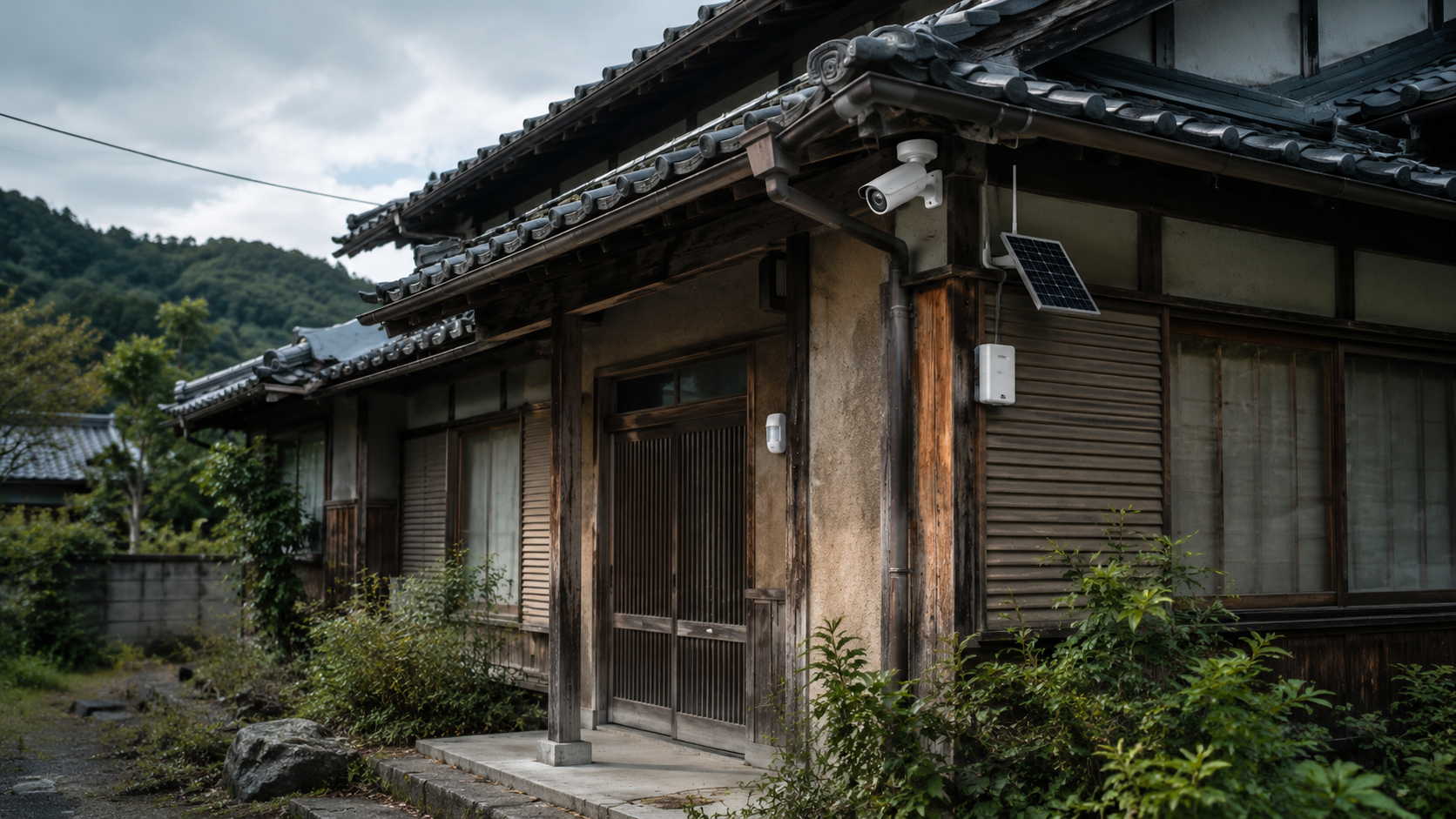
The growing number of Akiya, or vacant homes, across Japan is not simply a matter of unused property. When a house remains unoccupied for a long period, the risks extend beyond structural deterioration. Vacant homes can become vulnerable to unauthorized entry, theft, illegal dumping, arson, vandalism, overgrown vegetation, animal intrusion, water leaks, and fire.
This is especially problematic when the owner lives far away from the property. There are many situations in which someone may inherit an old house in a rural area while living in Tokyo, another prefecture, or even overseas. Some owners may only be able to visit the property a few times per year.
In those cases, it becomes difficult to know whether anyone has entered the property, garbage has been dumped on the land, a window has been broken, a fire or smoke incident has occurred, a typhoon has damaged the roof, or there is a water leak inside the building.
This is where a new concept becomes important: a smart Akiya monitoring system that combines security cameras, AI, IoT sensors, cloud connectivity, and remote alerts.
1. Why Do Vacant Homes Face Higher Security Risks?
A home that is actively occupied shows visible signs of daily life. Lights turn on and off, cars come and go, mail is collected, gardens are maintained, and windows are opened and closed. These everyday signs of occupation naturally create a certain level of deterrence.
An Akiya, however, gradually loses those signs. Mail begins to accumulate, weeds grow, shutters remain closed for months, and the garden becomes neglected. From the outside, it becomes easy to recognize that nobody is regularly present. This can make the property more vulnerable to unauthorized entry, theft, vandalism, illegal parking, and illegal dumping.
Illegal dumping can be especially serious. Once a small amount of waste is left on a property and remains there for a long time, others may assume that dumping is tolerated. Over time, a small problem can develop into a large one.
This is why effective Akiya management should not focus only on responding after something happens. The goal should be to detect abnormal activity as early as possible.
2. What Can Security Cameras Do for Akiya Management?
The most obvious solution is to install a security camera. However, a traditional camera that only records footage may not be enough. Conventional systems are often used after an incident has already occurred. For example, after discovering a broken window, the owner may review several hours of recorded video to see what happened.
Modern smart cameras can work differently. They can detect movement, people, and vehicles and send alerts directly to the owner’s smartphone. Imagine that nobody is normally expected at the property after midnight. At 2:00 a.m., a person enters the property. The camera detects the movement and immediately sends a notification.
The owner can then open the live feed from a smartphone and check the situation. If necessary, the owner can contact a property manager, security company, trusted local contact, or another appropriate service.
In this way, the camera becomes more than a recording device. It becomes an abnormal-event detection sensor.
3. The Key Is Not Recording Everything, but Detecting Abnormal Activity
No owner can realistically watch camera footage 24 hours a day. That is why AI-based event detection becomes important. A smart monitoring system may be able to distinguish between:
- People
- Vehicles
- Animals
- Packages
- Vehicles that remain parked for an unusually long time
- Entry into a restricted area
This distinction matters. If the system sends the same alert every time a cat crosses the garden and every time a person approaches the front door at midnight, the owner will receive too many notifications. Eventually, important alerts may be ignored.
An Akiya-specific system should therefore focus on unusual behavior, such as:
- A person entering the property late at night
- Someone approaching a window
- A person remaining inside the property for an unusually long period
- A truck unloading objects onto the land
The goal is not to watch everything constantly. It is to identify events that are different from normal patterns.
4. Security Cameras as a Tool Against Illegal Dumping
Illegal dumping is one of the most serious problems associated with vacant land and unoccupied properties. A security camera can provide two important benefits: deterrence and detection.
If people can clearly see that the property is monitored, they may be less likely to dump waste there. With AI-based analysis, a future system could also potentially recognize suspicious activities such as:
- A person leaving garbage bags behind
- A vehicle unloading a large object
- Someone placing an item inside the property and leaving
The system could then save an image, time, and event record and send a notification to the owner. Instead of discovering a large pile of waste several months later, the owner may be able to identify the incident on the same day. This could significantly improve Akiya management.
5. Cameras Alone Are Not Enough
A smart Akiya monitoring system should not rely only on cameras. Different sensors can detect problems that cameras cannot see.
- Door and window sensors: Detect unauthorized opening.
- Temperature and humidity sensors: Monitor indoor environmental conditions.
- Water leak sensors: Identify leaks under floors or near pipes.
- Smoke and fire sensors: Detect potential fire risks.
- Motion sensors: Monitor gardens and entrances.
- Vibration sensors: Detect unusual activity around gates or doors.
This creates a much more complete monitoring system. A camera outside the house cannot detect a pipe leaking under the floor, but a leak sensor can. A camera may not detect rapidly increasing humidity inside a closed room, but a humidity sensor can.
This is why combining multiple IoT devices is more effective than relying on video alone.
6. Fire Monitoring Is Also Extremely Important
When people think about Akiya security, crime prevention often comes first. However, fire is another major risk. Old homes may still contain aging electrical wiring, unauthorized visitors may enter the property and use fire or smoking materials, and dry weeds, abandoned belongings, and combustible materials may increase the risk.
A smart Akiya system should therefore consider fire monitoring alongside security monitoring. Possible sensors include:
- Smoke detection
- Rapid temperature increase detection
- Heat detection
- Fire alarms
If indoor temperature suddenly rises or smoke is detected, the owner could receive an immediate alert. Early notification may reduce the risk of a small incident becoming a major fire.
7. What If the Akiya Has No Electricity or Internet Connection?
This is one of the biggest practical challenges. Many long-term vacant homes no longer have active electricity or fixed internet contracts, making standard home security equipment difficult to use.
One possible solution is an independent system using:
- Solar panels
- Battery storage
- LTE or 5G mobile communication
- Low-power cameras
- IoT sensors
Such a system could operate without a fixed broadband connection. If designed efficiently, it could also reduce dependence on grid electricity. This may be particularly useful for rural Akiya properties where infrastructure is limited.
A standalone system could therefore be designed around the following concept:
Solar Panel + Battery + Mobile Communication + Security Camera + IoT Sensors
This combination could make smart monitoring possible even in remote areas.
8. Combine IoT Monitoring with Periodic Physical Inspections
Smart technology does not eliminate the need for human inspection. A camera cannot check every part of a roof, and sensors cannot always detect blocked drainage systems, odors, termite damage, overgrown plants, damaged fences, or structural deformation.
The most realistic solution may therefore be:
Remote Monitoring + Periodic On-Site Inspection
The property can be monitored continuously through sensors, while a property manager or local service provider performs a physical inspection once every month or every two months. If the system detects an abnormal event, an additional inspection can be arranged.
This reduces the need for unnecessary frequent visits while still maintaining physical oversight. For owners living far away, this combination can be very effective.
9. Smart Monitoring Could Also Help Local Governments
This type of system may also have value for municipalities. Local governments are increasingly responsible for dealing with dangerous, poorly maintained, or difficult-to-contact vacant properties.
A municipal dashboard could potentially show simple property statuses such as:
- Normal
- Inspection required
- Unauthorized entry detected
- Possible illegal dumping
- Fire alert
- Water leak alert
If a municipality manages or monitors many vacant properties, it would not need to inspect every property every day. Instead, it could prioritize properties where abnormal events are detected.
This is one example of how Akiya management could become more digital and data-driven.
10. Integration with Akiya Banks
Smart monitoring could also improve the value of properties listed in Akiya Bank systems. For example, a property could maintain records such as:
- Date of last inspection
- Temperature and humidity history
- Water leak alerts
- Unauthorized entry alerts
- Maintenance activity
- Regular inspection history
This information could provide reassurance to potential buyers. It is similar to a maintenance record for a used vehicle. A buyer may feel more confident about a property that has been continuously monitored and maintained.
In the future, the question may no longer be only, “How old is this house?” It may also become, “How well has this property been managed while vacant?”
That could affect the perceived value of an Akiya property.
11. Privacy Must Be Taken Seriously
Security cameras offer major advantages, but installation must be handled carefully. If a camera unnecessarily records neighboring homes, windows, entrances, gardens, or public spaces, it may create privacy concerns.
A smart Akiya camera should therefore be positioned primarily toward the owner’s property. Good design principles include:
- Avoid recording neighboring windows.
- Avoid unnecessary monitoring of public roads.
- Limit access to video data.
- Avoid storing footage longer than necessary.
- Clearly indicate when security monitoring is in operation where appropriate.
Facial recognition should be treated with even greater caution. In many cases, an Akiya monitoring system does not need to identify who a person is. It may be sufficient to know that a person entered the property.
This supports the principle of collecting only the minimum amount of personal information necessary.
12. AI Should Detect Abnormal Events, Not Decide Who Is a Criminal
This distinction is very important. An AI system cannot always know whether someone on camera is a suspicious intruder, a family member, a delivery worker, a neighbor, or a maintenance worker.
For this reason, the system should not automatically label people as criminals. Its role should simply be to report:
“An unusual event has been detected.”
A human should make the final judgment. This approach is safer, more practical, and more respectful of privacy.
13. Create a Digital “Akiya Management History”
Another interesting possibility is to turn monitoring data into a property management history. For example:
- April 12, 2027: Routine inspection completed
- May 3, 2027: Strong wind alert, property checked
- June 18, 2027: Garden maintenance completed
- July 2, 2027: Water sensor alert, no major issue found
- August 14, 2027: Entry detected, owner verified event
When the property is later sold, the owner could show that the house was not simply abandoned. Instead, it was actively monitored and maintained.
This could change the way some vacant properties are evaluated. A buyer may be more willing to trust a property with several years of documented management history.
14. A New Business Model for Akiya Management
As the number of Akiya properties grows in Japan, the market for vacant-home management services may also expand. A possible business model could include:
- Initial equipment installation fee
- Monthly monitoring subscription
- Periodic inspection fee
The monthly service could include:
- AI camera monitoring
- IoT sensor monitoring
- Smartphone alerts
- Cloud records
- Monthly condition reports
Additional services could then be offered when necessary:
- Grass cutting
- Cleaning
- Removal of abandoned belongings
- Minor repairs
- Renovation consultation
- Property sale consultation
- Rental consultation
- Demolition estimates
This would allow owners to manage multiple Akiya-related needs through one service.
15. A Possible Future Model for ANIHON AKIYA Japan
A smart monitoring system could also be integrated into a platform such as ANIHON AKIYA Japan. Each property could have an AKIYA SECURITY STATUS.
The property page could display information such as:
- Management condition
- Date of last inspection
- Unauthorized entry alerts
- Temperature and humidity
- Water leak alerts
- Fire alerts
- Photo history
- Repair history
An owner living in Tokyo or overseas could check the property from a smartphone. Property management companies could monitor multiple homes from one dashboard, while relevant information could also be shared with municipalities when appropriate.
If the property is later sold, part of the management history could potentially be shown to prospective buyers.
In the future, this could connect:
- Akiya Bank
- Real estate sales
- Demolition
- Renovation
- Security
- IoT management
- Municipal cooperation
All of these services could eventually operate within one integrated ecosystem.
Conclusion: Turning Akiya from “Abandoned Houses” into “Remotely Managed Assets”
Traditional Akiya management has relied heavily on physical inspections. Owners or property managers travel to the property, check the building, and then leave. However, as vacant homes increase across Japan and more owners live far away, this approach alone may become difficult to sustain.
The future may require a combination of:
- Security cameras
- IoT sensors
- AI
- Cloud systems
- Smartphone alerts
- Periodic human inspections
The goal is not to monitor everything. The goal is to detect the abnormalities that actually matter, notify the owner quickly, and send a person when necessary.
An Akiya is not a building that needs no management simply because nobody lives there. In many cases, it needs better management precisely because nobody lives there.
If smart monitoring can continuously record the condition of a property, an Akiya may eventually move from being seen as “an abandoned vacant house” to “a remotely managed real estate asset prepared for future reuse.”
Selling, renting, renovating, and demolishing are not the only solutions to Japan’s Akiya problem. There is another important option: protect the property safely until its next use is decided.
That may become an increasingly important part of the future of Akiya management in Japan.