
When people think of Japan, many imagine orderly cities, clean streets, safe neighborhoods, and beautiful traditional wooden houses. However, behind this calm and well-organized image, Japan is facing a serious and growing issue. That issue is akiya, or vacant houses.
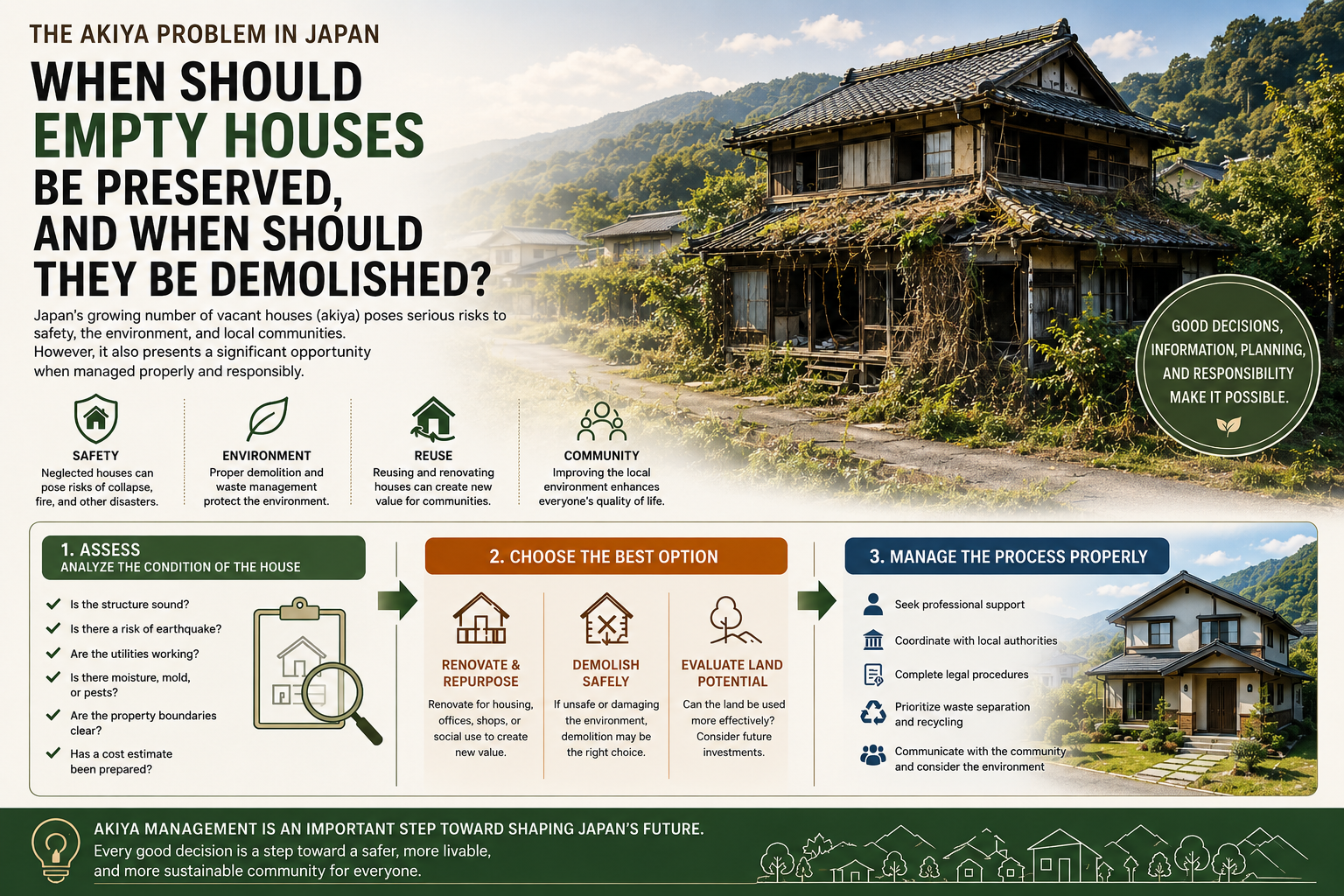
The akiya problem is not simply about finding “cheap houses in Japan.” It is closely connected to population decline, aging society, inheritance issues, rural depopulation, urban planning, disaster prevention, environmental responsibility, construction costs, and the future of local communities.
According to Japan’s 2023 Housing and Land Survey by the Statistics Bureau of Japan, the number of vacant houses nationwide has reached approximately 9 million, and the vacancy rate has risen to 13.8%, the highest level ever recorded. In addition, the number of more problematic vacant houses, excluding rental properties, properties for sale, and secondary residences, has reached approximately 3.85 million. These figures show that the akiya issue is no longer a small rural problem. It has become a structural challenge affecting Japan’s real estate market, local safety, living environments, and the future of urban and regional development.
What Is an Akiya?
The Japanese word “akiya” literally means an empty house. However, in practice, the meaning is broader. Even if a property has an owner, is registered, or has heirs, it can become part of the akiya problem if it remains unused for a long period, is not properly maintained, and is not connected to economic or community activity. Some akiya properties are still in relatively good condition. With limited renovation, they may be reused as homes, guesthouses, cafés, studios, community spaces, or tourist accommodations.
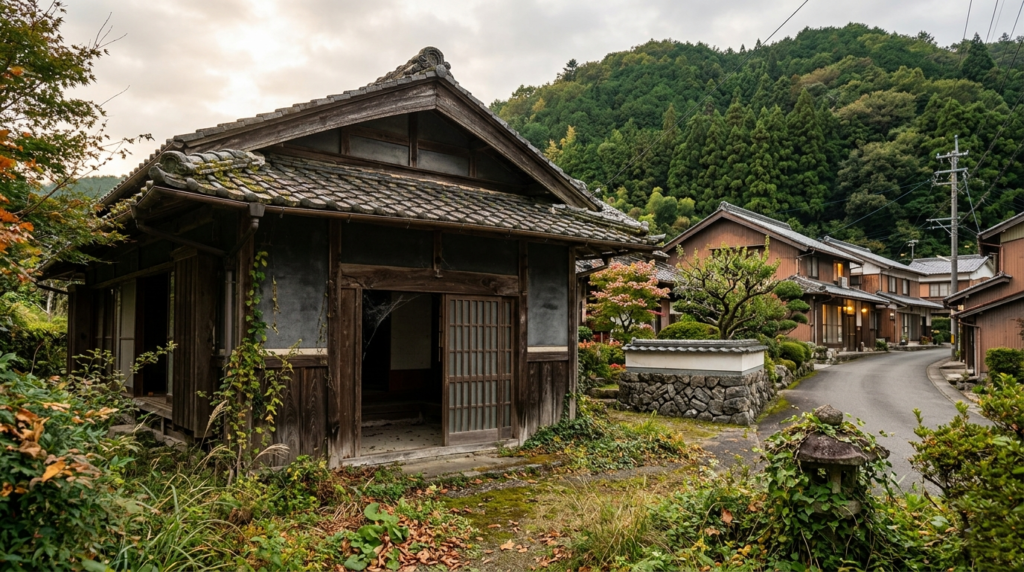
On the other hand, some vacant houses have damaged roofs, rotten wooden structures, old belongings left inside for years, mold, pests, animal damage, and serious risks for nearby residents. At this point, an important question arises:
Should this house be preserved?
Should it be renovated?
Should it be sold?
Or should it be safely demolished?
Why Are Vacant Houses Increasing in Japan?
There is no single reason why vacant houses are increasing in Japan. The issue is the result of several overlapping social and economic factors.
The first reason is population decline and aging. In many rural areas, younger generations move to large cities, while family homes are left behind after elderly parents pass away. The children may already be living in Tokyo, Osaka, Nagoya, Fukuoka, or other urban areas and may not wish to return to their hometown.
The second reason is complicated inheritance. One property may be inherited by several family members. One heir may want to sell, another may want to keep it, and another may not want to bear any costs. In some cases, the legal owner or heirs cannot be clearly identified. As a result, the house may remain untouched for years.
The third reason is demolition cost. Demolishing an old house in Japan can be expensive. Costs vary depending on whether the building is wooden, reinforced concrete, steel-framed, located on a narrow road, contains asbestos, or generates large amounts of construction waste.
The fourth reason is taxation and land-use concerns. Some owners hesitate to demolish an old house because removing the building may increase the property tax burden on the land. For this reason, even buildings that should be removed may be left standing for a long time.
The fifth reason is emotional attachment. In Japan, family homes, ancestral houses, childhood memories, and family history carry strong emotional meaning. Even when nobody lives in the house, some families find it difficult to sell or demolish it.
Not Every Akiya Is in Bad Condition
When discussing akiya, it is important to be careful. Not every vacant house is a dangerous building. Some vacant homes are in good locations, have solid structures, and hold strong potential. Traditional Japanese houses, kominka homes, rural properties with large gardens, and old houses near tourist areas can create new value when properly planned and managed.
A vacant house may be reused in many ways:
As a residential home.
As a base for rural living or dual-location living.
As a café, restaurant, or small shop.
As a guesthouse or minpaku accommodation.
As an art studio, gallery, or cultural space.
As a workspace for remote workers.
As a community exchange center.
As a temporary support space during disasters.
As a local support facility for elderly residents or foreign residents.
Therefore, the first question in akiya management should not be “Should we demolish it?” The first step should be to understand the true condition of the building.
First Checkpoint for an Akiya: Is the Building Safe?
Before buying, renting, renovating, or demolishing a vacant house, the physical condition of the building must be inspected.
The following points are especially important:
Are there cracks in the foundation?
Are the columns, beams, or structural wooden parts rotten?
Is the roof leaking?
Is the floor slanted?
Do the doors and windows open and close properly?
Does the house meet earthquake-resistance requirements?
Is there mold, moisture, pest damage, or animal damage inside?
Is the electrical system safe?
Are the water and drainage systems usable?
Is there a risk of asbestos, lead paint, or other hazardous materials?
Are the land boundaries clear?
Does the property have proper road access?
Are there legal issues with neighboring land?
A house may look beautiful from the outside but have serious structural problems inside. On the other hand, some houses may look old but still have strong foundations and good-quality timber, making them suitable for restoration.
The biggest mistake in akiya investment is judging a property only by its price.
A Cheap Akiya Is Not Always Cheap
In Japan, some vacant houses are listed at very low prices. In some regions, properties are even introduced at almost no cost. This can look very attractive to foreign investors and people who dream of living in Japan.
However, the true cost is not only the purchase price.
The total cost of an akiya may include:
Purchase price.
Registration and ownership transfer fees.
Real estate agent commission.
Taxes.
Removal of old belongings.
Garbage and waste disposal.
Cleaning and disinfection.
Repair or reconnection of electricity, water, and gas.
Roof repairs.
Earthquake reinforcement.
Thermal insulation work.
Bathroom, kitchen, and toilet renovation.
Land boundary confirmation.
Parking or road access improvements.
Demolition costs, if demolition is necessary.
Waste separation and recycling costs.
For this reason, a house that appears to cost 1 million yen may eventually require 10 million yen or more. In some cases, cleaning, repair, renovation, or demolition costs may be much higher than the purchase price itself.
When Does Renovation Make Sense?
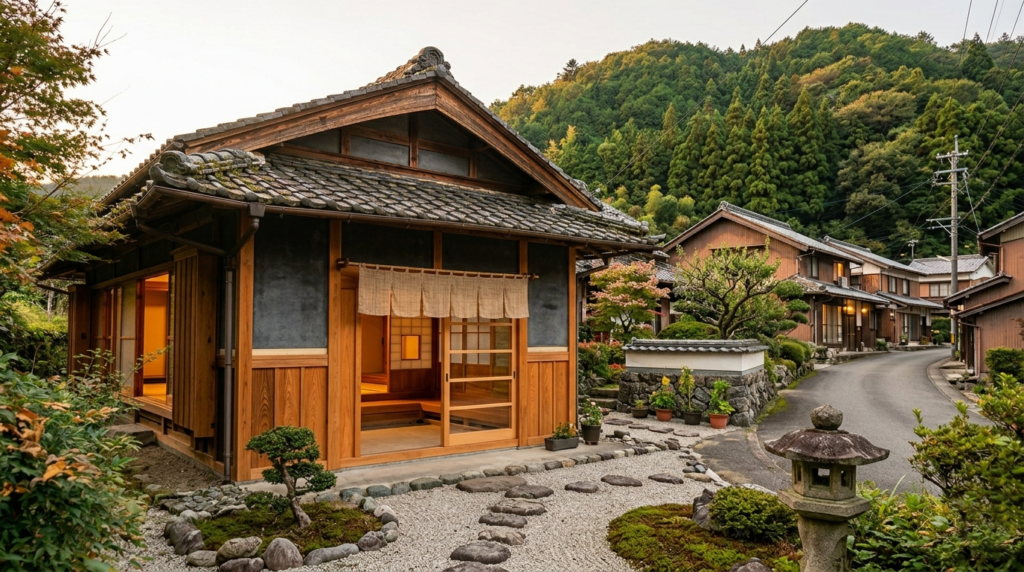
Renovating an akiya can become a valuable project when the right conditions are met. If the location, building quality, and purpose of use are appropriate, renovation can have economic, cultural, and environmental value.
Renovation may make sense when:
The house is located in a tourist area or an area with future potential.
The main structural parts are not seriously damaged.
The roof and foundation are not completely deteriorated.
Earthquake reinforcement costs are realistic.
Land boundaries and ownership rights are clear.
Local government subsidies or support programs are available.
The building has traditional or cultural value.
The future purpose of the property is clearly defined.For example, an old kominka house may be transformed into a boutique accommodation or café with the right design and professional support. A rural house with a large garden may become a base for agricultural tourism, nature experiences, or countryside living. An older house near an urban area may be reused as a small office or shared workspace.
However, although renovation may sound attractive, it can become a costly mistake if started without proper investigation and financial planning.
When Is Demolition the Better Choice?
Not every vacant house can or should be restored. If a building has become highly dangerous, its structural parts are severely damaged, the risk of fire or earthquake collapse is high, it negatively affects the surrounding environment, or renovation costs are no longer realistic, demolition should be considered.
Demolition may be the better option when:
The roof has collapsed or is seriously damaged.
Wooden columns or beams are rotten.
The building is leaning.
There is a high risk of collapse during an earthquake.
There is a risk of damaging neighboring houses or pedestrians.
There is a large amount of garbage, mold, pests, or animal damage inside.
There is a high risk of asbestos or hazardous materials.
Renovation costs are close to, or higher than, the cost of building new.
The land could be used more effectively for another purpose.
The local government has identified the building as dangerous.
Deciding to demolish a house can be emotionally difficult for owners. However, in some cases, demolition is the most responsible decision for protecting the safety of the neighborhood and the environment.
How Vacant Houses Affect Local Communities
The akiya issue is not only a problem for property owners. Poorly maintained vacant houses can affect the entire neighborhood.
A neglected vacant house may create risks such as:
Collapse during earthquakes or typhoons.
Fire hazards.
Overgrown weeds.
Pests and rodents.
Bad odors.
Illegal dumping.
Dangerous spaces for children.
Water leakage and mold problems.
Deterioration of the local landscape.
Negative impact on surrounding property values.
Decline in community vitality.
Japan is a country with earthquakes, typhoons, heavy rain, and high humidity. For this reason, unmanaged old buildings can become serious risks over time.
Akiya is not only a private property issue. It is also a social issue connected to community safety, landscape quality, and living conditions.
Environmental Responsibility and Waste Management During Demolition
Demolishing a building does not simply mean removing the structure. Demolition produces many types of waste, including wood, concrete, metal, glass, plastic, roof tiles, plasterboard, insulation materials, furniture, appliances, and sometimes hazardous substances.
In Japan, proper separation, transportation, and disposal of demolition waste are important. If this process is not managed correctly, it may lead to environmental pollution, legal risks, and additional costs.
Special attention should be paid to materials such as:
Wood.
Concrete and rubble.
Metals.
Roof tiles and ceramics.
Glass.
Plastic and vinyl materials.
Old furniture.
Home appliances.
Building materials that may contain asbestos.
Paint, chemicals, oil, or other residues.
For this reason, when demolition is necessary, choosing only the cheapest contractor is not enough. It is important to check the contractor’s permits, insurance, experience, safety procedures, and waste management methods.
Decision Steps for Akiya Owners
If you own a vacant house or are considering buying one in Japan, the following decision process may help:
First, check the property registration and ownership status.
If there are heirs or co-owners, confirm everyone’s intentions.
Check land boundaries and road access.
Ask the local government about local regulations and restrictions.
Request a professional building inspection.
Review earthquake resistance, roof, foundation, moisture, and utility conditions.
Estimate both renovation and demolition costs.
Decide the future purpose of the property.
Research local subsidies and support programs.
Communicate carefully with neighbors.
Consider environmental impact and waste disposal.
Make a decision based on total risk, not only price.
Following this process can help owners and investors avoid major mistakes.
Important Points for Foreign Investors
In recent years, Japanese akiya properties have attracted attention from foreign buyers. The weak yen, relatively low property prices, interest in Japanese culture, and the dream of countryside living have all increased interest.
However, foreign investors should be especially careful.
Buying real estate in Japan does not automatically grant a visa or residence status.
Cheap properties are often located far from major cities.
English-speaking professionals may not be available in every region.
Building good relationships with the local community is important.
Renovation may require Japanese contracts and technical documents.
Earthquake standards are especially important for old houses.
In rural areas, access to transportation, hospitals, schools, and shops may be limited.
In snowy regions, roof maintenance and snow removal costs can be high.
Internet and infrastructure quality may differ depending on the region.
Buying an akiya can be a major opportunity. However, without sufficient research and support from local experts, it can also become a risky investment.
Akiya and the Role of Local Governments
Many local governments in Japan are working on various measures to deal with vacant houses. Akiya banks, relocation support, renovation subsidies, support for families with children, and rural revitalization programs are some examples.
However, the scale of the akiya problem is large, and it is difficult for local governments to solve it alone. Real estate companies, construction companies, demolition contractors, local residents, investors, and technology companies need to work together.
In the future, digital technology is expected to play a larger role in akiya management.
Possible approaches include:
Digitalizing vacant house information.
Recording building conditions with photos and reports.
Map-based risk analysis.
Organizing ownership and inheritance information.
Comparing renovation and demolition costs.
Managing waste and recycling processes.
Improving communication between local governments, owners, and specialists.
Building regional data on vacant house usage and risks.
With these systems, Japan’s akiya problem can be addressed in a more planned, transparent, and practical way.
Vacant Houses Are Both a Problem and an Opportunity
The akiya issue should not be seen only as a negative problem. It is true that neglected vacant houses create many risks. However, when properly managed, they can also become a major opportunity for Japan.
By using vacant houses effectively, Japan may achieve:
Revitalization of rural communities.
Low-cost spaces for young entrepreneurs.
Greater interest from foreign investors in regional Japan.
Preservation of traditional architecture.
Diversification of tourism.
New community spaces for elderly residents and local people.
Reutilization of vacant land.
Improved safety through removal of dangerous buildings.
Greater awareness of waste and environmental management.
The most important point is not simply that “there are vacant houses.” The real challenge is to decide the best future for each property.
Should it be preserved?
Should it be repaired?
Should it be sold?
Should it be rented?
Should it be converted for another use?
Or should it be safely demolished?
This decision is at the center of effective akiya management.
What Should the Future of Akiya Management Look Like?
The future of akiya management in Japan should be more transparent, data-driven, and environmentally responsible.
For a vacant house, it is not enough to simply say “sell,” “rent,” or “demolish.” The technical condition, legal status, environmental impact, community impact, reuse potential, and cost must be considered together.
An ideal future akiya management system should be able to answer questions such as:
Is this building safe?
Can this building be restored?
If restored, can it create economic value?
If demolished, how will the waste be separated and treated?
Can the land be used for a better purpose?
How will nearby residents be affected?
What kind of support can the local government provide?
What is the lowest-risk option for the owner?
How can the local economy benefit?
A system that can answer these questions would transform the akiya issue from a simple real estate problem into an important theme of community development, regional revitalization, and environmental policy.
Conclusion: The Most Important Thing for Akiya Is Making Decisions Based on Reliable Information
Japan’s akiya problem will likely remain an important social issue in the coming years. The 2023 statistics clearly show that the number of vacant houses has reached a record high.
However, this situation is not hopeless.
Every vacant house has its own history and potential. Some can become homes again. Some can become places for new families. Some can become bases for tourism, culture, entrepreneurship, or community exchange. Others, however, may already be unsafe and should be demolished for the protection of the community.
The important thing is not to decide based only on emotions or price. Decisions should be made by considering building inspections, cost analysis, legal checks, environmental responsibility, and the impact on the local community.
The akiya issue is an important theme standing between Japan’s past and future. Old houses should not be seen only as abandoned buildings. With proper management, they can become assets that create new value.
Some houses should be preserved.
Some houses should be restored.
Some houses should be reused.
And some houses should be safely demolished.
The future of Japan’s local communities and regional cities depends on how wisely these decisions are made.
Proper akiya management is an important step toward creating a safer, more livable, and more sustainable future for Japan.