

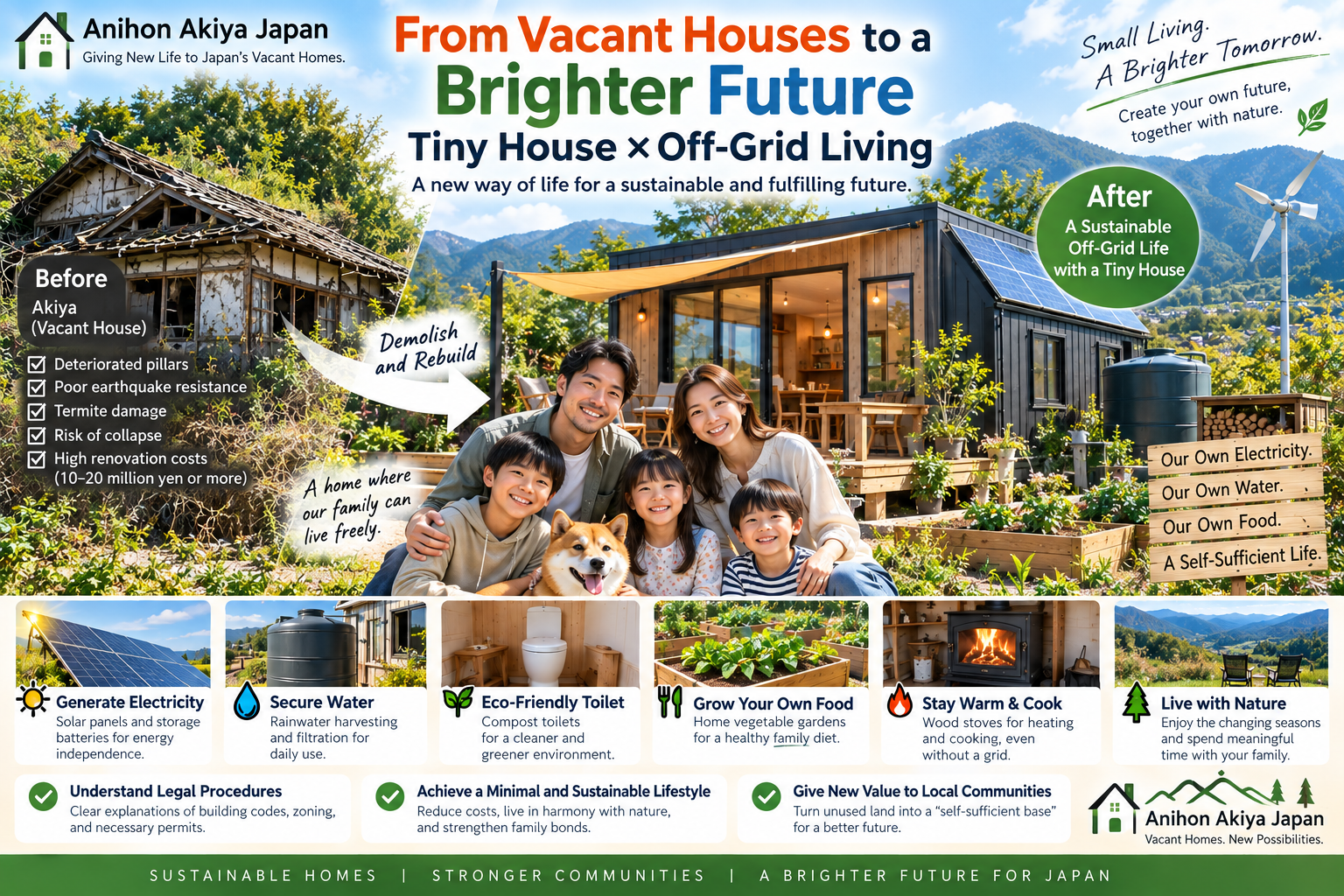
In rural and suburban areas of Japan, dealing with long-abandoned vacant houses (Akiya) has become a major challenge. When a property has severe issues such as rotting pillars, insufficient seismic resistance, or termite damage, a full renovation can easily incur massive costs, often exceeding 10 to 20 million yen.
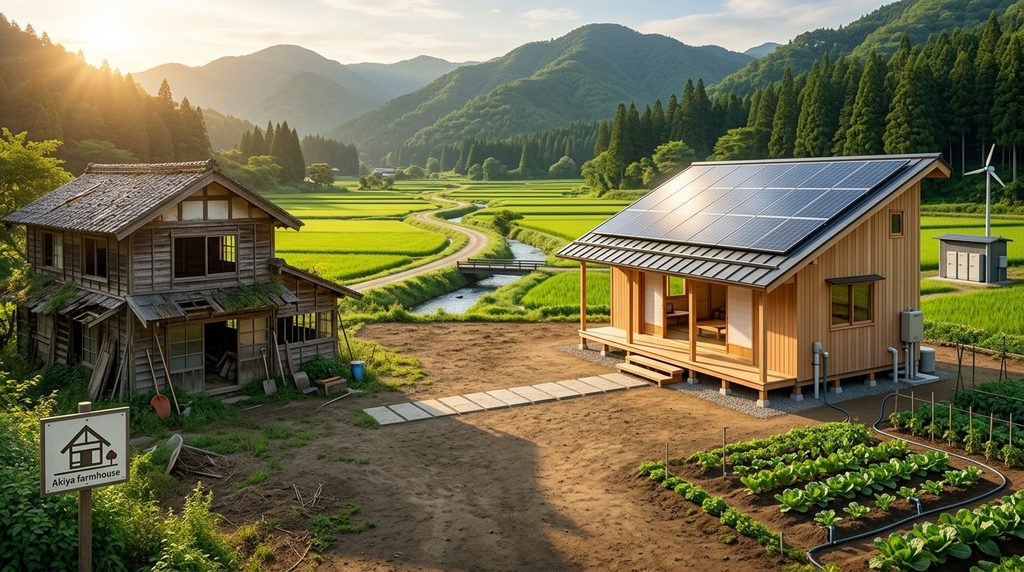
This is where a new alternative is gaining attention: boldly demolishing the unrepairable Akiya and using the cleared land to build a Tiny House or set up an Off-Grid (independent from public infrastructure) living space.
This article provides a detailed explanation of concrete ideas, equipment setups, and the “legal and regulatory hurdles” you must overcome to start a minimalist, sustainable off-grid life on the site of a dilapidated Akiya.
1. Why “Demolition + Tiny House” Instead of “Large-Scale Renovation”?
When faced with a dilapidated traditional or Showa-era Akiya, many people struggle to choose between “repairing it to live in” or “giving up on it.” However, the “demolition + innovative utilization” approach offers clear advantages:
- Controlling Costs and Transparency: In renovating old Japanese houses, unexpected reinforcement work (such as re-laying the foundation or replacing pillars) often emerges only after dismantling begins, risking budget blowouts that multiply initial estimates. By demolishing the structure and clearing the land, subsequent construction and equipment costs become clearly calculable.
- Minimizing Maintenance: Huge traditional Japanese houses are difficult to maintain in terms of cleaning, weeding, and winter heating efficiency (insulation). A tiny house with just the minimum necessary space dramatically reduces the effort and cost of upkeep.
- Disaster Resilience and Independence: In the event of natural disasters like earthquakes or typhoons, having an off-grid environment that does not rely on public infrastructure (the grid) such as power lines or water pipes holds tremendous value as a disaster prevention base and evacuation shelter.
2. Technologies and Ideas for Creating an Off-Grid Space
Technologies for living comfortably without relying on existing public infrastructure (electricity, water, gas) have advanced rapidly in recent years. Here are the main off-grid systems you can establish on a cleared Akiya plot:
① Electricity: Solar Power + Battery System
- Self-consumption Solar Panels: Generating power via roof-mounted or ground-mounted panels.
- Portable Power Stations / LiFePO4 Batteries: Storing daytime electricity for nighttime use. It is entirely possible to cover the power needs for daily life, such as air conditioning, refrigerators, and PCs.
② Water & Sanitation: Rainwater Harvesting + Wells + Circulation Systems
- Rainwater Collection & Filtration Systems: Storing rainwater from the roof in tanks and passing it through high-precision filters and UV sterilization for miscellaneous uses (laundry, toilet, shower).
- Re-drilling and Utilizing Wells: Old Akiya plots often have existing wells left behind. By conducting water quality tests and running a pump with solar power, it becomes a valuable water source.
- Bio-toilets / Composting Toilets: Toilets that use microorganisms to break down human waste without using water. This eliminates the need for sewage or septic tank (Johkaso) installation work, leading to significant cost reductions.
③ Heating & Cooking: Wood Stoves + Propane Gas
- Wood Stoves / Rocket Stoves: Using standing trees on the property or locally thinned wood as fuel ensures a heat source for winter heating and cooking.
- Off-grid Propane: For emergencies, combining this setup with individually deliverable propane gas cylinders is a safe backup.
3. Crucial! The “Legal and Regulatory” Hurdles You Must Know
The biggest obstacle to realizing this groundbreaking lifestyle is Japan’s building and land-related laws. Neglecting prior research risks resulting in illegal construction or facing unexpected fines and tax hikes.
① The Wall of the Building Standards Act (Kenchiku Kijun-ho)
When placing a tiny house, whether it qualifies as a “building” is a major turning point.
- For “Fixed Tiny Houses”: If you lay a foundation and fix the structure to the ground, it is considered a “building,” regardless of its small size.
- Building Confirmation (Kakunin Shinsei): Unless it is an extension of 10 square meters or less outside of fire prevention or quasi-fire prevention zones, an application for building confirmation is generally required.
- Road Access Requirement (Setsudo Gimu): As a rule, you cannot build a new structure unless the plot has at least 2 meters of frontage touching a road that is 4 meters or wider (the trap of non-rebuildable properties).
- For “Mobile (Trailer Houses)”: If it has tires and maintains a state where it “can be moved at any time and arbitrarily,” it may be treated as a “vehicle” rather than a building. This could potentially help avoid the Building Standards Act’s road access requirements. However, since the criteria for “ready mobility” are strictly defined by each municipality (designated administrative agency), prior consultation before installation is mandatory.
② The Agricultural Land Act (Nochi-ho) and City Planning Act
Many vacant houses in rural areas are “Akiya with farmland (Nochi-tsuki Akiya).”
- If the land acquired with the Akiya is “farmland (paddy or field),” you must complete the “Farmland Conversion (Nochi Ten’yo)” procedure (Articles 4 and 5 of the Agricultural Land Act) to demolish the house and place a tiny house, obtaining permission from the Agricultural Commission and the prefectural governor.
- In areas designated as “Urbanization Control Areas,” the construction of new buildings is generally strictly restricted, making prior investigation essential.
③ Skyrocketing Property Taxes (Exclusion from Special Provision for Residential Land)
The most significant financial issue to consider when demolishing an Akiya is the increase in Fixed Asset Tax (Kotei Shisan Zei).
- Land with a house where people live is subject to a “Special Provision for Residential Land,” which reduces the property tax on the land to a maximum of one-sixth.
- If you demolish the Akiya and turn it into a vacant lot, this exemption no longer applies, and the land’s property tax for the following year can effectively multiply (up to 6 times).
- *Note: Simply placing a “vehicle-treated” structure like a trailer house may not qualify the land as residential. Therefore, you must estimate the increased property tax as part of your annual maintenance costs.
4. Steps to Success: How Should You Proceed?
- Prior Consultation at the Municipal Office (City Planning Dept., Building Guidance Dept., Agricultural Commission): Before purchasing or demolishing a property, you must confirm “what size structure can be built after demolition,” “whether the road access situation is acceptable,” and “what the installation standards are for trailer houses” on the target land.
- Calculating Demolition and Infrastructure Removal Costs: Get an estimate for demolishing the Akiya while also arranging for the safe processing (shut-off procedures) of old electrical connections and gas pipes.
- A Phased Approach (Starting with a Dual-Life): Rather than aiming for full permanent relocation right away, a realistic and low-risk method is to build an off-grid environment as a “weekend camping base” or a “base for a dual life,” gradually upgrading the facilities over time.
Conclusion
A dilapidated Akiya that is beyond repair might seem like a burdensome “negative asset” (Fudosan) at first glance. However, by shifting your perspective, it can be reborn into a “valuable, low-cost private space for a self-sufficient lifestyle.”
By correctly understanding rules such as the Building Standards Act and tax systems, and combining them with the latest off-grid technologies and tiny houses, why not embrace a new, eco-friendly, and highly flexible way of living?