
From Aichi Prefecture to All of Japan: The ANIHON Akiya Japan Vacant Home Revitalization Project
Across Japan, the number of vacant and unused homes continues to grow.
Some properties have remained unoccupied for many years. Others have been inherited by family members who live far away and are unable to maintain them. Many have overgrown gardens, aging structures, or furniture and unwanted belongings left inside.
For property owners and their families, these vacant houses—known in Japan as akiya (空き家)—can become a significant responsibility.
At ANIHON Akiya Japan, we believe there is another possibility.
“Every unused home deserves a second chance and a new future.”
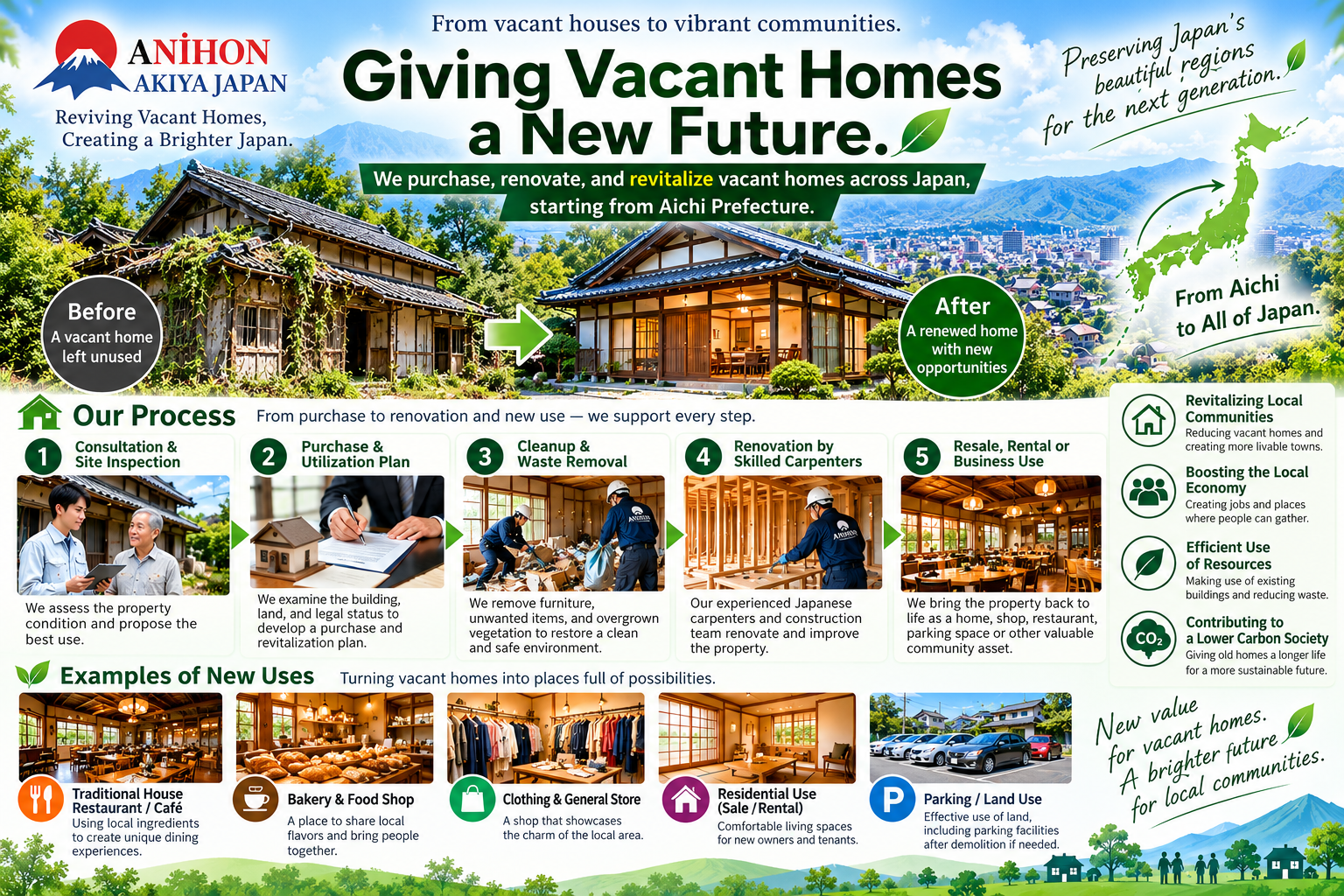
Starting in Aichi Prefecture, our goal is to identify, evaluate, acquire, clean, renovate, and revitalize suitable vacant properties, gradually expanding our activities throughout Japan.
1. Transforming Vacant Homes into Valuable Community Assets
Our vision goes beyond simply purchasing old houses and reselling them.
We aim to understand each property’s structural condition, location, surrounding environment, and potential contribution to the local community.
Depending on the property’s characteristics and applicable regulations, possible uses include:
- Traditional Japanese kominka restaurants and cafés
- Bakeries and local food shops
- Clothing boutiques, gift shops, and small retail businesses
- Renovated residential properties for resale
- Rental homes and community gathering spaces
- Parking facilities or alternative land uses following demolition, where appropriate
We want to preserve the unique architectural character of traditional Japanese homes wherever practical while adapting them to modern needs.
By giving unused properties a new purpose, we hope to create opportunities for local businesses, residents, and future generations.
2. From Property Acquisition to Renovation and Reuse
ANIHON Akiya Japan is operated by Asumoto Kogyo LLC (合同会社アスモト工業), a Japan-based company with experience in construction, demolition, and renovation.
We aim to develop a coordinated process covering property evaluation, acquisition, cleanup, renovation, and future utilization.
Step 1: Property Consultation and On-Site Inspection
Vacant property owners can contact us to provide information about their buildings.
For suitable inquiries, our team will evaluate the property’s condition, location, accessibility, land characteristics, and surrounding environment.
This initial assessment helps us understand whether acquisition or redevelopment may be feasible.
Step 2: Property Evaluation and Acquisition Planning
Before making a purchase decision, we will review relevant information, including ownership status, building condition, legal restrictions, and economic feasibility.
For properties that meet our criteria, we may discuss purchase opportunities directly with the owners.
At this stage, we will also consider potential future uses for the property.
Step 3: Interior Cleanup and Exterior Maintenance
Many long-abandoned homes contain furniture, household items, and other unwanted materials.
Our objective is to arrange appropriate sorting, removal, and disposal in accordance with applicable Japanese regulations and permit requirements.
We will also assess necessary exterior work, such as removing overgrown vegetation, maintaining trees, and cleaning surrounding areas.
These activities will help prepare suitable properties for renovation or alternative use.
Step 4: Renovation by Experienced Japanese Carpenters and Construction Professionals
Working with experienced Japanese carpenters (daiku-san, 大工さん), architects, and construction professionals, we plan to develop renovation strategies tailored to each building.
Depending on the property’s condition, work may involve:
- Roof and exterior repairs
- Interior wall and flooring improvements
- Door and window replacement
- Kitchen and bathroom renovation
- Structural repairs and reinforcement where necessary
- Improvements to functionality, safety, and comfort
Our goal is to preserve the character of traditional Japanese properties while making them suitable for contemporary living or commercial activities.
Step 5: Resale, Rental, or Alternative Use
Once renovation work has been completed and the necessary legal requirements have been satisfied, properties may be offered for sale, rental, or other appropriate uses.
Some homes may become family residences, while others may be transformed into restaurants, cafés, shops, or community facilities.
Important: Not every vacant property will qualify for purchase or renovation. All decisions will depend on building conditions, ownership rights, legal requirements, and financial feasibility.
3. Do You Own a Vacant Property in Japan?
Many property owners face similar challenges:
“I inherited my parents’ house, but I have no plans to use it.”
“I live in another city or country and cannot maintain the property.”
“The house is full of furniture and unwanted belongings.”
“The building is old, and I don’t know whether to renovate or demolish it.”
“The garden is overgrown, and I am concerned about neighboring properties.”
“I would like to sell my vacant house, but I don’t know where to begin.”
“I want my unused property to become useful to the community again.”
If any of these situations sound familiar, we invite you to contact ANIHON Akiya Japan.
An old building, an overgrown garden, or a house full of unwanted belongings does not necessarily mean that a property has no future value.
With proper evaluation and planning, some vacant properties can be given a meaningful second life.
4. Starting in Aichi Prefecture, Expanding Across Japan
Our initial focus will be Aichi Prefecture and neighboring regions.
We plan to begin by receiving inquiries from vacant property owners, conducting property assessments, and establishing a practical foundation for acquisition and revitalization activities.
As our operations develop, we aim to expand into Gifu, Mie, and other prefectures throughout Japan.
We also recognize the importance of collaboration with municipalities, local businesses, architects, construction professionals, and community organizations.
Our long-term objective is to contribute to the revitalization of unused properties while supporting local communities and regional economic activity.
5. Vacant Home Revitalization and Environmental Sustainability
Renovating and reusing existing buildings can help extend the useful life of construction materials, conserve resources, and reduce waste.
Not every aging building needs to be demolished.
Some properties can remain useful for many more years when they are properly assessed, repaired, and maintained.
This philosophy also connects with the environmental vision of ANIHON Carbon Navi, our initiative focused on waste awareness, responsible resource use, and more sustainable communities.
Through ANIHON Akiya Japan, we hope to address vacant property challenges while contributing to environmental responsibility and regional revitalization.
Turning vacant homes from burdens into opportunities.
Transforming forgotten buildings into places where people can gather again.
Creating valuable community assets for future generations.
6. We Welcome Inquiries from Vacant Property Owners
Do you own a vacant house that you are considering selling?
Have you inherited a property that is difficult to maintain?
Do you own an unused building or parcel of land?
Are you unsure whether your property should be renovated, sold, or put to another use?
We invite you to contact ANIHON Akiya Japan.
Our team will review your inquiry and consider whether there may be suitable options for evaluation, acquisition, renovation, or future use.
Contact ANIHON Akiya Japan
Operating Company: Asumoto Kogyo LLC (合同会社アスモト工業)
Website: https://asumotokogyo.com
Email: info@asumotokogyo.com
“New Value for Vacant Homes. A New Future for Local Communities.”