
The number of “Akiya” (abandoned houses) across Japan continues to rise. These properties are currently drawing global attention from investors and those looking to relocate as a chance to acquire traditional Japanese architecture at incredible prices. However, in the search for the perfect property, there is a uniquely Japanese concept that is unavoidable and often difficult for foreigners to grasp. This is what is known as “Jiko Bukken” (Accident Properties), or legally referred to as properties with “Psychological Defects” (Shinriteki Kashi).
In this blog, we will delve deep into why abandoned houses often become stigmatized properties, the risks involved, and how to turn these risks into investment opportunities.
1. What is a Stigmatized Property? Defining Psychological Defects
In Japanese real estate transactions, even if a property has no physical defects (such as roof leaks or termites), it is classified as having a “Psychological Defect” if there are background circumstances that make a resident feel “uncomfortable” or “fearful.”
Specifically, this includes cases such as:
- Incidents/Accidents: Murder, manslaughter, or death by arson.
- Unnatural Deaths: Suicide.
- Deaths Requiring Special Cleaning: Cases of “Kodokushi” (solitary death) involving elderly residents where the body is discovered late, requiring professional restoration (special cleaning) due to decomposition.
According to the Building Lots and Buildings Transaction Business Act, real estate agents are legally obligated to provide “Full Disclosure” to buyers or tenants regarding these facts before a contract is signed.
2. Why Do “Akiya” Often Become Stigmatized Properties?
The backdrop of Japan’s abandoned house problem is the country’s severe aging population and declining birthrate. Many Akiya in rural areas were previously inhabited by elderly individuals living alone.
- Rise in Solitary Deaths: It is common for elderly residents living away from their relatives to pass away at home and remain undiscovered for days or weeks. This results in the property being labeled a “Jiko Bukken.”
- The Chain of Inheritance Renunciation: When a property has a psychological defect, relatives often dread inheriting it and abandon its management. Consequently, the house decays rapidly, giving birth to a “negative legacy” Akiya.
3. Japan’s Unique Aversion to Death and Price Depreciation
Japanese society retains a strong traditional culture regarding “Kegare” (impurity or defilement). Influenced by Shintoism and Buddhism, people are highly sensitive to locations where a death has occurred.
This psychological hurdle is directly reflected in the market price:
- Suicide: 30% to 50% reduction from market value.
- Murder: Over 50% reduction, or the property may fail to find a buyer at all.
- Solitary Death (Immediate Discovery): While disclosure is still required, the impact on price is often minor (around 10%).
For foreign investors who can overcome this “psychological wall,” this represents a chance to acquire structurally sound homes at unbelievably low costs.
4. Three Steps to “Revive” a Stigmatized Property
If you purchase an abandoned house that is a stigmatized property, how should you restore its value?
I. Thorough Special Cleaning and Renovation
Most psychological defects stem from “odors” or “visual traces.” By hiring professional cleaners and replacing floorboards or wallpaper, physical traces can be completely erased. Modern renovations can entirely wipe away the “old” image of the house.
II. Performing “Oharai” (Purification Ceremony)
When dealing with a Jiko Bukken in Japan, the most important step is an “Oharai” performed by a Shinto priest or Buddhist monk. This is not just a ritual; it serves as a powerful form of social proof to neighbors and future residents that “this house has been purified.”
III. Understanding Disclosure Obligations
Guidelines established by the Ministry of Land, Infrastructure, Transport and Tourism in 2021 state that for rentals, the obligation to disclose solitary deaths or suicides generally expires after three years. While sales still require more cautious handling, the psychological burden diminishes over time.
5. An Investor’s Perspective: Turning Risk into Return
For a savvy investor, the “Stigmatized” label signifies “Reduced Entry Cost.”
- Inbound Accommodation (Airbnb): Foreign tourists generally do not care about the “psychological defects” that local Japanese residents worry about. If the location and interior quality are good, you can maintain high occupancy rates.
- Share Houses and Community Hubs: Younger generations and artists tend to be more rational. The benefit of renting a large space at a low cost often outweighs the history of the property.
Conclusion: Replacing the Soul of the House
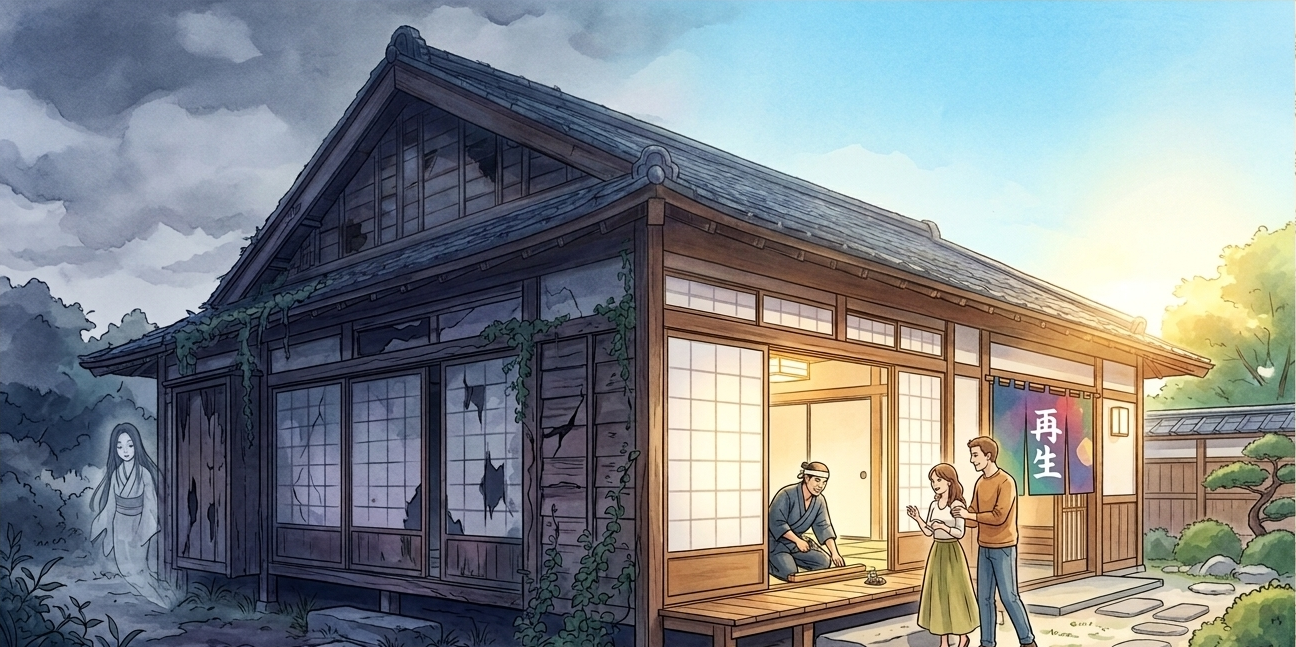
The stigmatized Akiya hidden across Japan may carry sad histories. However, rather than leaving them to become ruins, an owner who steps in to renovate and breathe new light into the building is also contributing to the local community (Regional Revitalization).
By correctly understanding the reason behind the “low price” and taking appropriate measures, a stigmatized property can be transformed from a “liability” into a “valuable asset.”