

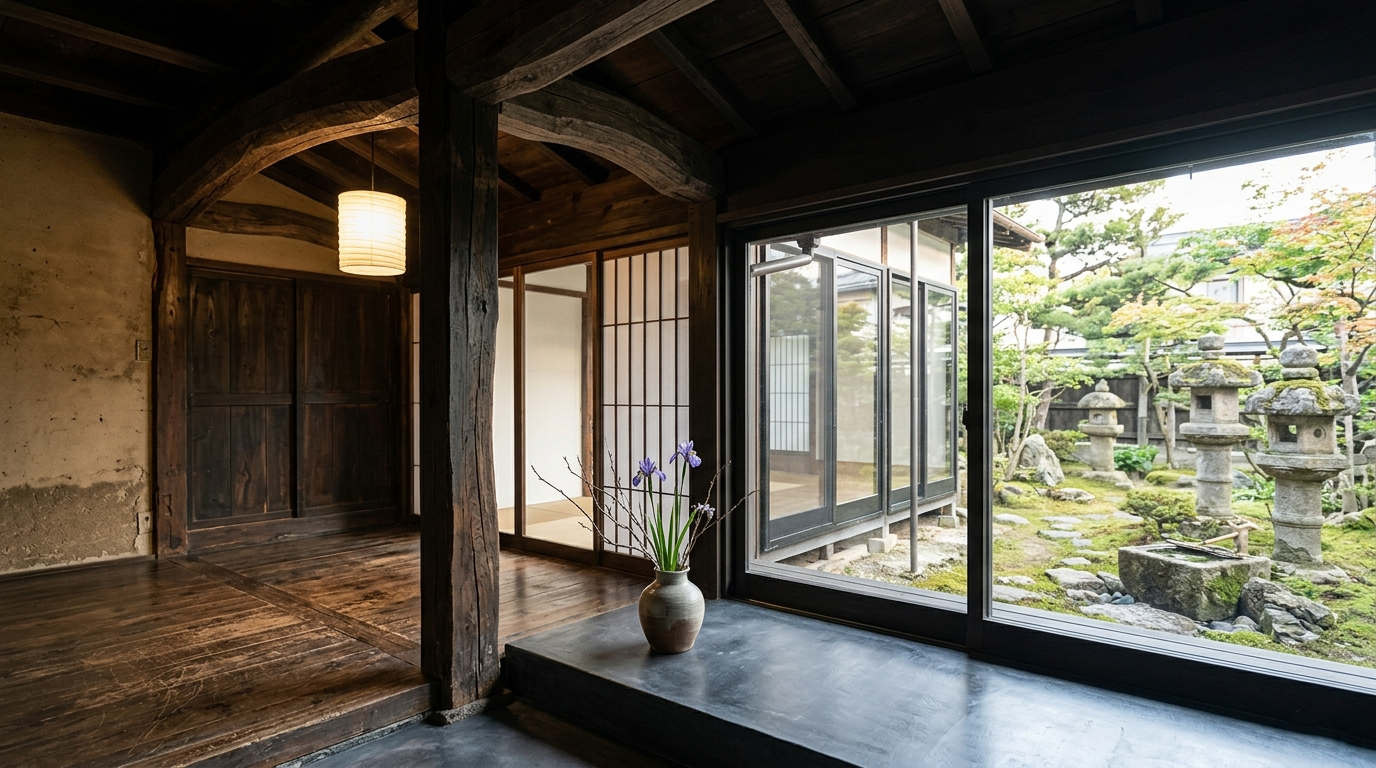
When walking through Japan’s rural villages and regional towns, one often encounters “Akiya” (vacant houses) that seem to be quietly marking time. Having endured the wind and snow for decades while watching over the lives of generations, these houses possess a unique “presence” that is entirely absent in modern, efficiency-oriented architecture.
Many people might look at peeling mud walls or faded timber and dismiss them as “irreparable ruins.” However, through the lens of Japan’s ancient aesthetic philosophy, Wabi-Sabi, these structures reveal an overwhelming beauty and richness that no brand-new building can ever replicate.
In this article, we will delve into the essence of Akiya renovation—not as a simple modern “remodel,” but as a way to cherish the “imperfections” of a home and inherit its history.
1. The True Value of Akiya as Taught by “Wabi-Sabi”
Wabi-Sabi is a uniquely Japanese concept that rejects the pursuit of perfection and finds beauty within the natural cycle of growth and decay.
- Wabi (侘): Finding spiritual fulfillment in simplicity and detachment from luxury; the richness found in “lacking.”
- Sabi (寂): Affirming the wear, patina, and tarnishing that appear over time as a beautiful “story” the object has lived through.
Applying Wabi-Sabi to Akiya renovation does not mean returning a house to its “original, brand-new condition.” Rather, it means accepting the scratches carved into the pillars, the deep darkening of wood grain, and the luster of hallways polished by years of use as the house’s unique identity.
2. Practical Design Techniques to Shape the “Beauty of Imperfection”
In modern renovations, there is a tendency to cover everything with smooth drywall and uniform wallpaper. However, to preserve the soul of an Akiya, one must have the courage to avoid “over-refining.”
① The “Arashi” (Exposed) Method: Revealing the Skeleton of History
In the attics of traditional Japanese houses, powerful structural beams (Hari) are often hidden away. Unlike modern pre-cut timber, these are artistic structures that utilize the natural curves of the trees. By removing the ceiling and “exposing” these beams, you grant the space an overwhelming sense of openness and the comforting weight of a century of support.
② Embracing Contrast: The Fusion of Old and New
There is no need to keep everything old. The key lies in the contrast between aged materials and modern elements. For example, placing a minimalist stainless steel kitchen next to an old glass window with hand-blown distortions, or setting sophisticated Scandinavian furniture against a raw mud wall. By allowing the “heavy texture” of time to coexist with the “light texture” of modernity, imperfection is sublimated into a refined design.
③ Encouraging Rather Than Stopping “Aged Change”
Vinyl wallpaper and plywood are at their most beautiful the day they are installed; from there, they only degrade. Conversely, natural materials like solid wood, plaster (shikkui), persimmon tannin (kakishibu), and soot-colored bamboo (susudake) grow deeper in color and develop a unique luster as they are used. Choosing these materials for a renovation means designing the joy of aging alongside your home.
3. From “Scrap and Build” to “Inheritance and Circulation”
It has often been said that the lifespan of a Japanese house is roughly 30 years. However, traditional Japanese architecture is inherently designed to last over 100 years with proper care. To demolish an Akiya is to discard the accumulated skills of craftsmen, the memories of former residents, and precious resources.
Renovation based on Wabi-Sabi is not merely a matter of taste; it is a proposal for a sustainable lifestyle that minimizes environmental impact and connects culture to the next generation. Honoring the old is directly linked to valuing the future.
4. Conclusion: A Home Does Not End When It Is Finished
In the world of Wabi-Sabi, much like the art of Kintsugi (joining broken pottery with gold), the marks of repair are viewed as part of the object’s beauty. Akiya renovation is no different. Accepting imperfection and finding new value in what is “broken” enriches the heart of the inhabitant.
A life surrounded by a history of warmth is often more fulfilling than one surrounded by perfect newness. Why not breathe new life into a sleeping Akiya and create a “living space” that is truly one of a kind?