

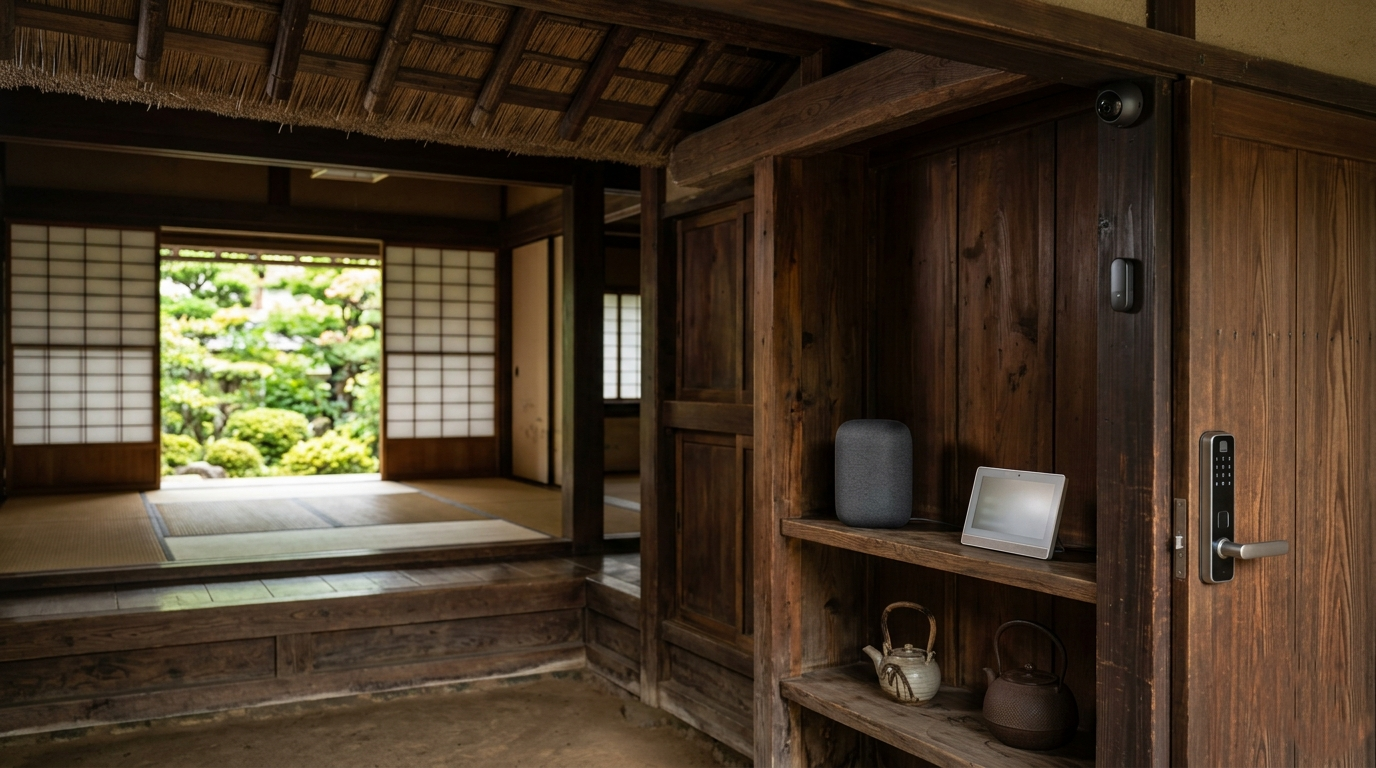
Japanese traditional houses (Kominka) are captivating with their massive wooden beams, masterfully crafted joinery, and a spatial design that harmonizes with nature. However, challenges like poor thermal insulation, security vulnerabilities, and maintenance difficulties can make these homes demanding for modern living.
In this article, we provide a comprehensive guide on how to breathe new life into a Kominka through technology, without compromising its aesthetic integrity.
1. Invisible Security: Defense Systems That Respect Aesthetics
Old Japanese houses often have an open structure. Modern, bulky security cameras can significantly disrupt the home’s historic silhouette.
- Hidden Cameras and Design Integration: Ultra-small smart cameras can be placed under eaves or in the shadows of wooden lattices (koshi). Today, there are camera models hidden inside traditional stone lanterns (toro) or garden lights that blend seamlessly with the landscape.
- “Invisible” Smart Locks: It was long thought difficult to install smart locks on traditional sliding doors (hikido). However, wireless electronic locks are now available that can be mounted on the interior or at the meeting points of the doors. Systems synced with your smartphone’s GPS can unlock the door automatically as you approach, eliminating the need to fumble for keys.
- Vibration Sensors for Early Warning: Slim vibration sensors placed on wooden frames or old glass panes send notifications to your smartphone at any sign of forced entry. This system can be paired with smart lights to illuminate the entire house instantly upon a breach attempt.
2. Optimizing Thermal Efficiency: Smart Solutions for the “Cold” Problem
The biggest challenge of a Kominka is the winter cold. To efficiently heat large areas with high ceilings, technology is essential.
- Smart Thermostats and Zonal Control: Kominkas have many rooms. Using smart thermostats like Google Nest, you can maintain target temperatures only in occupied areas, ensuring energy savings in empty rooms.
- Motorized Smart Curtains (or Shōji Screens): Motorized rails hidden behind traditional shōji paper screens move based on outdoor temperature and sunlight sensors. They block sunlight in the summer while maximizing daylight in the winter, closing automatically at sunset to prevent heat loss.
- Smart Underfloor Heating: Thin infrared heaters placed under tatami mats or solid wood floors can be controlled via smart plugs. Automation that warms the floor 30 minutes before you wake up reduces the risk of “thermal shock” common in Kominkas.
3. Intelligence Protecting the Structure: Monitoring Moisture and Fire
For a 100-year-old wooden building, the greatest enemies are moisture (mold/termites) and fire.
- Underfloor and Attic Humidity Sensors: Real-time monitoring of humidity levels under Japanese houses is vital. When humidity exceeds critical levels, the automatic activation of smart ventilation fans prevents the wood from rotting.
- Smart Smoke and CO Detectors: If an irori (sunken hearth) or wood stove is used, smart detectors should be placed in inconspicuous areas. In the event of a leak, smart speakers can broadcast voice alerts while all lights turn to maximum brightness to illuminate evacuation routes.
4. Lighting: Highlighting the Beauty of Shadows with Smart Light
It is possible to provide modern comfort while preserving the famous aesthetic of shadows mentioned in Jun’ichirō Tanizaki’s In Praise of Shadows (In’ei Raisan).
- Smart LED Filament Bulbs: Opt for LEDs that look like retro Edison bulbs but allow for brightness and color temperature adjustments via smartphone. An automation that shifts the light to warm orange tones at sunset deepens the home’s atmosphere.
- Motion-Sensored Night Lighting: Setting smart LED strips in hallways to dimly light only the floor level when someone wakes up at night ensures safe passage without breaking the silent and mystic aura of the house.
Conclusion: An Update for Future Generations
Integrating technology into 100-year-old architecture is not a sign of disrespect to the past; rather, it is an “evolution” that carries the structure into the next 100 years.
The golden rule here is to keep technology in the background like a “shadow player” and let the massive pillars and wooden textures take center stage. This balance is one of the most fascinating solutions to Japan’s Akiya (vacant house) problem.