

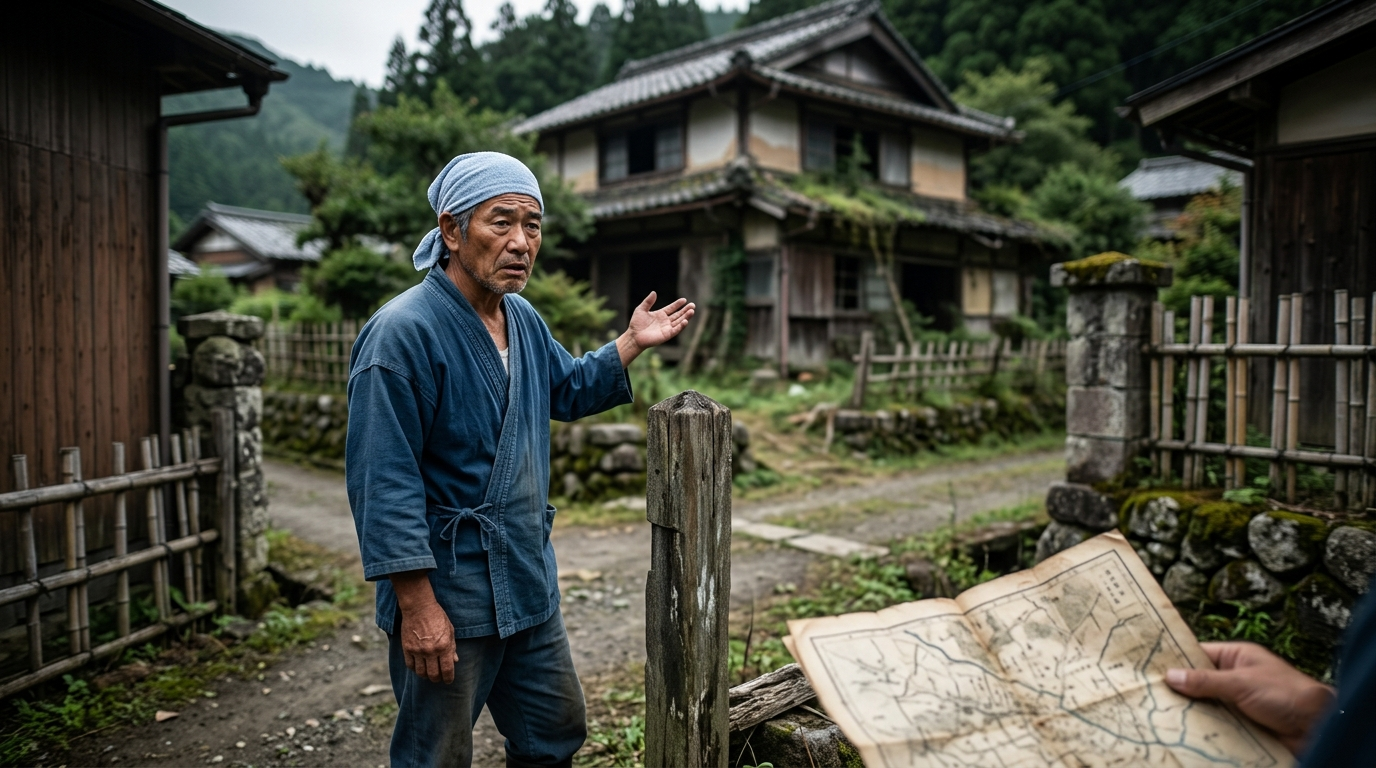
As regional migration and real estate investment gain momentum in Japan, budget-friendly “Akiya” (vacant houses) appear to be highly attractive options. However, jumping in blindly can lead to millions of yen in additional costs or severe disputes with neighbors. One of the most significant factors behind these risks is the “Boundary Issue” (unconfirmed boundaries or lack of clear demarcation).
In this article, from the perspective of a specialized real estate consultant, we will thoroughly explain the boundary risks you must check when purchasing an Akiya and how to resolve them.
1. Why Are Akiyas So Cheap? The Background of Neglected Boundaries
The reason rural Akiyas are traded at surprisingly low prices isn’t just due to the aging of the building. In many cases, the legal risk of “unconfirmed boundaries” is baked into the price.
Unlike urban land, rural plots are often vast and have historically been managed through a “silent understanding” between relatives and neighbors. However, once the owner changes and tries to sell or renovate, this ambiguity can turn into a serious liability.
2. The Trap of “Indistinct Boundaries” and “Public Maps”
In Japanese land management, one must be extremely wary of the reliability of the “Kozu” (Public Map).
- Legacy of the Meiji Era (Land Tax Reform): In many rural areas of Japan, maps are still based on the “Land Tax Reform” of the Meiji era. These were created using amateur surveying techniques of the time, leading to frequent discrepancies between the actual area/shape and the records—known as “Nauenobi” (stretched) or “Nauchijimi” (shrunk).
- Lack of “Meicho” (Clear Demarcation): “Meicho” refers to a state where boundaries are physically and legally clear. In the case of Akiyas, it is common for boundary markers (concrete stakes or metal plates) to be buried under soil or to have never been installed at all.
3. Typical “Boundary Troubles” Encountered with Akiyas
Purchasing a property with unconfirmed boundaries puts you at risk for the following:
① Encroachment (Ekkyo) Issues
This occurs when a neighbor’s fence extends into your lot, or conversely, when your roof or eaves protrude into the neighbor’s airspace.
- Risk: When rebuilding in the future, you may be unable to get a building permit unless the encroachment is resolved, or a neighbor might demand removal costs.
② Elderly Neighbors Relying on “Memory”
In rural areas, many elderly residents judge land boundaries based on personal memory, such as “from that big persimmon tree to that stone in a straight line.”
- Risk: Scientific survey results may clash with “ancestral oral traditions,” leading to quagmires and disputes that can take years to resolve.
③ Difficulty in Future Resale
If you decide to sell the Akiya later, most banks will require a “Boundary Determination Survey Map” (Kakutei-zu) if the buyer is using a loan. Without this, the asset value drops significantly, often leading to low-ball offers.
4. The Role of the Land and House Surveyor
The only professional capable of resolving boundary issues is the “Land and House Surveyor” (Tochi Kaoku Chosashi). They do more than just measure distance; they perform the following:
- Document Research: Scrutinizing public maps and land survey records at the Legal Affairs Bureau.
- Current State Survey: Precision measurement of the current site.
- Witnessing (Tachiai): Meeting with all adjacent landowners on-site to obtain consent for the boundary lines.
- Marker Installation: Placing permanent boundary markers at the agreed-upon points.
The document created through this process is the “Boundary Determination Survey Map.” It is no exaggeration to say that your rights to the land are only 100% protected once you have this.
5. Pre-Purchase “Boundary Checklist”
Before signing a sales contract, always verify the following:
| Item | What to Confirm |
| Boundary Markers | Are stakes or plates visible at every corner? |
| Survey Map Age | If a map exists, is it a high-precision one from the Heisei era or later? |
| Discrepancy | Is there a clear difference between the registered area and the actual size? |
| Encroachments | Do roofs, gutters, branches, or fences cross the boundary line? |
| Contract Terms | Is the property being sold under “Boundary Not Disclosed” or “As-Is” conditions? |
Pro Advice:
Budget properties often include a “Non-Disclosure of Boundaries” clause (where the seller does not identify the boundaries). In this case, you take full responsibility for any neighbor disputes after purchase. Always consider a preliminary survey by a professional before buying.
Conclusion: “Cheap” Has a Reason. Calculate Risk as a Cost.
Renovating an Akiya is a wonderful endeavor, but boundary issues are an invisible “negative legacy.” A boundary determination survey generally costs between 400,000 JPY to 1,000,000 JPY, depending on location and size.
To avoid the “buy cheap, pay later” trap, the first step for a wise investor or resident is to include the “Boundary Determination Cost” in the initial purchase budget. True rural life of abundance begins only after you have secured legal peace of mind.
If you find a property with boundary uncertainties, we recommend consulting a specialist first.