

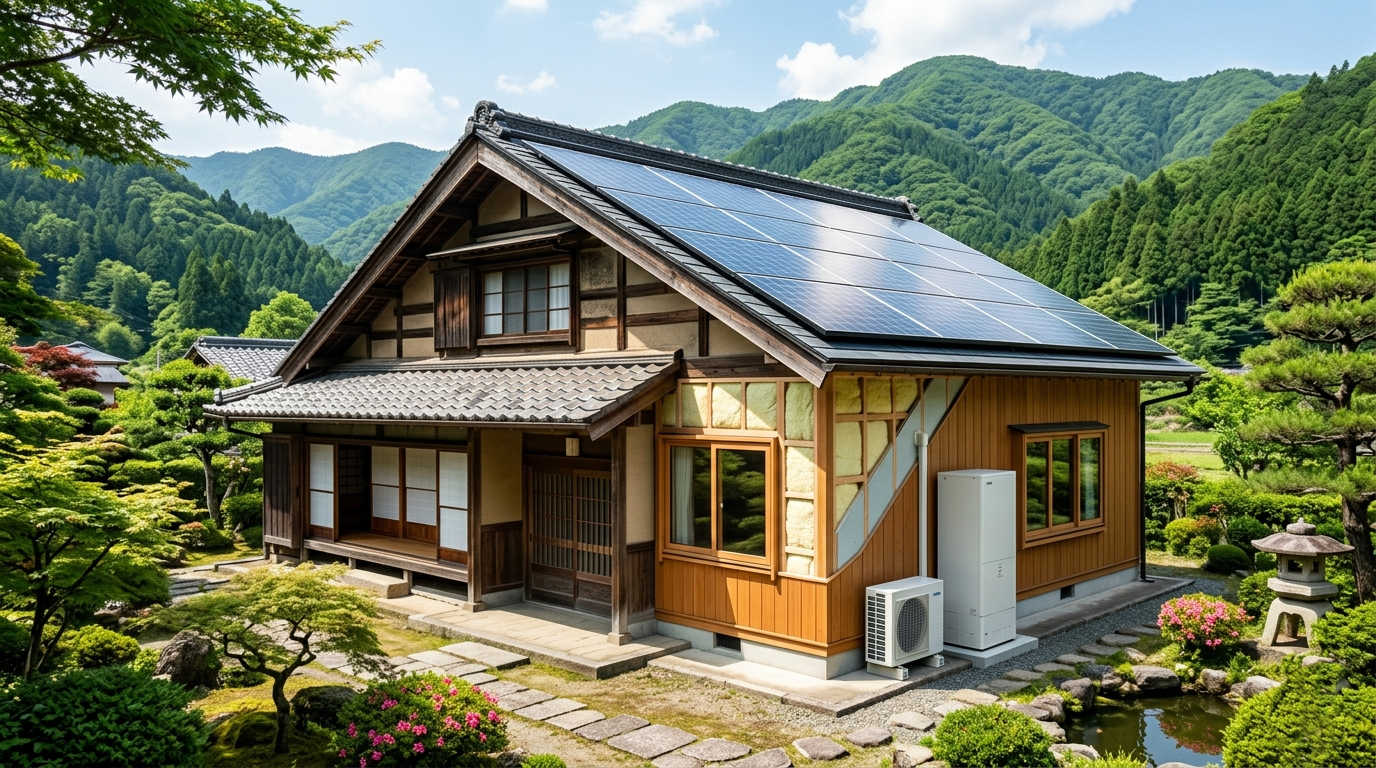
Hello everyone, and welcome back to the blog where we explore the exciting new possibilities of Japan’s vacant homes, known as Akiya.
There is a profound charm to quaint, old wooden houses. With their magnificent beams and traditional earthen walls, they possess a deep character that you simply cannot find in a newly built home. However, when it comes to actually living in one, many people hit a major wall. That wall is the harsh thermal environment unique to older Japanese houses: “Freezing in the winter, and like a sauna in the summer.”
But there is no need to give up. By leveraging modern technology and renovation techniques, even a 50-year-old Akiya can be reborn into a “zero-emission” (carbon-neutral) home that is incredibly kind to the environment and keeps utility bills to an absolute minimum.
Today, we will break down the three essential steps to transform an old, wooden Akiya into a state-of-the-art eco-house.
Why Are Old Akiyas So Energy Inefficient?
Before aiming for zero emissions, we must first understand the enemy. Traditional Japanese homes were built based on the philosophy that “houses should be built for the summer,” prioritizing airflow and ventilation above all else. Because of this, they have the following weaknesses:
- A Massive Lack of Insulation: It is very common to find no insulation in the walls, under the floors, or in the ceilings—or to find that what little insulation exists has deteriorated and lost its function.
- Low Airtightness: Due to the natural shrinkage of wood over time, these houses are full of “gaps.” Any air you spend money heating (or cooling) quickly escapes outside.
- Heat Loss Through Windows: Old aluminum sashes paired with single-pane glass are the “greatest weakness” of the house, acting as the primary gateway for heat to enter and escape.
If you install the latest eco-friendly equipment without fixing these foundational issues, it is like pouring water into a bucket with holes in it. The road to zero emissions starts with improving the basic performance of the house itself.
Step 1: Thorough Insulation and Airtightness (Creating a “Thermos” House)
The first and most critical step to reducing energy consumption to practically zero is insulation. By wrapping the entire house so that it functions like a thermos, you can maintain a comfortable temperature year-round with very little energy.
- Upgrading the Windows (Top Priority) About half of a home’s heat escapes through the windows. The most cost-effective solution is installing “inner windows” (secondary glazing). Simply adding a new resin sash and double-pane glass inside the existing window frame dramatically improves insulation. If your budget allows, replacing the entire window unit with high-insulation resin sashes is highly recommended.
- Insulating Floors, Walls, and Ceilings When replacing floorboards or redoing walls, tightly pack high-performance insulation materials like glass wool or urethane foam into the cavities. Blocking the heat that escapes through the roof and the cold air that rises from beneath the floorboards directly translates to a massive boost in comfort.
- Ensuring Airtightness To prevent drafts, airtight sheets and tapes must be carefully applied during construction. This makes “planned ventilation” possible and significantly boosts the efficiency of heating and cooling systems.
Step 2: Modern “Heat Pump” Technology for AC and Water Heating
Once the home’s insulation is up to par, it is time to install equipment that operates efficiently on minimal energy. The star of the show here is the “heat pump.”
A heat pump is a technology that collects heat from the air and transfers it. Rather than using electricity to directly generate heat, a highly efficient heat pump system uses 1 unit of electrical energy to generate 3 to 6 units of heat energy from the outside air.
- Switching to High-Efficiency Air Conditioners: If your Akiya is well-insulated and airtight, you no longer need large space heaters in every room. Just one or two high-efficiency modern air conditioners can keep the entire house at a comfortable temperature. Say goodbye to fossil-fuel-burning kerosene stoves and drastically cut your CO2 emissions.
- Installing an EcoCute (Heat Pump Water Heater): Water heating accounts for about 30% of household energy consumption in Japan. By replacing old gas or kerosene water heaters with an “EcoCute” system, you can use heat from the air to heat your water, slashing both your energy use and carbon footprint.
Step 3: “Creating” Energy with Solar Panels
Once you have minimized your energy consumption (energy saving), the final step is to generate that remaining required energy right at home (energy creation). This completes the “zero-emission” equation, bringing your net energy usage to zero.
- Installing a Solar Power System: Solar panels should be installed in optimal locations, such as a south-facing roof. Because the home’s power consumption has already plummeted thanks to the insulation and heat pumps, even a relatively small-capacity solar panel system is often enough to cover the household’s electricity needs.
- Home Batteries (Optional): If you install a home battery to store the electricity generated during the day for use at night or on rainy days, you can further reduce your reliance on the grid. Additionally, this allows your house to have power during disaster-related blackouts, turning your old Akiya into a resilient, off-grid safe haven.
Conclusion: A Home That Inherits History and Connects to the Future
An old wooden Akiya is by no means an “obsolete cold box.”
By drawing out the building’s potential through insulation upgrades, using energy efficiently with heat pumps, and converting nature’s gifts into electricity with solar panels, you can achieve the ultimate balance. You preserve the historic value and beautiful design of a traditional folk house while creating a cutting-edge home that is zero-impact on the environment and gentle on your wallet.
Renovating an Akiya is more than just fixing up a house. It is a wonderful project that contributes to a sustainable, carbon-neutral future while protecting the beautiful, historic landscapes of Japan.
If you are considering buying or renovating an Akiya, please try incorporating this “zero-emission” perspective into your plans. It will surely be one of the best investments you can make for yourself—and for the planet.