
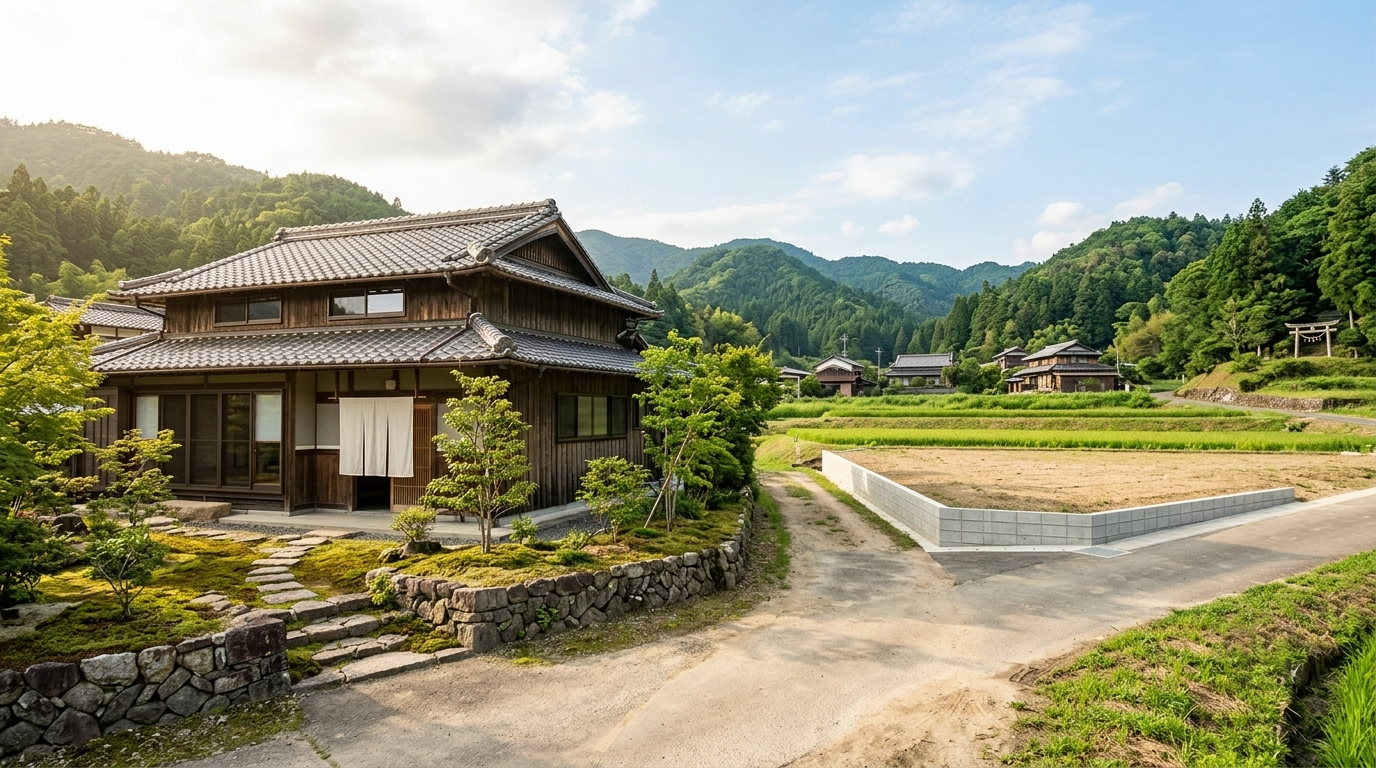
With growing interest in revitalizing vacant houses (Akiya) across Japan, many property buyers and investors face the same fundamental question: “Should we renovate and preserve this traditional structure, or demolish it entirely?”
Even a property that appears outdated on the surface can be transformed into a stylish, high-value space with proper restoration. However, if there is severe structural damage, demolition may be the safer and more cost-effective path.
Here are the 5 essential checkpoints to evaluate when deciding whether to renovate or demolish an Akiya.
1. Year of Construction & Earthquake Standards (The June 1981 Threshold)
The first element to verify is the construction date of the building.
- Old Earthquake Standards (Pre-June 1981): Built to withstand seismic intensity around Level 5. Living safely in these structures usually requires comprehensive and costly retrofitting.
- New Earthquake Standards (Post-June 1981): Designed to resist strong earthquakes up to Level 6–7. These buildings generally have structural frames that can be safely retained for interior renovation.
2. Foundation Integrity, Structural Posts, and Termite Damage
A house may look sound from the outside while concealing major structural issues underneath or in the roof assembly.
- Suitable for Renovation: Superficial wall/flooring wear, minor roof leaks, or cosmetic weathering where timber framing remains sound.
- Consider Demolition: Severe termite infestation that has hollowed out load-bearing posts, or prolonged water exposure that caused rot and structural tilting.
Note: If structural reinforcement costs exceed reasonable bounds, clearing the land can yield a better return on investment.
3. Road Access & “Rebuilding Prohibited” Status (Saikenchiku Fuka)
Before ordering a demolition, you must check whether the property is subject to re-building restrictions.
Under the Japanese Building Standards Act, a parcel must connect to a public road (at least 4 meters wide) with a frontage of at least 2 meters to allow new construction.
- Rebuildable Land: Once cleared, you can construct a new building or convert the plot into alternative uses like parking or gardens.
- Non-Rebuildable Land (Saikenchiku Fuka): If you demolish the existing structure, you will not be permitted to build a new one. For these properties, a full structural renovation (“skeleton renovation”) is mandatory instead of demolition.
4. Overall Cost Comparison (Renovation vs. Demolition + New Build)
A precise budget analysis is essential before proceeding.
- Full Renovation: Preserves the underlying frame and foundation, often keeping costs lower than new construction. However, extreme structural damage can push renovation costs close to new build budgets.
- Demolition + New Build: Incurs upfront demolition costs, but leaves a clean site that can be resold easily or customized with a brand-new architectural design.
5. Property Taxes & Municipal Subsidies
Demolishing an Akiya to create empty land removes the special residential land tax reduction (which reduces fixed asset tax up to 1/6th). Consequently, your land tax may increase the following year.
However, if an unattended property is designated as a “Specified Vacant House” by local authorities, tax relief is revoked even if the building stands. Additionally, many municipalities offer grant programs specifically covering demolition or renovation costs.
Summary: Professional On-Site Assessment Is the Key
Deciding whether to demolish or renovate an Akiya requires evaluating physical condition, road access regulations, tax benefits, and long-term investment strategy simultaneously.
To ensure a safe and profitable decision, consulting professionals with combined expertise in construction, demolition, and real estate is strongly recommended.
At Anihon Akiya Japan, we provide comprehensive consultation on property evaluation, renovation planning, and demolition strategies tailored to your goals. Feel free to contact us for further information.