
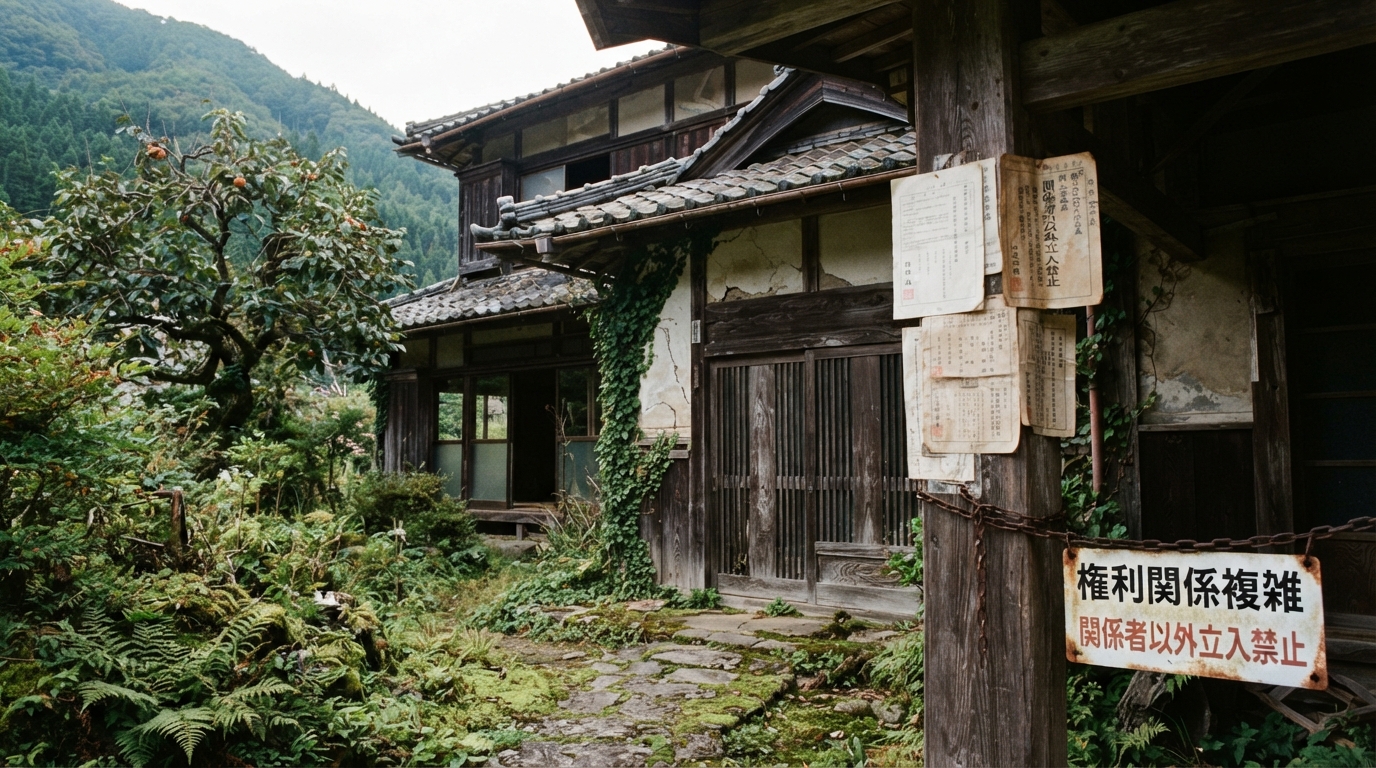
Across Japan, the number of vacant homes (Akiya) continues to climb. Among them, the properties that fail to find buyers, remain undemolished, and pose the steepest challenges for local municipalities share one defining trait: deeply entangled, legally frozen ownership rights.
“I found a charming traditional wooden house (kominka), but nobody can reach the registered owner.” “When I checked the title deed, the property was still registered under someone born in the Meiji era (1868–1912).” “There are dozens of heirs, and if even one person objects, the sale cannot go through.”
In Japan’s Akiya market, these scenarios are far from rare. This guide breaks down the three core legal and practical bottlenecks behind Japan’s vacant-home crisis—Owner-Unknown Land/Buildings, Successive Inheritance (Fragmented Co-Ownership), and Inheritance Renunciation—with concrete examples and actionable checkpoints.
1. The “3 Legal Bottlenecks” Freezing Akiya Transactions
The very first step in acquiring or revitalizing a vacant home in Japan is obtaining a Certificate of Registered Matters (Tokijiko Shomeisho) from the Legal Affairs Bureau. On properties left untouched for decades, however, the names on the registry rarely match the people who actually hold legal rights today.
① Owner-Unknown Land and Buildings (Frozen Title Registries)
This occurs when the real estate registry fails to identify who the current owner is, or when an owner’s name is listed but they cannot be located. Because inheritance registrations (sozoku toki) were skipped across multiple generations, it becomes impossible to tell where the current rights holders live—or even whether they are still alive.
② Fragmented Co-Ownership via Successive Inheritance (Suji Sozoku)
When an original property owner passes away without a formal estate division agreement or title transfer, and the next generation also passes away before resolving it, ownership shares branch out exponentially. In Japanese law, this chain reaction is known as Suji Sozoku (Successive Inheritance).
【Case Example: A Rural Family Home Left Unregistered for 3 Generations】
- Grandfather (A) passes away in 1970; the title is left unchanged.
- His four children (B, C, D, and E) become statutory heirs, but all live far away and leave the house unmanaged.
- Over the following decades, B, C, and D also pass away, passing their fractional shares down to their spouses and children (the grandchild generation).
- As a result, a single 60-year-old vacant house ends up owned by 18 distant relatives as co-owners—many of whom have never met.
Under Japan’s Civil Code, selling a jointly owned property (an act of disposition) requires the unanimous consent of all co-owners. Even if 17 out of 18 relatives agree to sell, the transaction comes to a complete halt if the remaining single person refuses (“I won’t sell our ancestral land”), lacks legal capacity due to dementia, or cannot be contacted.
③ The Chain of Inheritance Renunciation and the “Management Vacuum”
In rural areas, aging Akiya frequently carry demolition costs (often several million yen), annual property taxes, and ongoing maintenance expenses (such as brush clearing) that far exceed their market value. Rather than assets, they become “negative real estate” (Fudosan).
Consequently, a growing number of heirs file for Inheritance Renunciation (Sozoku Hoki) at the Family Court when a parent passes away. When every statutory heir renounces the inheritance, the property enters a state of “no existing heirs,” leaving a legal vacuum in which no individual holds clear ownership responsibility.
2. Real-World Deadlocks Faced by Buyers, Investors, and Municipalities
Entangled ownership is not merely a theoretical legal issue—it directly paralyzes real estate transactions and municipal revitalization plans on the ground.
Hurdles for Buyers and Investors
- Ballooning Due Diligence Costs and Timelines: To identify all living heirs on the seller’s side, a judicial scrivener (Shiho Shoshi) must trace family registries (Koseki Tohon and Joseki Tohon) back to the Meiji or Taisho eras. Legal research fees alone can easily reach hundreds of thousands of yen.
- Collapsed Price Negotiations: Even after tracking down every heir, negotiations frequently fall apart when individual co-owners demand higher payouts for their fractional shares or when long-standing family disputes resurface.
- Inability to Secure Financing: Banks cannot appraise properties with unresolved title chains as valid collateral, making conventional mortgage or investment loans virtually impossible to obtain.
Hurdles for Local Municipalities
- Exclusion from Akiya Banks: Municipal Akiya Bank portals can generally list only properties with verified ownership and a confirmed intent to sell or lease. This creates a paradox where towns have dozens of empty houses yet “zero properties available to introduce.”
- Delayed Disaster and Safety Interventions: Even when loose roof tiles threaten neighbors during typhoon season or a neglected structure becomes a target for illegal dumping and arson, tracking down and notifying dozens of co-owners imposes massive administrative costs and delays urgent action.
3. Mandatory Inheritance Registration and New Legal Solutions
To break this deadlock, the Japanese government has enacted major reforms to the Real Property Registration Act and the Civil Code in recent years.
| Legal System / Mechanism | Overview & Key Rules | Practical Impact |
| Mandatory Inheritance Registration | Heirs must apply for title transfer within 3 years of learning they inherited real estate. Failure to comply without a valid reason carries an administrative fine of up to ¥100,000. | Prevents new “owner-unknown” properties from accumulating in the future. |
| Heir Declaration Registration (Sozokunin Shinkoku Toki) | A simplified filing allowing an heir to notify the Legal Affairs Bureau of their status even before a formal estate division agreement is finalized. | Protects heirs from fines while making relevant parties visible on the public title registry. |
| Owner-Unknown Land/Building Administration System | Allows a court-appointed Administrator to manage—and, with court approval, sell—a property on behalf of unreachable owners. | Enables sales or demolitions to proceed even when some co-owners cannot be located. |
| State Treasury Transfer System for Inherited Land | Allows heirs to surrender unwanted inherited land to the national government if specific criteria are met and a management fee is paid. | Applies only to vacant land; properties with existing buildings must first be demolished at the owner’s expense. |
4. Essential Checkpoints When Dealing with “Unbuyable” Akiya
If you are considering purchasing or renovating an Akiya in Japan, early-stage verification is essential to avoid getting trapped in a title dispute:
- Inspect the Full Title Registry (Zenbu Jiko Shomeisho) First Before falling in love with a property’s architecture or low price tag, verify that the registered owner matches the person selling the property. If the registered owner is deceased, always make completion of inheritance registration a strict condition precedent before finalizing the purchase contract.
- Verify a Single Point of Contact and Written Consent for Co-Owned Properties When multiple co-owners are involved, confirm through your real estate broker or judicial scrivener who is coordinating the group and whether every co-owner has agreed in writing to the sale price and terms.
- Factor in the “Estate Liquidator” Process for Renounced Properties To purchase a property where all heirs have renounced inheritance, an interested party must petition the Family Court to appoint an Estate Liquidator (Sozoku Zaisan Seisannin) and purchase the property through them. Because court deposits (yono-kin) for this process typically range from several hundred thousand to ¥1,000,000, carefully calculate whether the combined cost still makes financial sense.
5. The Key to Akiya Revitalization Lies in “Unlocking Title,” Not Just Renovating Buildings
Countless vacant houses across Japan feature irreplaceable timber craftsmanship and traditional construction techniques that cannot be replicated today. Yet no matter how high a building’s architectural value may be, no renovation or relocation can begin until the legal lock on its title is opened.
Succeeding in Japan’s Akiya market requires looking beyond carpentry and design. Reading the “invisible legal infrastructure” of title registries, inheritance chains, and co-ownership—and working closely with judicial scriveners (Shiho Shoshi), attorneys, and licensed real estate brokers—is what turns a frozen property into a viable home or project.