
Discovering the True Potential of Japan’s Vacant Homes | ANIHON Akiya Japan
November 8, 2026 | ANIHON Akiya Japan
Across Japan, it is not uncommon to come across houses that have remained empty and unused for many years.
When you see an old Japanese house, what catches your attention first?
Is it the age of the building?
The condition of its roof and exterior walls?
The overgrown garden?
Or perhaps its asking price?
All these factors are important.
However, at ANIHON Akiya Japan, we believe there is another essential question to consider when evaluating the future of a vacant property:
“If this building were brought back into use, what new value could it create for the surrounding community?”
Even an aging house may offer significant opportunities depending on its location and the needs of the local area.
On the other hand, a property in relatively good condition may fail to achieve its potential if its intended use does not match local demand.
We believe Japan’s vacant house challenge should be viewed not only as a real estate issue but also as an opportunity to support regional development, local businesses, and the revitalization of communities.
1. Understanding the Community Before Purchasing a Vacant House
Japan’s regions differ considerably in population, lifestyles, transportation infrastructure, and community needs.
Some neighborhoods have aging populations, while others attract young families.
Certain urban areas benefit from busy railway stations and commercial activity, while many rural communities depend heavily on private vehicles for everyday transportation.
These differences can significantly influence the most suitable future use of a vacant property.
Imagine that we are considering purchasing an akiya located near a railway station.
Before making a decision, we would investigate several important questions:
- Is the property easily accessible on foot from the nearest railway station?
- What services do local residents need?
- Is there sufficient parking in the surrounding area?
- Is there demand for small businesses, shops, or offices?
- Are nearby residential properties occupied, or is the number of vacant homes increasing?
- What types of activities are permitted under local zoning and building regulations?
By examining these factors, we can look beyond renovation costs and begin to identify the most appropriate long-term use for the property.
Our approach is simple: Understand the community first, then determine the future of the building.
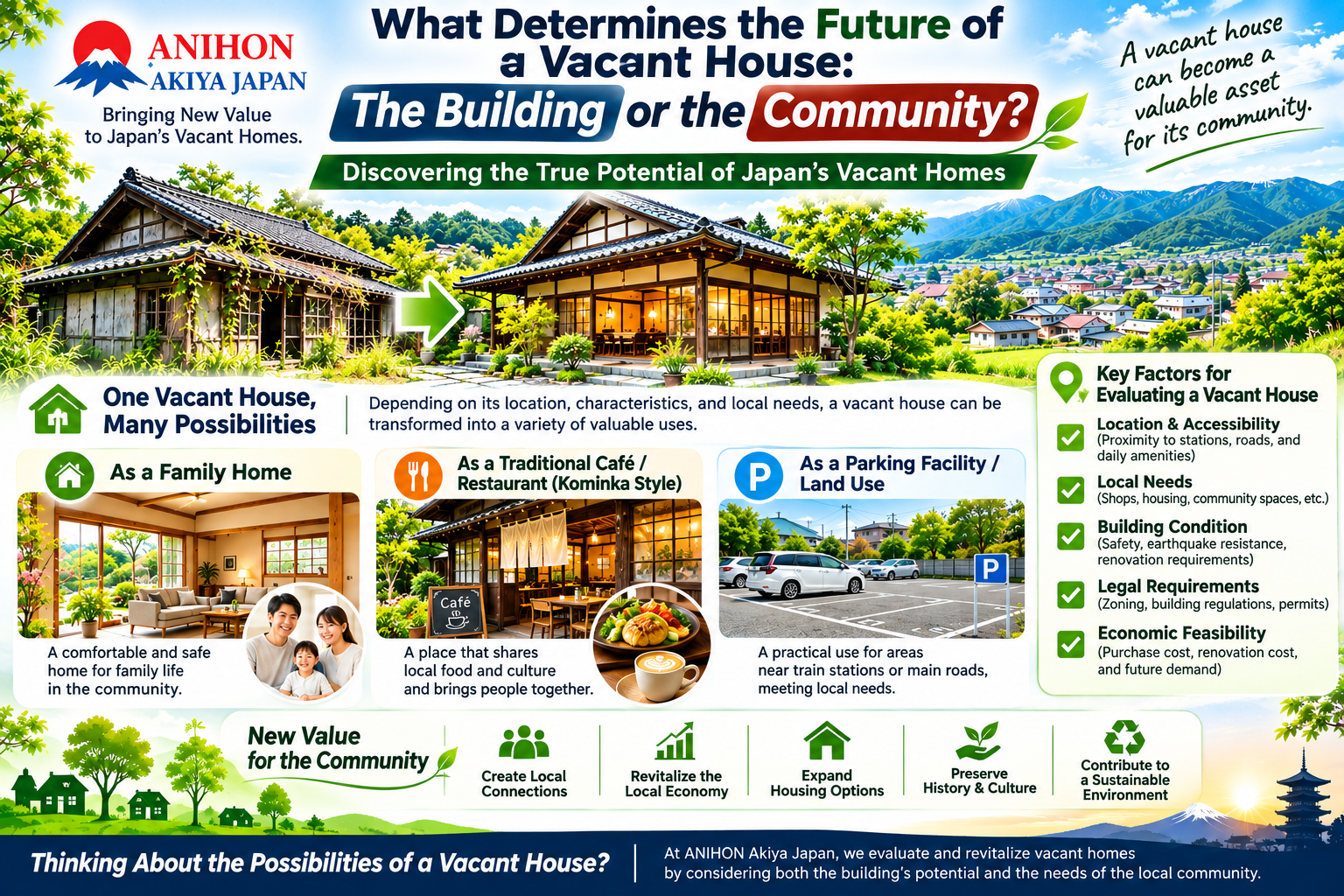
2. One Vacant House, Five Different Possibilities
A vacant property does not necessarily have only one potential use.
Depending on its location, structure, and local demand, several possibilities may be considered.
① A Vacant House Near a Railway Station
In areas close to railway stations, pedestrian activity, accessibility, and surrounding commercial facilities can play an important role.
Under suitable conditions, an older residential property may be converted into a small café, bakery, office, or retail shop.
If maintaining the existing building is not economically feasible, alternative land uses may be considered after demolition, subject to applicable regulations and permits.
However, proximity to a railway station does not automatically guarantee business success.
Actual customer demand, accessibility, competition, and operating costs must be carefully evaluated.
② A Traditional Japanese House in a Rural Village
Many rural areas of Japan are home to traditional houses surrounded by mountains, forests, and agricultural landscapes.
Wooden structures, tatami rooms, traditional sliding doors, verandas, and spacious gardens may give these properties a distinctive character.
Depending on the building’s condition and legal requirements, such properties may be suitable for residential use, creative workshops, or small accommodation businesses with the necessary approvals.
The objective should be to preserve the traditional architectural character wherever practical while introducing a sustainable new purpose.
③ A Vacant House in a Neighborhood with an Aging Population
In communities with a large elderly population, access to daily necessities, transportation, and opportunities for social interaction can be especially important.
A suitable vacant property might be considered for use as a small neighborhood shop, community meeting space, or another locally relevant facility.
However, these ideas should not be based on assumptions alone.
Understanding residents’ actual needs through local research and community engagement is essential.
④ A Vacant House in an Area Popular with Young Families
Residential neighborhoods near schools, parks, supermarkets, and other daily amenities may offer opportunities for family-oriented housing.
In such locations, renovating an older house for residential use may be more appropriate than converting it into commercial premises.
Important considerations include structural safety, earthquake resistance, insulation, heating and cooling systems, and the overall comfort and functionality of the living space.
The aim is to create a property that meets the practical needs of modern households.
⑤ A Vacant Property with a Large Plot Near a Main Road
In some cases, the land itself may offer greater potential than the existing building.
Properties with convenient road access and sufficient land area may be considered for parking facilities or other appropriate commercial uses.
However, any such project requires careful examination of road access, zoning restrictions, land-use regulations, and relevant permits.
The most suitable option depends on both the property’s characteristics and the needs of the surrounding area.
3. Is Renovating Every Old House a Good Investment?
Traditional Japanese houses often possess architectural features and historical character that are difficult to reproduce in modern buildings.
However, an attractive appearance does not necessarily mean that a property is economically suitable for renovation.
For example, a house may have a very low purchase price but require extensive repairs to its roof, foundation, electrical systems, or plumbing.
In such cases, the total investment may be significantly higher than initially expected.
At ANIHON Akiya Japan, we believe property evaluation should go beyond the purchase price.
We consider three essential questions.
First: Can the building be used safely?
Its structural condition, earthquake resistance, water damage, moisture problems, timber deterioration, and other potential risks must be assessed.
Second: Is renovation financially reasonable?
The overall investment should include acquisition costs, cleanup, renovation, taxes, required approvals, and future maintenance expenses.
Third: Will the property actually be used after renovation?
Demand from potential buyers, tenants, or commercial operators should be investigated before committing to a project.
If these conditions cannot be satisfied, choosing not to purchase a property may be the most responsible investment decision.
Our goal is not to purchase every vacant house, but to identify properties with realistic potential to create lasting value.
4. How Can Revitalizing One Vacant House Influence an Entire Neighborhood?
Imagine a house that has stood empty for many years.
Its garden is overgrown, its exterior walls are deteriorating, and its windows have remained closed for a long time.
Perhaps the neighbors have gradually stopped paying attention to it.
Now imagine that the same property is carefully revitalized.
The garden is maintained.
The exterior is repaired.
The entrance opens once again.
A new family might move in.
A small local business might open.
Or the building might become a place where members of the community can gather.
Such changes may influence more than the appearance of the property itself.
They can potentially improve the surrounding environment, create opportunities for local businesses, and encourage renewed activity in the neighborhood.
Of course, not every renovation project will achieve these outcomes.
However, even a relatively small project can make a meaningful contribution when it responds to genuine local needs.
“Sometimes, the future of a community may begin to change when the door of a long-forgotten house opens once again.”
5. The Long-Term Vision of ANIHON Akiya Japan
At ANIHON Akiya Japan, we aim to identify and evaluate vacant properties across Japan, beginning in Aichi Prefecture.
Our approach is not simply to search for buildings available for purchase.
We also want to understand the surrounding communities, local demand, and possible future uses of each property.
By drawing on the construction, demolition, and renovation experience of Asumoto Kogyo LLC (合同会社アスモト工業), we aim to develop practical revitalization plans for suitable properties.
Working with experienced Japanese carpenters, architects, and construction professionals, we intend to explore different ways of bringing aging buildings back into productive use.
However, we do not believe that every old building should automatically be purchased or renovated.
Some buildings deserve preservation.
Others may gain new value through a change of use.
In certain cases, demolition may be the more appropriate option because of safety concerns, structural conditions, or economic considerations.
What matters most is making the right decision for each individual property.
6. Could Vacant Houses Become New Opportunities for Japan’s Future?
Japan’s vacant house challenge affects more than individual property owners.
It is also relevant to municipalities, local businesses, and communities throughout the country.
At ANIHON Akiya Japan, our long-term objective is to develop a carefully planned and sustainable business model for vacant property revitalization.
We do not intend to apply the same renovation strategy to every property.
Instead, we want to explore solutions that reflect the characteristics and needs of each region.
In one community, residential housing may be the priority.
In another, small shops or commercial spaces may be more appropriate.
Elsewhere, preserving traditional architecture may help protect the area’s cultural identity and historical landscape.
When evaluating these possibilities, we believe environmental responsibility, economic feasibility, and community benefits should be considered together.
For us, an akiya is not simply an old or abandoned building.
Under the right conditions, it can become a valuable asset once again—and the beginning of an entirely new story.
Contact ANIHON Akiya Japan About Your Vacant Property
Do you own an unused house in Japan?
Are you considering selling a property or exploring possible ways to make use of it?
ANIHON Akiya Japan aims to review inquiries from property owners and explore opportunities for the acquisition and revitalization of suitable vacant homes.
Our initial focus is Aichi Prefecture and surrounding regions, with the long-term goal of expanding our activities throughout Japan.
If you are uncertain about the future of your vacant property, we welcome your inquiry.
ANIHON Akiya Japan
Operating Company: Asumoto Kogyo LLC (合同会社アスモト工業)
Official Website: https://anihonakiyajapan.jp
Email: info@asumotokogyo.com
“The value of a house is determined not only by its walls and structure, but also by the lives it can support and the future it can help create for its community.”