

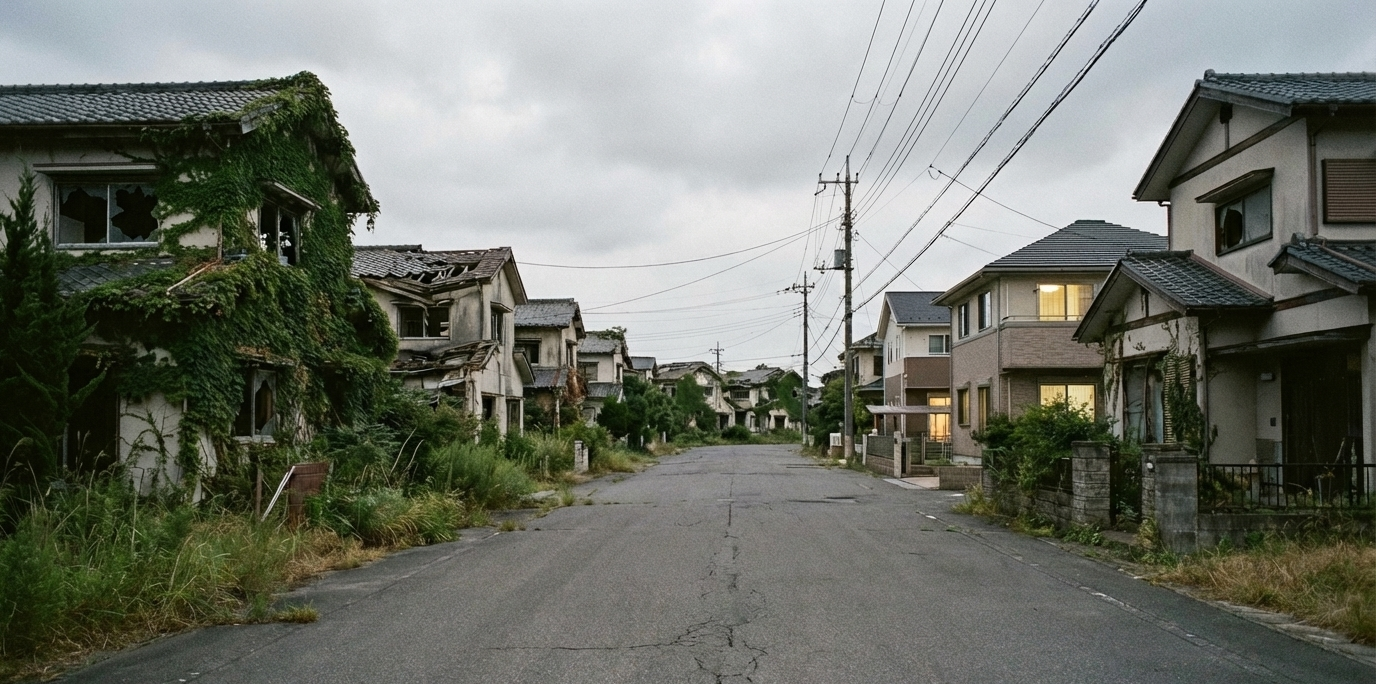
Owning a “My Home” (a detached house) was once the ultimate symbol of success and the biggest dream for the Japanese people. However, today, the remnants of that dream are silently but surely beginning to erode the entirety of Japan.
“By 2040, approximately 30% to 40% of residential homes in Japan will be vacant.”
This is not a line from a science fiction novel. It is an unavoidable projection calculated by numerous research institutions, including the Nomura Research Institute. A future where your neighbor’s house, and the one next to it, are completely uninhabited is just around the corner.
In this article, we will take an in-depth look at why vacant houses (known as akiya) continue to increase at such a rapid pace and how this is leading to the collapse of the “cities” (urban planning) we live in, incorporating the latest data and legislative changes.
1. Shocking Data: Why “1 in 3 Houses”?
Japan’s current vacancy rate is approximately 13.6% (2018 Housing and Land Survey by the Ministry of Internal Affairs and Communications), but this is predicted to exceed 30% by 2040. Why is this increase so drastic?
① The Unstoppable “Multi-Death Society” and “Renunciation of Inheritance”
The primary factor is population decline and an aging society. Around 2040, when the “Dankai Junior” (Second Baby Boomer) generation reaches old age, Japan will hit its peak in annual deaths. If there is a child to inherit the house, the problem might be solved; however, most children have already established their lives in major metropolitan areas. Many choose to renounce their inheritance or leave the property abandoned without even changing the title registration, citing reasons like “I don’t need my parents’ home in the countryside” or “I don’t want to pay fixed asset taxes.” These properties are now mockingly referred to as “Negative Assets” (Fudosan), a play on the Japanese word for real estate.
② The Curse of the “New Construction Obsession”
Japan’s unique housing culture further fuels this issue. While it is common in the West to buy and renovate pre-owned homes, Japanese people overwhelmingly prefer “newly built” (shinchiku) houses. Despite the shrinking population, developers continue to supply new apartments and houses. As a result, older homes are overlooked and continue to accumulate as vacant stock.
2. The Collapse of Urban Planning: Limits of Infrastructure Maintenance
The terrifying aspect of the vacant house problem is not just that “old houses remain.” The real issue lies in the “impossibility of maintaining administrative services.” This is precisely why it is called the “collapse of urban planning.”
The “Sponge City” Phenomenon
The phenomenon where vacant houses pop up like holes in a city is referred to in urban planning terminology as “Spongification.” Even in areas where people live sparsely, the local government must still pave roads, maintain water pipes, run garbage trucks, and deliver mail.
- Decrease in Density: While the number of taxpayers (residents) decreases, the cost of maintaining infrastructure (roads, water, electricity) remains the same.
- Risk of Fiscal Bankruptcy: Municipal budgets will be strained, leading to risks like skyrocketing water bills or the neglect of aging bridges and tunnels, which will drastically lower the quality of life.
Traditional urban planning expanded areas based on the assumption that the “population would grow.” Now, we face the unprecedented challenge of how to “fold and shrink” our cities.
3. Risk of Slumification and Deterioration of Security
Abandoned vacant houses pose a direct threat to neighboring residents.
- Disaster Risks: Abandoned houses in densely packed wooden residential areas significantly increase the risk of collapse during earthquakes or the spread of fire. They are particularly vulnerable to arson.
- Hygiene and Aesthetic Deterioration: Weeds grow unchecked, properties become breeding grounds for illegal dumping, and pests or wild animals move in.
- Security Risks: Places without “eyes on the street” become hideouts for criminal activity. Once an area is labeled as “blighted,” land prices plummet, causing more people to leave—a downward spiral known as slumification.
4. Government Measures: A Policy Shift of Carrots and Sticks
In response, the government has finally taken action. Previously, strong intervention was avoided out of respect for “private property rights,” but policy has shifted significantly in recent years.
Increase in Fixed Asset Tax (2023 Amendment)
Previously, if a house stood on a plot of land, the fixed asset tax was reduced to one-sixth, even if the house was a ruin. bu created a distorted incentive where it was “cheaper to leave a vacant house standing than to demolish it.” However, following a legal amendment, properties designated as “Poorly Managed Vacant Houses” will lose this tax break. In other words, the government has started using the “stick”—“if you abandon it, your taxes will rise.”
Promoting the “Compact City” Concept
From an urban planning perspective, the “Compact City” initiative is being promoted to centralize living areas. The goal is to encourage residents to move from sprawling suburbs to designated zones where administrative services can be provided efficiently. However, progress is slow due to the psychological resistance of elderly residents who do not want to leave ancestral lands.
5. How Should We Live?: Fostering New Values
Is the future of 2040 only dark? Recently, movements have emerged that view these “excess houses” as a resource.
- Dual Life (Two-Base Living): With the spread of remote work, more people are adopting a lifestyle of commuting between a city apartment and an affordable vacant home in the countryside.
- Foreign Investor Interest: Due partly to the weak Yen, Japanese traditional folk houses (Kominka) are attracting attention from overseas as “affordable, high-quality vintage assets.”
- Vacant House Banks and DIY: A culture is budding among the younger generation to acquire houses for free or very cheaply and renovate them to their own taste.
Summary: Facing the “End-of-Life” of Cities
The prediction that 1 in 3 houses will be vacant by 2040 shows that the Japanese system, which was based on “growth and expansion,” has reached its limit.
Urban planning is not “collapsing” in the traditional sense; it is in a painful transition period toward a new phase called “Shrinking Equilibrium.”
As individuals, what we can do is discuss the inheritance of family homes while our parents are still healthy and shift our vision away from “new construction obsession” toward utilizing existing assets. Before our cities become hollowed out, we must update our own mindsets.