

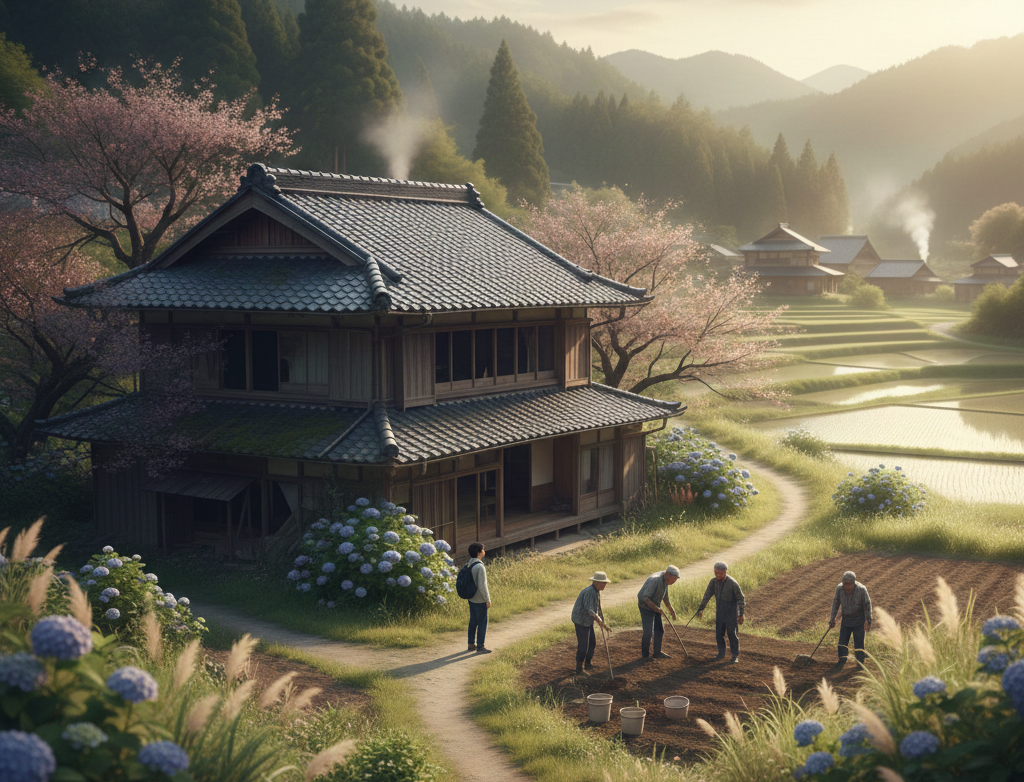
Buying an Akiya (abandoned house) in Japan is not just about acquiring a cheap property or restoring your dream home. The moment you receive the deed, you aren’t just the owner of a building; you become a thread in a social fabric that has existed for centuries. In rural Japan, there is a dimension to homeownership as critical as property taxes or renovation costs, yet it is often completely overlooked: Social Responsibilities and Local Customs.
This is a comprehensive guide to the deep-rooted social structures of Japan that every prospective Akiya owner must understand.
1. Buying a House Means Joining a Community
In Western countries or major Japanese cities, buying real estate often involves little more than a polite nod to your neighbors. In rural Japan (Inaka), it is fundamentally different. From the second you move in, you are expected to be part of a “collective” that maintains the local infrastructure.
What are Neighborhood Associations (Chonaikai / Jichikai)?
These are voluntary organizations that act as a bridge between residents and the local government. However, while they are technically “voluntary,” membership is effectively mandatory in many rural areas.
- Membership Fees (Jichikaishi): You will pay a monthly fee ranging from a few hundred to several thousand yen.
- Garbage Station Management: In Japan, garbage collection points are cleaned and managed by the residents on a rotating schedule. If you don’t join the association, you may face conflicts regarding where to dispose of your trash.
- Streetlight Maintenance: The electricity for streetlights is often paid for by the neighborhood association’s collected fees.
2. The Weight of the Term “Mura-Hachibu”
To understand rural Japan, you must know the term Mura-Hachibu. Historically, this refers to a form of social banishment or “ostracism” directed at those who break local rules.
The term comes from the “Ten Points” of traditional social interaction (coming-of-age, weddings, births, caring for the sick, home construction/renovation, flood relief, memorial services, travel, fire, and funerals). Mura-Hachibu meant the community would help with only two (Fire and Funerals) while completely ignoring the other eight.
While blatant Mura-Hachibu is considered a human rights violation in modern Japan and can lead to lawsuits, psychological isolation or “silent treatment” remains a real risk for those who disregard local social norms.
3. The Reality of “Community Labor”
Enjoying your Akiya life requires more than just weekend DIY projects. You will be expected to participate in various “roles”:
- Grass Cutting (Kusakari): Clearing weeds along roadsides and communal lands. These sessions often start as early as 5:00 AM.
- Ditch Cleaning (Mizo-soji): Residents gather to clear mud and debris from local drainage ditches.
- Festival Preparation: You may be asked to donate money or help set up for local shrine festivals and events.
- Fire Brigade/Women’s Association: Younger residents are often strongly encouraged to join the local volunteer fire department or community groups.
If you dismiss these activities as a “waste of time,” you risk being labeled as someone who “does not cooperate,” which is the primary cause of social isolation in rural areas.
4. Five Steps for a Successful Akiya Life
The secret to integrating into a local community lies in two things: the initial greeting and a humble attitude.
① Execute the “Aisatsu” (Greeting) Thoroughly
Don’t just greet your immediate neighbors. You must bring a small gift (Temiyage) and introduce yourself to the Neighborhood Association Head (Jichicho or Kumicho). There is a Japanese proverb: “When in the village, do as the villagers do.”
② Ask About the “Village Rules” First
Proactively ask, “How do I dispose of trash here?” or “When is the next grass-cutting day?” This signals that you respect the community and its established order.
③ Maintain a Healthy Distance
Getting too close can sometimes feel like a loss of privacy (where neighbors seem to monitor your every move). It is important to be polite and helpful, while also maintaining your own boundaries.
④ Show Your Face at Local Events
Even if you only attend the first few drinking parties (Nomikai) or meetings, being “a face they know” significantly reduces the chance of future friction.
⑤ Check the “Vibe” Before Buying
Before finalizing your purchase, talk to the neighbors. Ask them, “What is this neighborhood like?” Their reaction will tell you a lot about whether the community is open or closed to outsiders.
5. Conclusion: You Aren’t Buying a Building; You’re Buying an Environment
The biggest tip for successful Akiya renovation in Japan is not fixing the physical walls—it’s tearing down the social walls.
While community obligations can feel burdensome, they provide a vital safety net. In times of natural disaster, neighbors help each other, and the community bond serves as an effective security system. If you embrace the Japanese spirit of “Otogaisama” (mutual support), your life in an Akiya will be far richer and warmer.
Do not fear Mura-Hachibu. If you understand the rules and approach the community with sincerity, you will transform from a “Yosomono” (outsider) into a “Nakama” (companion) who helps shape the future of the region.