

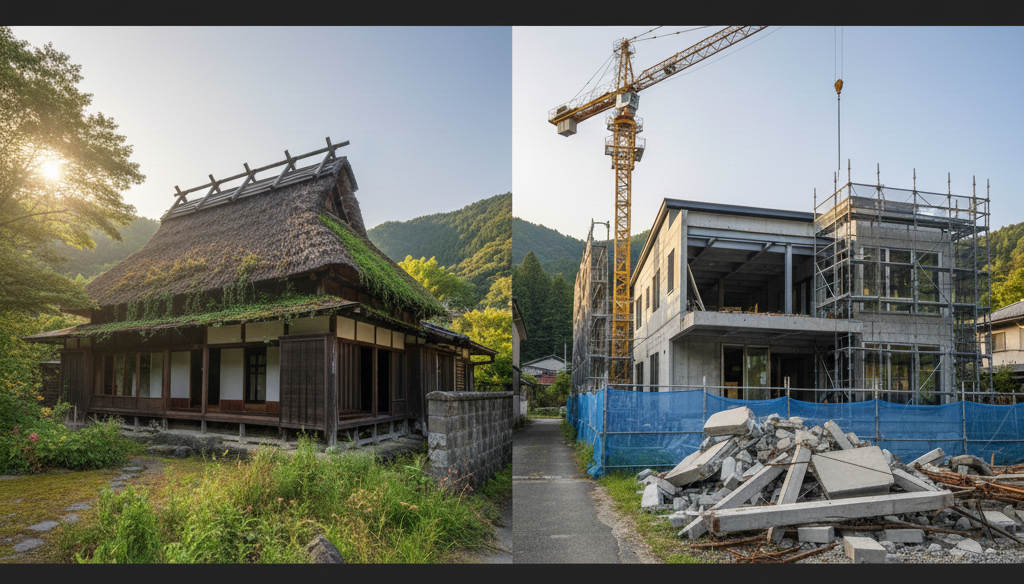
The greatest contradiction in Japan’s real estate market, and a massive social issue today, is the phenomenon of “Akiya” (Abandoned Houses). At the heart of this crisis lies a uniquely Japanese architectural philosophy known as “Scrap and Build.”
In this post, we will take a deep dive into why Japanese homes lose their value in just 30 years and explore whether these houses can be transformed from “negative legacies” into “ecological assets” in an era where sustainability is paramount.
An Architectural Paradox: Why Japanese Homes Reach the End of Their Life at 30?
In Western architectural cultures—such as in the UK or France—a 100-year-old house is often considered a “vintage” asset that increases in value. However, in Japan, once a building hits the 20-to-30-year mark, its asset value is usually deemed to be zero. Three primary factors intertwine to cause this extreme depreciation:
1. Adaptation to Disasters and the Spirit of “Tokowaka”
Japan exists in a harsh natural environment of earthquakes, typhoons, and high humidity. The constant need to update buildings to the latest seismic standards has ingrained a perception that “old equals dangerous or unhygienic.” Furthermore, as symbolized by the “Shikinen Sengu” of the Ise Grand Shrine—where the shrine is rebuilt every 20 years—there is an inherent Japanese spiritual concept called “Tokowaka.” This is the idea that life force is renewed not by repairing the old, but by creating anew.
2. The Post-War Economic Model: Housing as a “Consumable Good”
During the rapid economic growth period after WWII, the Japanese government used housing construction as a pillar for economic stimulus. New homes, bundled with mortgages, triggered demand for appliances and furniture. As a result, houses were defined not as “generational assets” to be passed down, but as “disposable consumer goods,” much like cars or refrigerators.
The Aesthetics of “Newness is Purity” and the Stigma of the Resale Market
The “Scrap and Build” culture is supported by more than just economic rationality. It is rooted in a unique sense of space that distinguishes between “Tokoyo” (the eternal world) and “Utsushiyo” (the present world).
The Traditional Concept of “Kegare” (Impurity)
For many Japanese people, a house previously occupied by someone else is felt to retain that person’s “energy” or “traces of life.” The “scent of fresh tatami” or the “untouched walls” of a new home are linked to Shinto concepts of “Seijo” (purity). Pre-owned homes are often judged as inferior to new builds specifically because they lack this sense of spiritual “cleanness.”
Clashing with the Western “Maintenance Culture”
In the West, repairing a home (DIY) is a hobby and a status symbol. Conversely, the Akiya crisis has exposed a fragile infrastructure for “repair and inhabit” in Japan. The fact that renovation costs can often rival the cost of building a new home has accelerated the abandonment of older properties.
Are Akiyas a “Liability” or the “Ultimate Ecology”?
As of 2026, it is estimated that there are approximately 9 million abandoned houses across Japan. Continuing to demolish these structures as “concrete waste” has reached its limit in terms of environmental impact.
1. “Kominka” as Buried Cultural Assets
Traditional Japanese houses (Kominka), built with ancient techniques such as timber framing (Kumiki), plaster, and mud walls, are actually far better suited for reuse than modern airtight homes. These are treasure troves of natural materials. Instead of discarding them, “upcycling” these homes can create dwellings with a significantly lower carbon footprint.
2. Shifting from “Scrap and Build” to “Stock Utilization”
Due to the global rise in resource prices, the “New Construction Myth” is beginning to waver in Japan. Among the younger generation, there is a shift toward a “lifestyle of one’s own”—choosing to buy an Akiya cheaply and customizing it to fit their personal needs rather than buying a standardized new-build house.
Conclusion: Akiya as the “Seeds of Future Cities”
Japan’s Akiya problem is not merely a failure of the real estate market. It presents us with a philosophical question: “How do we define a home, and how shall we live?”
The “Scrap and Build” culture supported Japan’s growth, but it also created homogenized landscapes and massive waste. Today, we must stop fearing Akiyas as “relics of the past” and instead rediscover them as “free materials for constructing the future.”
Merging the history found in every old pillar with modern technology… this is the key to a “truly sustainable architecture” that Japan can present to the world.