
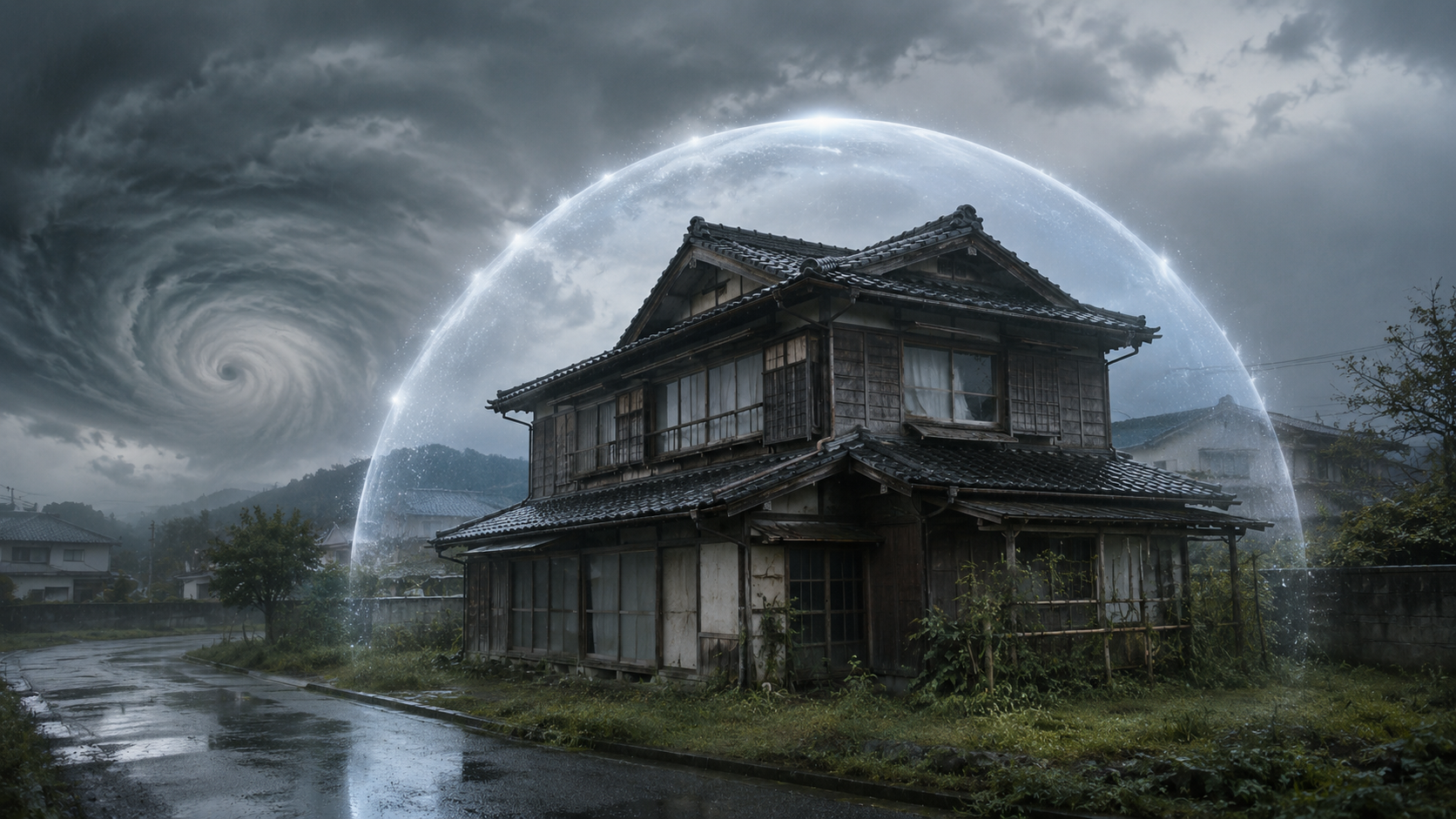
The akiya issue in Japan is no longer only about finding a cheap house or renovating an old property. A vacant house can involve many risks, including fire, earthquakes, typhoons, water leaks, damage to neighboring properties, theft, pests, collapse, and legal liability.
When people consider buying an akiya, they often focus first on the price, location, renovation cost, and future potential of the property. These are, of course, very important. However, one essential topic is often overlooked: insurance and risk management.
Just because a house is empty does not mean the risk disappears. In fact, some risks may become greater precisely because nobody is living there. If there is a small water leak, it may go unnoticed for months. If the electrical system is old or faulty, the risk of fire may increase. If the roof is damaged by a typhoon and is not repaired quickly, the building may deteriorate even faster. Small cracks after an earthquake may become serious structural problems during the next disaster.
For this reason, every akiya owner should ask an important question:
Have I planned not only how to use this house, but also how to protect it?
As Vacant Houses Increase, So Do the Risks
The number of vacant houses in Japan has been increasing in recent years. This is not only a real estate issue. It also affects insurance companies, local governments, neighbors, investors, renovation companies, demolition contractors, and property owners.
When a vacant house is left unmanaged for a long time, various problems may occur. These include roof damage, rainwater leaks, decay of wooden columns and beams, electrical system problems, fire risk, unnoticed structural damage after earthquakes, flying debris during typhoons, damage to neighboring properties, overgrown weeds, pests, bad odors, broken windows, and unauthorized entry.
Some of these risks may be covered by insurance, but not all of them. The most important thing is to understand in advance what can be insured, what may be excluded, and in what situations the responsibility may remain with the owner.
Why Insurance for Vacant Houses Can Be Complicated
In a house where people live, problems are usually discovered quickly. If the roof leaks, the resident notices it. If there is a strange smell from an electrical outlet, someone can investigate. If a garden tree begins leaning toward a neighboring property, it can be handled early.
However, in a vacant house, problems often progress silently. Because nobody lives there, damage and abnormalities may be discovered late. For this reason, insurance companies may evaluate vacant houses differently from ordinary occupied homes.
Important questions include whether the house is completely vacant, whether someone inspects it regularly, whether electricity, gas, and water are still connected, whether old belongings remain inside, what type of structure the building has, how old it is, whether renovation is planned, and whether the property will be used as a residence, rental property, guesthouse, café, or business facility.
The answers to these questions may affect whether the property can be insured, how much the premium will be, and what kind of coverage is available.
Why Fire Insurance Is Important for Akiya
One of the most basic types of insurance for homeowners in Japan is fire insurance. However, fire insurance should not be understood simply as insurance that pays only when a house burns down. Depending on the policy, it may also include coverage for wind damage, water damage, snow damage, lightning, theft, water leaks, and external damage.
For akiya properties, fire insurance is especially important. Old homes may have higher fire risk due to aging electrical systems, wooden structures, dry materials, and long periods of poor maintenance.
A fire in a vacant house is not only a problem for the owner. It may spread to neighboring homes, damage nearby vehicles or buildings, injure people, or become a major issue for the entire community.
Therefore, owners should not think, “This house is old and has little value, so it does not matter.” Even if the market value of the building is low, the potential damage to surrounding properties can be significant.
Earthquake Insurance Should Be Considered Separately
Japan is an earthquake-prone country. For this reason, earthquake risk is one of the most important issues for akiya owners. However, fire insurance alone does not automatically cover all damage caused by earthquakes.
To prepare for collapse, fire, tsunami, or ground movement caused by earthquakes, owners should separately check earthquake insurance. In many cases, earthquake insurance is added to fire insurance and is not usually purchased as a completely independent policy.
In old vacant houses, earthquakes may cause foundation cracks, wall cracks, damage to columns and beams, roof displacement, loosening of wooden joints, leaning of the building, fire after an earthquake, and damage caused by tsunami or ground movement.
For this reason, akiya owners should evaluate fire insurance and earthquake insurance separately.
Preparing for Typhoons, Strong Winds, and Heavy Rain
In Japan, typhoons and heavy rain are also major risks. For older vacant houses, loose roof tiles, broken windows, rusted gutters, deteriorated exterior walls, and unmanaged trees can become serious problems during typhoon season.
Typhoons may cause roof tiles to be blown away, rainwater to enter the building, windows to break, trees to fall, garden objects to be blown into neighboring land, exterior wall materials to come loose, flooding, and land damage in areas at risk of landslides.
For an akiya owner, the issue is not only damage to their own building. If part of the building is blown away and damages someone else’s car or home, the owner may face liability.
For this reason, it is important to check not only building insurance but also coverage related to third-party liability.
Information to Prepare Before Applying for Insurance
Before speaking with an insurance company or agent, an akiya owner should prepare basic information about the property.
Useful information includes property registration and ownership details, age of the building, structure type, current usage status, total floor area, number of floors, roof type, date of last repair or renovation, condition of electricity, gas, and water, whether belongings remain inside, earthquake resistance information, past damage history, distance from neighboring buildings, land and garden condition, and future usage plan.
If this information is unclear, obtaining insurance may become difficult. In very old akiya properties, building documents may be missing. In such cases, it is helpful to consult an architect, construction company, real estate advisor, or local specialist.
Situations That May Be Excluded from Insurance Coverage
Even if a property is insured, not every type of damage will be covered. Owners should carefully check the exclusions before signing a policy.
For akiya properties, special attention should be paid to long-term lack of maintenance, serious negligence by the owner, natural deterioration due to aging or decay, damage that existed before the contract, unauthorized change of use, failure to act despite knowing the building was dangerous, unsafe electricity or gas systems, damage during renovation, non-professional repair work, and failure to inform the insurance company that the house is vacant.
The last point is especially important. If the property is actually vacant but reported as an ordinary occupied home, coverage disputes may occur when an accident or disaster happens.
Insurance contracts should always be based on accurate information.
Conclusion
Owning an akiya is not only a real estate opportunity or a renovation project. It is also a serious responsibility involving fire, earthquakes, typhoons, water leaks, collapse, theft, damage to neighbors, and legal issues.
The most important question is not only:
How cheaply can I buy this house?
The real questions should be:
Can I protect this house safely?
Do I understand its risks?
Am I prepared for fire, earthquakes, and typhoons?
Have I considered my responsibility to neighbors?
Is my insurance coverage appropriate?
Can I manage this house legally, safely, and sustainably over the long term?
An akiya can become an asset with a future. But that future is possible only with reliable information, proper maintenance, appropriate insurance, and responsible management.