

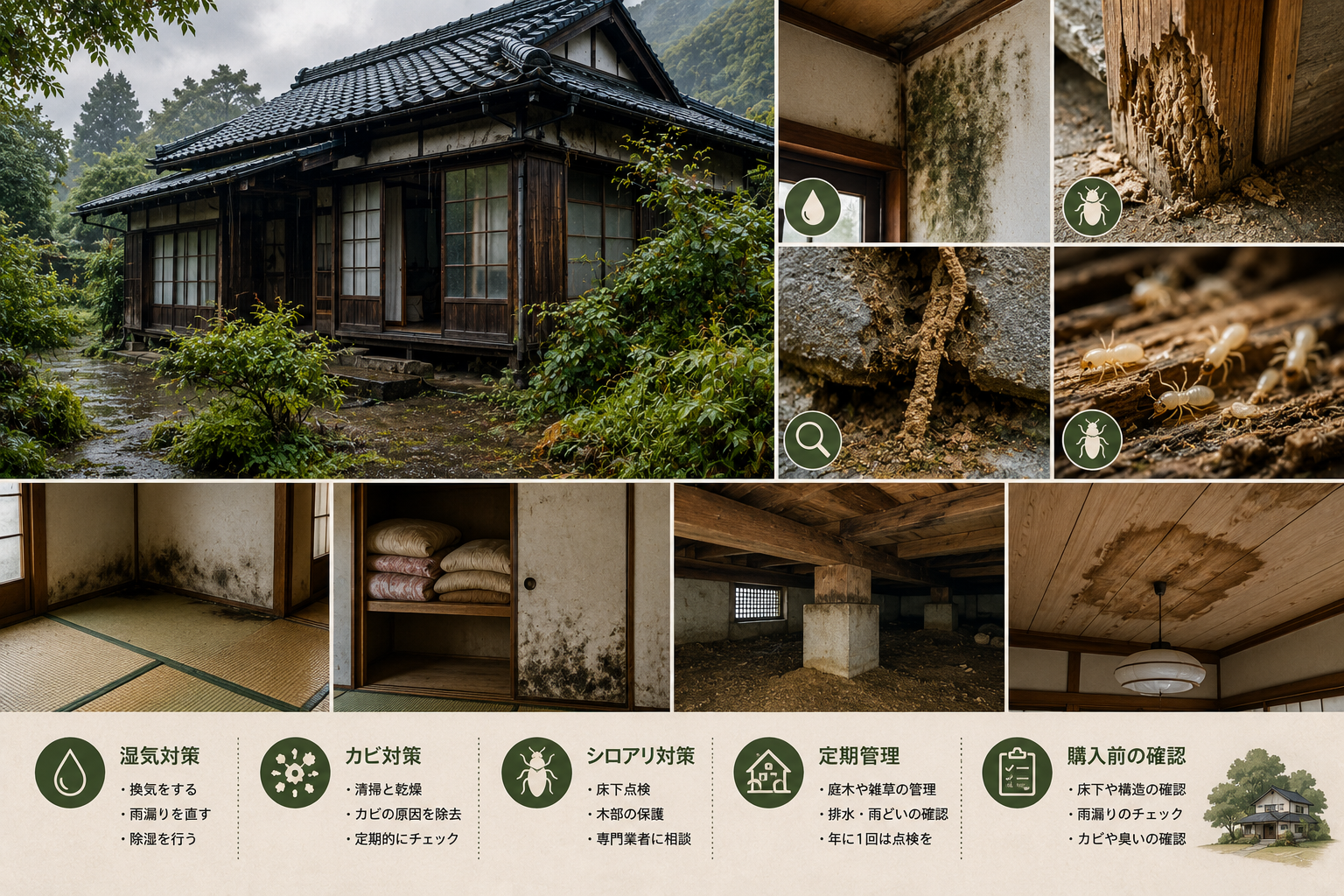
The Hidden Deterioration Quietly Damaging Japan’s Vacant Houses
When people think about akiya, or vacant houses in Japan, they often focus on price, location, building age, renovation costs, inheritance issues, and earthquake resistance. These are all important points. However, there is another major issue that should never be overlooked when buying, managing, or reusing an old vacant home.
That issue is hidden deterioration caused by humidity, mold, and termites.
Japan has a climate that can be demanding for buildings. The rainy season, typhoons, hot and humid summers, winter condensation, and regional differences in moisture all affect houses over time. In vacant homes that have been left unused for years, poor ventilation, roof leaks, moisture under the floor, overgrown gardens, and drainage problems can quietly damage the building from the inside.
A house may still look usable from the outside, but under the floor, inside the walls, in the attic, or around the base of wooden columns, mold, termites, and wood decay may already be spreading. The true risk of an akiya cannot be judged by appearance alone.
Why Are Vacant Houses Vulnerable to Humidity?
In a home where people live, daily management happens naturally. Windows are opened, ventilation fans are used, rooms are cleaned, air conditioners and dehumidifiers may be operated, and leaks or unusual smells are noticed quickly.
In a vacant house, however, this daily care does not happen. Windows remain closed, air does not circulate, and moisture can easily build up indoors and under the floor. If there is a roof leak, nobody may notice it for months. Moisture can spread into tatami mats, floorboards, wallpaper, wooden columns, closets, and storage areas.
This is especially important in Japan’s older wooden houses. Wood is a natural material that can last for a long time when properly maintained. However, when moisture remains trapped, it can lead to decay, mold, and insect damage.
Common reasons why akiya become vulnerable to humidity include:
Windows are not opened for long periods.
Ventilation fans and air conditioning are not used.
Small leaks exist in the roof or exterior walls.
Underfloor ventilation is poor.
Overgrown plants reduce sunlight and airflow.
Gutters and drains are blocked.
Old furniture, futons, papers, and clothing are left inside.
Moisture builds up in tatami rooms and closets.
The house is located on lower ground.
The property is in a humid area, near mountains, rivers, or forests.
When several of these conditions exist together, the building may slowly deteriorate. By the time the owner notices the problem, repair costs may already be much higher than expected.
Mold Is Not Only a Visual Problem
Mold is one of the most common problems found in vacant houses. It often appears on walls, ceilings, tatami, closets, bathrooms, kitchens, window frames, and underfloor areas where moisture is high.
Mold is not just an aesthetic issue. It can affect indoor air quality, create unpleasant odors, and accelerate the deterioration of wood and interior materials. In a house that has been closed for a long time, there may be a strong damp smell as soon as the door is opened.
For potential buyers or tenants, this smell creates a negative impression. Even if the location is good, a house with a strong mold odor may feel unsafe or uncomfortable.
In some cases, surface cleaning is not enough. If the source of moisture is inside the walls, under the floor, or in the roof structure, deeper repair work may be necessary.
Termite Damage Can Greatly Reduce the Value of an Akiya
One of the most serious risks in old Japanese wooden houses is termite damage. Termites eat wood from the inside, which means the damage may not be obvious from the outside.
Areas that require special attention include wooden columns, foundations, underfloor spaces, entrances, bathrooms, kitchens, and other damp places where wood is used. Warning signs may include soft floors, weakened column bases, hollow sounds when tapping wood, flying termites, or mud tubes under the floor.
If termite damage has progressed, it may affect the durability and earthquake resistance of the building. Even if the interior looks clean after cosmetic renovation, serious damage to the structural parts can lead to expensive repairs after purchase.
For this reason, before buying an akiya, it is very important to inspect not only the visible interior but also the underfloor and structural areas.
Small Roof Leaks Can Become Major Problems
One of the most important causes of deterioration in vacant houses is roof leakage. At first, a leak may appear as a small stain. A slightly discolored ceiling, peeling wallpaper, damp tatami, or dark marks around a window may seem minor, but these signs should not be ignored.
If a leak continues, water can enter ceiling materials, wall cavities, wooden beams, columns, and floors. This can lead to mold, wood decay, and termite problems.
In a vacant house, roof leaks are often not discovered quickly. Months or years of neglect can greatly expand the damaged area. A problem that could have been solved with a small roof repair may eventually require ceiling, wall, floor, and structural repairs.
When inspecting an akiya, it is ideal to visit not only on a sunny day but also after rain. Checking odors, ceiling stains, damp floors, and moisture around windows after rainfall can reveal hidden problems.
Tatami, Closets, and Futons Often Reveal Moisture Problems
Many older Japanese houses have tatami rooms and built-in closets. These areas are important indicators of the moisture condition of a vacant house.
If the tatami is soft, discolored, wavy, or smells moldy, moisture may have accumulated. If old futons, clothes, or paper items remain in closets, they may have absorbed moisture and become sources of mold or insects.
When inspecting leftover items in an akiya, it is important not to think only, “These can be cleaned out.” The condition of these items may also show the moisture level of the building.
If a strong mold smell comes from a closet that has been closed for a long time, it may be necessary to inspect the walls and floors, not just ventilate the room.
Poor Garden Maintenance Can Accelerate Building Deterioration
The problem of akiya is not only inside the house. Poor garden and exterior maintenance can also increase humidity and accelerate deterioration.
When trees and weeds grow too much, airflow around the building becomes poor. Sunlight may not reach the exterior walls and foundation, making it harder for moisture to dry. If leaves block gutters and drains, rainwater may collect near the building.
Branches touching the roof or exterior walls may also damage the house during typhoons or strong winds. In addition, a vacant house with an overgrown garden can create concern or discomfort for neighbors.
To protect an akiya over the long term, owners must manage not only the building but also the garden, drainage, gutters, and exterior areas.
Humidity, Mold, and Termite Checklist Before Buying an Akiya
Before buying a vacant house, it is important to check the following points:
Is there a strong mold smell inside?
Are there stains from roof leaks on the ceiling or walls?
Are the tatami mats soft or discolored?
Are there areas where the floor sinks?
Are there signs of wood decay around columns or foundations?
Is the wood around the bathroom or kitchen damaged?
Is there mold or moisture inside closets?
Are there signs of moisture or termites under the floor?
Are the gutters damaged or blocked?
Does water collect around the building?
Are trees or weeds touching the house?
Do windows and doors open and close properly?
Are there cracks or moisture marks around the foundation?
These checks are very important for estimating renovation costs after purchase. Even if an akiya appears cheap, serious moisture or termite damage can lead to unexpectedly high expenses.
What Should Be Done Before Renovation?
If an akiya is going to be renovated, it is important to remove the cause of moisture before improving the interior appearance.
Simply replacing wallpaper, flooring, or tatami may not solve the real problem. If roof leaks, underfloor moisture, poor drainage, exterior wall damage, or termite problems remain, the same issues may return within a few years.
Before renovation, owners should check:
Roof and gutter condition.
Cracks and gaps in exterior walls.
Underfloor ventilation.
Moisture around the foundation.
Termite damage.
Leaks around bathrooms, kitchens, and washrooms.
Drainage flow.
Indoor ventilation methods.
Insulation and condensation prevention.
Garden and drainage environment.
Akiya renovation should not focus only on making the house look beautiful. It should also ensure that the building can be used safely and sustainably for many years.
Practical Ways to Prevent Moisture Damage in Vacant Houses
Even if a vacant house will not be sold, rented, or renovated immediately, basic maintenance can slow deterioration.
Open windows regularly for ventilation.
Reduce leftover items inside the house.
Remove futons, papers, clothing, and other moisture-absorbing materials.
Check for roof leaks.
Inspect the exterior after typhoons or heavy rain.
Maintain trees, weeds, and the garden.
Clean gutters and drains.
Keep underfloor vents open.
Open closets to allow airflow.
Use moisture absorbers or ventilation equipment if necessary.
Ask a professional to inspect the house at least once a year.
The longer a vacant house is neglected, the more easily it loses value. However, regular maintenance can preserve future options such as sale, rental, renovation, or reuse.
Special Notes for Foreign Buyers
Interest in Japanese akiya among foreign buyers has been increasing. However, humidity, mold, and termite problems are difficult to understand from photos or online listings alone.
Beautifully taken photos cannot show odor, soft floors, moisture inside closets, or underfloor conditions. Foreign buyers who are not familiar with Japanese wooden houses or tatami rooms may also find it difficult to judge how serious the deterioration is.
Before buying, foreign buyers should visit the property in person whenever possible. It is also recommended to bring a Japanese architect, renovation contractor, real estate professional, or local specialist familiar with akiya.
The decision should not be based only on a low purchase price. Buyers should consider the total cost, including moisture prevention, mold removal, termite treatment, underfloor repairs, and roof repairs.
Conclusion: The True Value of an Akiya Is Decided by What You Cannot See
The value of an akiya is not determined only by its appearance or price. In many cases, the most important factors are hidden: the underfloor space, wooden columns, roof, inside of walls, moisture level, mold, and termite damage.
A house may look old but still have strong potential if its structure is sound and moisture is properly managed. On the other hand, a house may look clean but carry major risks if hidden decay or termite damage is progressing inside.
For those who buy, inherit, manage, or renovate vacant houses, the most important lesson is not to judge only by surface appearance.
An akiya can become an asset that creates new value for a community when it is properly inspected and managed. However, if humidity, mold, and termites are ignored, the value of the building may quietly disappear.
To address Japan’s vacant house problem, it is necessary to look beyond sales and renovation. We must also pay attention to this hidden deterioration.
The future of an akiya is shaped not only by visible design, but by how carefully we protect the parts that cannot be seen.