
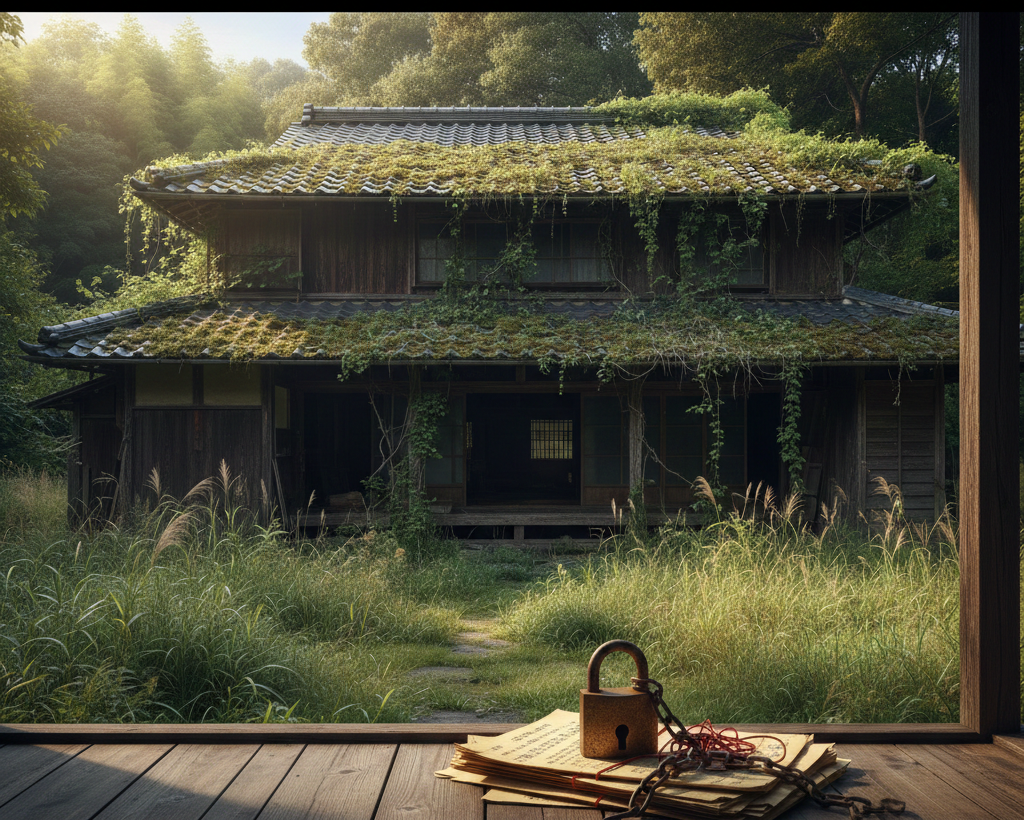
Traveling through Japan, you may encounter old, dilapidated houses standing silently amidst beautiful landscapes. These are known as “Akiya” (vacant houses). However, the deepening crisis in Japan today isn’t just that these houses are empty—it is the “Unclaimed Land and Building Problem,” where it becomes impossible to identify or contact the owner, leaving the property in a state of legal paralysis.
Why has such an “inheritance maze” emerged in a developed nation like Japan? Let’s dive deep into the legal barriers and the path toward a solution.
1. The Reality of the “Owner Unknown” Crisis
Currently, it is said that the total area of unclaimed land in Japan exceeds the size of the entire island of Kyushu. But how does the owner of a house or land simply vanish from the records?
The Main Cause: Neglected Inheritance Registration
For many years in Japan, registering the “Real Estate Registry” after acquiring property was not mandatory.
- Avoiding Costs: Registration involves a “Registration and License Tax” and fees for a judicial scrivener (shiho-shoshi).
- Lack of Incentive: For rural land with no plans for sale, there was little motivation to spend money on a name change.
- Avoiding Property Taxes: In some cases, people intentionally left the property in a deceased person’s name to evade pursuit by local tax authorities.
When this is repeated over several generations (30 to 50 years), the number of heirs swells to dozens, making it virtually impossible to track the actual ownership status.
2. The “Stalemate” Structure of Japanese Inheritance Law
Japan’s Civil Code and inheritance systems contained “bugs” that were fundamentally incompatible with a modern, shrinking population.
① The Requirement for Unanimous Consent in Estate Division
Under Japanese law, deciding who inherits a piece of real estate requires the unanimous consent of all heirs.
- If there are 30 heirs and just one person disagrees or cannot be contacted, the house can neither be demolished nor sold.
- If an heir has lost mental capacity (e.g., due to dementia), a legal guardian must be appointed, making the procedure even more complex.
② Properties Turning into “Negative Assets”
While real estate was once an asset, many properties in rural Japan have become “Negative Assets” (often jokingly called fudousan—a pun on the word for real estate that implies “unmovable burden”) due to management costs and property taxes.
- The Inheritance Renunciation Trap: An heir cannot choose to reject “just one specific house.” It is an all-or-nothing choice: inherit everything or renounce everything.
- Ongoing Management Responsibility: Even if an heir renounces the inheritance, they may still be held responsible for managing the property (to prevent collapse or injury to others) until a new manager is officially appointed.
3. The Lack of Practical “Exits”
Even when the owner is known, there are often no viable solutions.
- Demolition Costs: Demolishing a wooden house costs millions of yen. Few heirs are willing to pay out of pocket to clear a piece of land that has no market value.
- The “Residential Land Tax Exception”: Japan has a system that reduces property taxes by up to 1/6th if a house is standing on the land. Ironically, this created a situation where “it is cheaper to leave a ruin standing than to clear the land,” encouraging the neglect of Akiya.
4. The Great Pivot of 2024: Solutions via Legal Reform
The Japanese government has finally taken drastic action against this crisis. The new systems being phased in starting in 2024 are powerful enough to be considered “forced enforcement.”
① Mandatory Inheritance Registration (Starting April 2024)
Inheritance registration, which was previously optional, is now mandatory by law.
- Failure to register within three years of learning of the inheritance can result in a fine (administrative penalty) of up to 100,000 yen.
- This applies to past unregistered properties as well, aiming to clear out the “unknown owner” status across Japan.
② The State Land Return System (Started April 2023)
A new system allows heirs to return unwanted land to the state.
- However, there are strict conditions: the land must be vacant (no buildings), free of soil contamination, and the owner must pay a fee covering 10 years of management costs (review fee).
③ Strengthening the Special Measures Act for Vacant Houses
If a local government designates a house as a “Special Vacant House,” the property tax reduction mentioned earlier is cancelled. This means taxes can jump several times higher if the house is left neglected. Furthermore, it is now easier for local governments to proceed with “administrative execution” (forced demolition).
5. Summary: How to Solve the Akiya Problem
The Akiya problem in Japan is not just a legal flaw; it is a tragedy born from the mismatch between a “shrinking population” and “outdated family values.”
Going forward, the three key actions we must take are:
- Thorough End-of-Life Planning (Shukatsu): Creating a will while healthy to decide the future of one’s real estate.
- Early Registration: Organizing ownership titles immediately after an inheritance occurs, even if the property has little value.
- Exploring New Uses: Recently, there has been a surge in foreigners purchasing old Japanese houses at low prices, renovating them into vacation homes or Airbnb rentals.
Rather than letting “ownerless houses” become a negative legacy for Japan, the wisdom to find new ways to utilize them is what is needed right now.